
Navy Carrier
Richard L. Perry
I WAS quite pleased when Carl Wheeley asked me to write this column. The Navy Carrier events have had little publicity in the past few years, and I am hoping that this column can provide a focal point for Carrier activities and a valuable forum for the exchange of ideas and information.
I like to think of all CL modelers as Carrier flyers—those who actively participate in the event and those who haven't yet tried it. I hope to provide good reading for both, and to encourage more of those "haven't yets" to come aboard and find out what they have been missing.
Future columns will contain some contest results, details of equipment used by winning flyers across the country, design philosophy, construction methods, information on full-scale carrier aircraft, and sources of equipment and information. If any of you have questions about any phase of Carrier flying, or if you need information about a particular aircraft, let me know. I am certain that someone among the many modelers who read this column will have the necessary information.
If this column is to be successful, it will be with the support of Carrier modelers. Your ideas are welcomed and encouraged. AMA will pay five dollars for ideas and photographs used in this column. When submitting photographs, please send black-and-white glossy prints, preferably in 5 x 7 size or larger. Send your contributions, comments, or questions to me at 5016 Angelita Ave., Dayton, Ohio 45424.
NATS: The Carrier events at the NATS this year will be changed slightly from past years in that all age groups will be combined in Class I and Class II. This is to be expected after the extremely poor attendance in the junior and senior age categories last year (one contestant). This poor participation is not representative of the interest in the Carrier events that exists in many areas. The primary cause of the poor attendance in all Carrier events has to be the location of the Nats. Lake Charles is anything but a hotbed of Carrier activity with the nearest concentration of contestants some 600 miles away. I hope the picture will be brighter this year, and I want to do all I can to encourage a good turn-out in Carrier. We need to keep up a good level of participation in Carrier if we expect to have our events returned to full status when the NATS move to a more convenient location. In flying Carrier in various parts of the country, I have noticed differences in models, equipment, and techniques. The NATS provides an excellent opportunity to see what is happening in other areas. I'll be there, and I hope to see many of you.
Rules: There are numerous Carrier proposals before the Control Line Contest Board. By the time you read this, the CLCB will have decided which proposals will be on the final ballot in September. If you haven't voiced your opinion on these rules as yet, now is the time. I hope that this will be the last NATS under the existing Profile Carrier engine rules. The reason why we now have a rule with which so many modelers are dissatisfied is that the CLCB members received almost no input from Carrier modelers in their districts in 1973. With very little Carrier experience on the CLCB, and with no participation on the part of the modelers, the chances of making a decision that reflected the desires of the modelers were small. The Navy Carrier Advisory Committee (NCAC) was formed to be certain that the CLCB would have the benefit of some input from Carrier modelers in the future. The NCAC has representatives from all areas of the country. While the NCAC hopes that its opinions are representative of the feelings of the majority of U.S. Carrier modelers, the NCAC members' best source of information about themselves is their district and other modelers.
With all modelers now receiving rules information as part of the services of this magazine, we should all know what is happening in our events. Get your views to your CLCB and Ad visory Committee representatives. The NATS, by the way, is an excellent opportunity for direct contact with your representative on the contest boards and advisory committees.
Colors and Markings: The fact that appropriate paint schemes and markings are required on our Carrier models (Profile included) should come as no surprise, but information on appropriate paint or markings is hard to find in some areas. To make this information available to those who need it, there will be a section in this column in the next few months which will follow the development of U.S. Navy coloring and markings. Since there have been numerous color schemes used on U.S. Navy aircraft over the years, the Carrier events should never suffer from a lack of variety.
Before WW I the Navy had no standardized paint scheme, and there was no established U.S. national marking which was internationally recognized. With the U.S. entry into the war, a standardized national marking was necessary, and standard camouflage paint was adopted for Navy aircraft.
The color used initially was designated "stone grey" and was used on the entire aircraft. In 1920, this color was replaced by silver on all parts of the aircraft except metal areas, which remained grey. A lighter shade of grey was introduced in 1930, but this was replaced six years later, and silver was adopted as the basic color for Navy aircraft. This color persisted until the approach of WW II when camouflage again became desirable. During most of that period, starting in the mid-1920's, the upper surfaces of the wing and horizontal tail of most aircraft were painted "chrome yellow" to aid visibility.
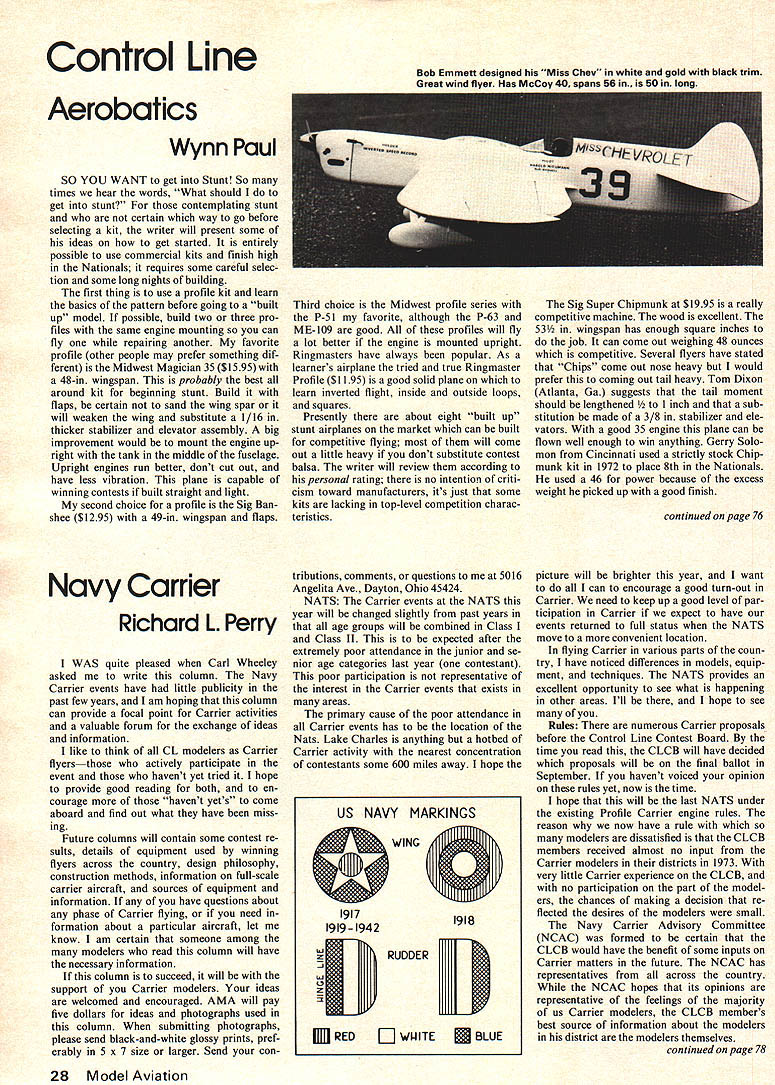
The first standardized national marking carried by Navy aircraft was the red, white, and blue star emblem shown in the drawing. This emblem was carried on both sides of the upper and lower surfaces of the wings and was supplemented by vertical blue, white, and red stripes on the rudder with the blue stripe appearing as the most forward stripe.
To standardize U.S. markings with those of our allies, the Navy adopted the roundel marking consisting of a white center with a blue inner ring and a red outer ring. At the same time, the order of the tail stripes was reversed so that the red stripe was forward and the blue stripe was aft.
Following WW I, the markings reverted back to the original star and tail stripes. These markings continued in use until the beginning of WW II although the tail stripes gradually were replaced with solid color tails used to identify particular units.
The next installment will cover some of the variations that appeared during WW II.
Transcribed from original scans by AI. Minor OCR errors may remain.

