
CONTROL LINE NAVY CARRIER
Dick Perry 31010 East Sunset Dr. North, Redlands, CA 92373-7453
Topics
- Brodak's Control Line Aviation Supplies and Service offerings
- Preview of the Carrier revival at Whittier Narrows
- Adapting the Fox Combat Special to use other carburetors
- Update on the Magnum .36 engine
Correction
Ooops — Mike Keville of Mesa, Arizona, writing from Kuwait City, was first to point out a serious error in my April column. The model I carelessly misidentified as a Dauntless is not the SBD but the earlier Douglas TBD Devastator. I promise to do better next time.
Three-line control systems
Leon Ryktarsyk no longer manufactures the three-line handles and bellcranks that were marketed under the LR Products name. These control systems, designed and originally manufactured by J. Robert (Bob) Smurthwaite, are now manufactured and distributed by John Brodak.
Brodak's Control Line Aviation Supplies and Service 100 Park Ave., Carmichaels, PA 15320 Tel.: (412) 966-2726
Brodak's catalog and stock
If you haven't seen John's catalog, it is worth the $3 price (refundable on the first order). John's philosophy is to provide everything a control-line modeler needs. He stocks a complete line of kits, accessories, tools, and materials.
Examples of kits and lines carried:
- Tony Drago's Control Line Classics
- Bill Hopkins's Custom Models
- Flite Line
- Aerosmith
- J. Roberts (Bob Smurthwaite)
- Goldberg
- Sterling
- Top Flite
- Sig CL kits
John also carries specialty items from manufacturers and shops that rarely appear on hobby-shop shelves and is constantly expanding his stock to serve CL modelers. In particular, John has the J. Roberts Bearcat, Corsair, and Skyraider kits (manufactured by Bob Smurthwaite) that were unavailable in recent years. He hopes soon to offer other Bob Smurthwaite profile models that were designed but not produced (Mustang, Supermarine Seafang, Tigercat, Mauler). These models will qualify for Profile Carrier bonus points.
Carrier revival at Whittier Narrows
The Navy Carrier revival mentioned previously will be held on June 13 at Whittier Narrows Recreation Area, just east of Los Angeles, California. The meet is run by the Knights of the Round Circle and the Black Sheep Exhibition Squadron. The Knights are holding a two-day contest for non-Carrier events; the Black Sheep are handling Carrier activities on Sunday.
Carrier events will include:
- Profile Carrier
- Class I and II (combined)
- .15 Carrier
- Skyraider Carrier
- Nostalgia Carrier (three classes)
The Nostalgia event will be an opportunity to fly older models and relive past Carrier flying. Rules for Nostalgia will revert to the original scoring system; line sliders (never part of the original Carrier concept) will be prohibited. I plan to attend and will discuss the meet in a future column.
Fox Combat Special
The Fox Combat Special has long been popular in combat: it is light, powerful, and has readily available parts and rework sources. While the Combat Special is not available in an RC configuration, a Fox RC carburetor can be fitted to its square intake with little work. Some modelers prefer other carbs, especially O.S. types, but the square intake of the Fox presents a challenge: the intake cross-section is large but the lateral dimensions are small compared to the bases of most carburetors.
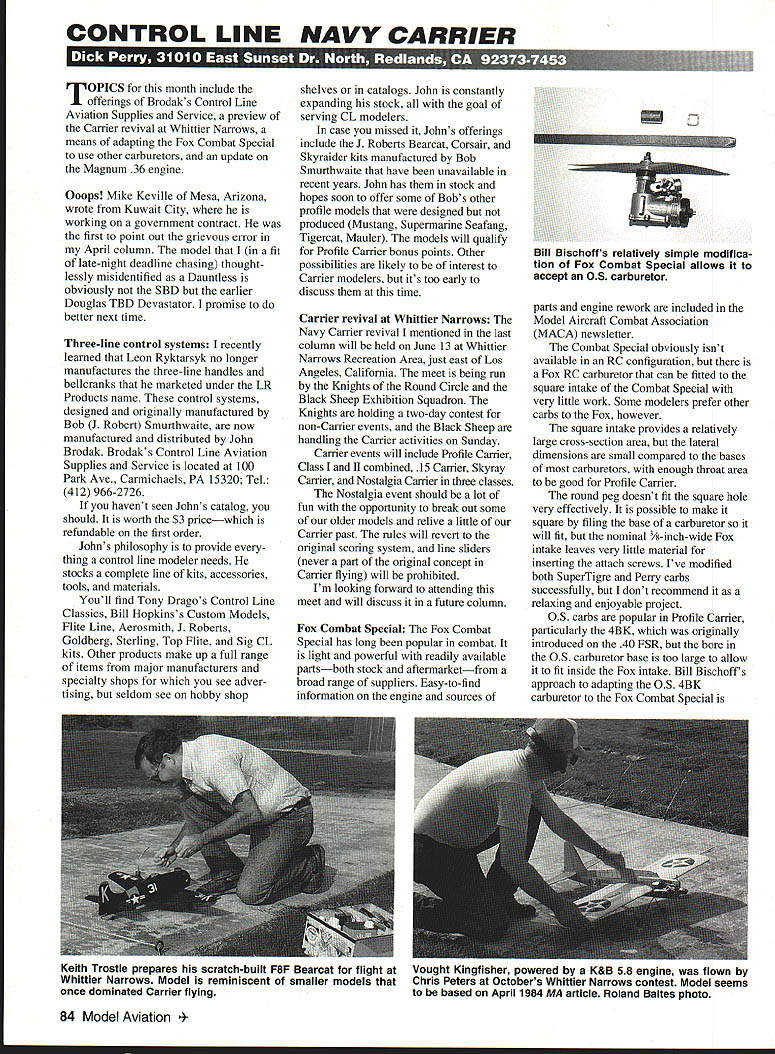
The O.S. 4BK carburetor (popular in Profile Carrier) has a base bore too large to fit inside the Fox intake. Bill Bischoff's approach adapts the O.S. 4BK to the Fox by using an external sleeve over the Fox intake. The method is strong, reliable, and yields a good, easy-to-adjust carburetor installation.
Bill Bischoff / George Fogerty technique (overview):
- Use a copper pipe coupling (common hardware-store item) with a 5/8-inch inside diameter. A straight coupling about 1 inch long is suitable.
- Convert the round coupling to a square sleeve using 1/2-inch square steel bar stock:
- File a taper on one end of the steel bar, apply grease, and hammer it progressively into the coupling to form the square shape.
- Re-grease as needed to prevent sticking.
- After shaping, heat the coupling red and allow slow cooling to relieve forming stresses.
- Modify the Fox intake:
- Cut off the intake just above the lower spray-bar holes to allow the carburetor to sit low enough to clear the propeller (the Combat Special has a short crankshaft).
- Grind down raised areas around spray-bar holes until flush with the intake sides.
- Saw through the web at the front and back sides of the intake so the sleeve can fit over the intake and form a good seal.
- Shape the base of the sleeve to match the round contour of the crankcase at the base of the intake.
- Assembly and sealing:
- Use a metal-filled epoxy to glue the sleeve over the intake for strength and an effective seal. Clean all parts thoroughly before assembly.
- Cut the sleeve so the carburetor will rest on the top of the original intake; drill mounting holes in the sleeve at the appropriate points.
- Form the carburetor seat with metal-filled epoxy: grease the carburetor base and screws, stuff the carburetor base with tissue, apply epoxy to the inside corners of the sleeve, insert the carburetor, invert the assembly so excess epoxy is accessible, and install the screws to secure the carburetor.
- After the epoxy cures, remove the carburetor and clean up any excess epoxy from the mounting area.
- Note: Making a square adapter by filing the base of a carburetor into the Fox intake is possible but leaves little material for attachment screws; it is not recommended unless you enjoy that kind of project.
Magnum Pro .36 engine
The Magnum Pro .36 RC mentioned in April is not the .36 I suggested. Although the engine looks well-made and is attractively priced, its actual displacement is approximately .365 cubic inches — effectively .37 cubic inches. The engine's design displacement is .365 cu in (oversize by about 1.4 percent).
Measured dimensions:
- Bore: 20.8 mm (0.819 in; actually measured 0.820 in)
- Stroke: 17.6 mm (0.693 in)
- Displacement: 0.365 cu in (advertised as .36)
This tendency to oversize slightly appears common among engines positioned against competitors but not intended for displacement-limited classes. Examples include:
- SuperTigre X11 displaces 0.113 cu in
- O.S. ".12" is actually closer to a .13
- Webra .32 displaces 0.323 cu in
Advice:
- Always check actual displacement against published specifications before purchasing, especially by mail.
- There are no obvious parts swaps to reduce the Magnum Pro .36 to the required .3600 cu in maximum for certain AMA events. Given its weight and other attributes, it would be a good candidate for .3600-class events if the displacement could be reduced. Don't give up yet.
Transcribed from original scans by AI. Minor OCR errors may remain.

