
Control Line: Navy Carrier
Joe Just, 709 Crescent, Sunnyside, WA 98944
On my way to the Nats this year, it was my privilege to have a seat next to a young boy traveling from Florida to the Indiana area. As we flew from Cincinnati to Evansville, he asked me what I was going there for, and what I would be doing once I arrived. I told him as much as I could in the one-hour trip, and after finishing, he asked, "Why would anyone do that stuff?" I was at a loss for words at first, and then I simply said, "Because we love it!"
Now, after my return from the 1993 National Aeromodeling Championships, I am convinced that the phrase, "We love it!" says it all. Why else would anyone put themselves into the extreme heat and humidity of a midwest summer—complete with rain, lightning, and wind? If we didn't love the hobby so much, we wouldn't have attended the Nats.
Once again, it was my pleasure to spend most of my time at the Navy Carrier circle, and while the temperature was hot, the competition was even hotter.
Pre-Nats Planning and Processing
A pre-Nats Navy Carrier planning team, which included Brenda Schuette, Bill Bischoff, and I (officers of the Navy Carrier Society), met on the evening of July 20. It was soon evident that as event director, Brenda had nearly all items of concern ironed out. Her team was fully assigned, each member had a good working idea of what was expected, and they were ready to begin.
In a brilliant move, the team was able to look ahead to the days of competition and instituted a new plan for formulating a raffle system and a precontest pull-testing procedure to get things rolling on time. The next day was devoted to practice, and processing began that evening for Profile Carrier.
From around the country, avid Carrier modelers met in the glider hangar near the AMA tent and began processing for the next day's competition. They were able to move smoothly through the rather complicated process.
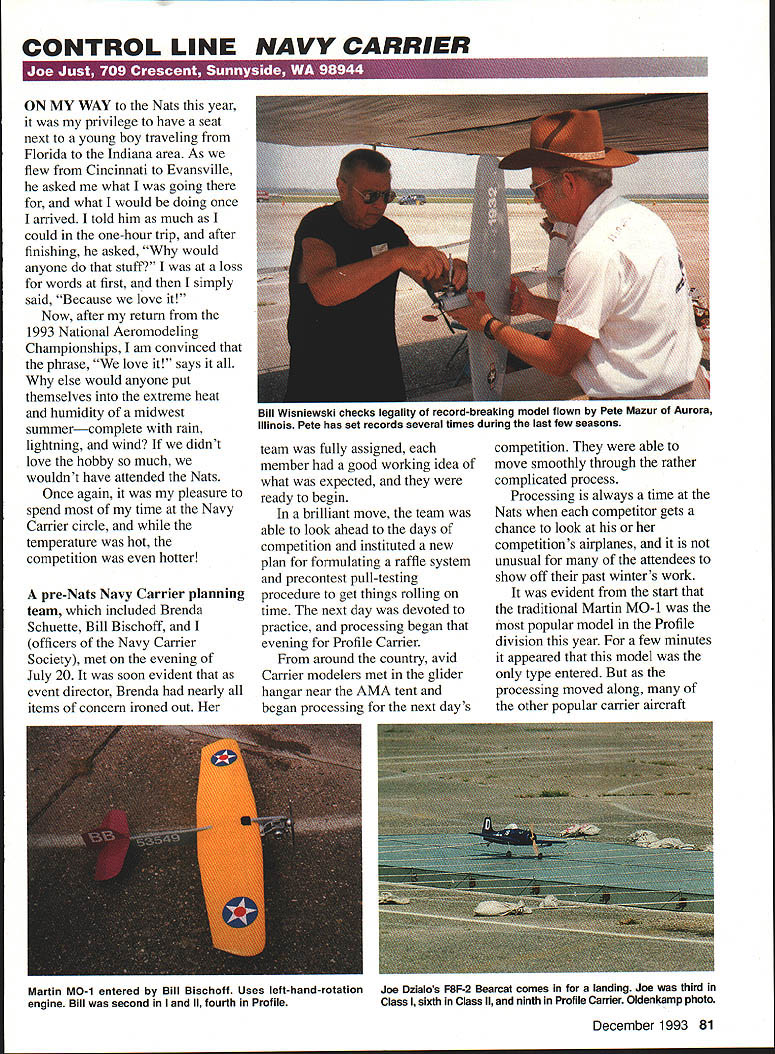
Processing is always a time at the Nats when each competitor gets a chance to look at his or her competition's airplanes, and it is not unusual for many of the attendees to show off their past winter's work.
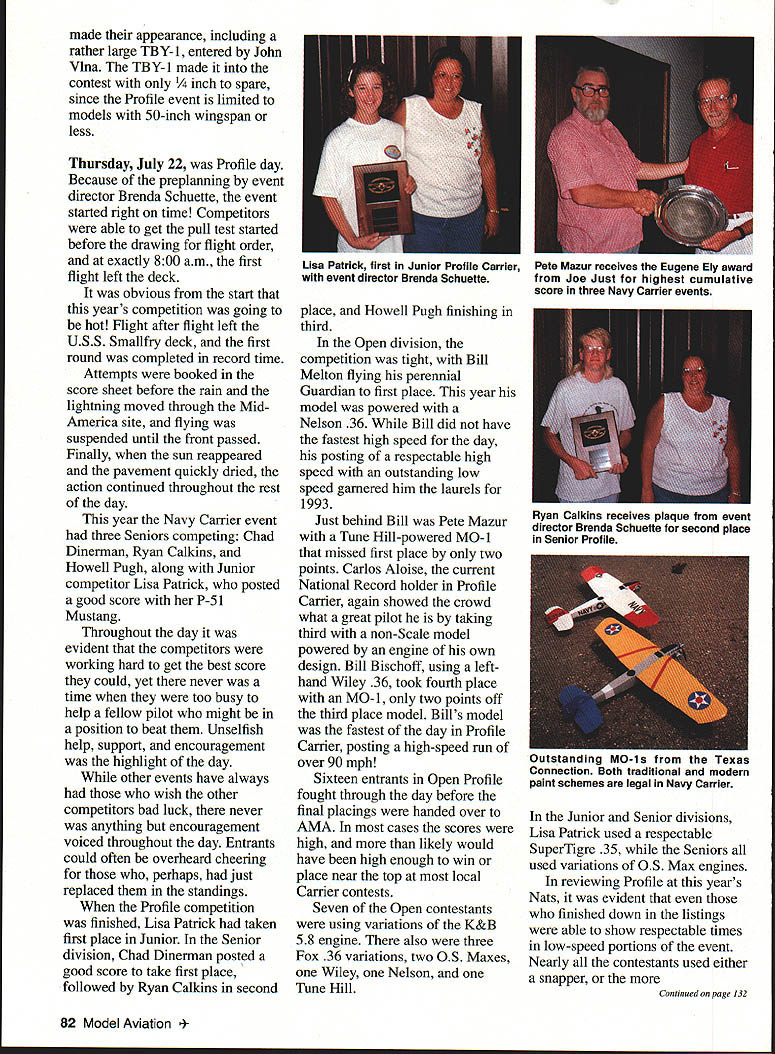
It was evident from the start that the traditional Martin MO-1 was the most popular model in the Profile division this year. For a few minutes it appeared that this model was the only type entered. But as the processing moved along, many of the other popular carrier aircraft made their appearance, including a rather large TBY-1, entered by John Vina. The TBY-1 made it into the contest with only 1/4 inch to spare, since the Profile event is limited to models with 50-inch wingspan or less.
Profile Day (Thursday, July 22)
Because of the preplanning by event director Brenda Schuette, the event started right on time. Competitors were able to get the pull test started before the drawing for flight order, and at exactly 8:00 a.m., the first flight left the deck.
It was obvious from the start that this year's competition was going to be hot. Flight after flight left the U.S.S. Smallfry deck, and the first round was completed in record time.
Attempts were booked in the score sheet before the rain and lightning moved through the Mid-America site, and flying was suspended until the front passed. Finally, when the sun reappeared and the pavement quickly dried, the action continued throughout the rest of the day.
This year the Navy Carrier event had three Seniors competing: Chad Dinerman, Ryan Calkins, and Howell Pugh, along with Junior competitor Lisa Patrick, who posted a good score with her P-51 Mustang.
Throughout the day it was evident that the competitors were working hard to get the best score they could, yet there never was a time when they were too busy to help a fellow pilot who might be in a position to beat them. Unselfish help, support, and encouragement was the highlight of the day.
While other events have always had those who wish the other competitors bad luck, there never was anything but encouragement voiced throughout the day. Entrants could often be overheard cheering for those who, perhaps, had just replaced them in the standings.
When the Profile competition was finished, Lisa Patrick had taken first place in Junior. In the Senior division, Chad Dinerman posted a good score to take first place, followed by Ryan Calkins in second place, and Howell Pugh finishing in third.
Open Division (Profile)
The Open division competition was tight, with Bill Melton flying his perennial Guardian to first place. This year his model was powered with a Nelson .36. While Bill did not have the fastest high speed for the day, his posting of a respectable high speed with an outstanding low speed garnered him the laurels for 1993.
Just behind Bill was Pete Mazur with a Tune Hill-powered MO-1 that missed first place by only two points. Carlos Aloise, the current National Record holder in Profile Carrier, again showed the crowd what a great pilot he is by taking third with a non-scale model powered by an engine of his own design. Bill Bischoff, using a left-hand Wiley .36, took fourth place with an MO-1, only two points off the third place model. Bill's model was the fastest of the day in Profile Carrier, posting a high-speed run of over 90 mph.
Sixteen entrants in Open Profile fought through the day before the final placings were handed over to AMA. In most cases the scores were high, and more than likely would have been high enough to win or place near the top at most local Carrier contests.
Engine types in the Open field included:
- K&B 5.8 variations (7 entrants)
- Fox .36 variations (3)
- O.S. Max (2)
- Wiley (1)
- Nelson (1)
- Tune Hill (1)
In the Junior and Senior divisions, Lisa Patrick used a respectable SuperTiger .35, while the Seniors all used variations of O.S. Max engines.
In reviewing Profile at this year's Nats, it was evident that even those who finished down in the listings were able to show respectable times in the low-speed portions of the event. Nearly all the contestants used either a snapper or the more traditional slider mechanism. This enables the model a yawing 60° flight, which is important for high scores at a contest like the Nats.
Event Team and Volunteers
Thanks go out this year to the excellent team put together by Brenda Schuette. Doing yeoman work for two days as the center judge—the position responsible for calling all flight infractions—was John (Doc) Holliday. He fought the heat, humidity, and a frantic pace of flight order, and did so with grace, humor, and, most importantly, skill.
The pit boss duties were ably handled by Dave King, who also entertained the team with some excellent tapes of 1950s-type rock & roll during the few breaks in the action.
Timing duties for this event were spread among the ever-willing:
- Gerry DeNeau
- Art Johnson
- Joe Just (author)
- Roy Stewart
Roy traded wonderful "war stories" with me during the brief lulls between flights. Working on the team is always a pleasure that I highly recommend—it's the best seat in the house for up-close action.
Final Official Day Processing and Competition
Processing for the final day of official events at this year's Nats took place in the comfortable AMA tent. From the start it was evident the MO-1 was the model of choice, with many of the competitors in both Class One and Class Two events.
Usually, the MO-1 is finished in rather plain, somewhat drab colors. This year, the Texas connection showed up with MO-1s in beautiful colors and finished in the proper configuration. In the case of Bill Bischoff, a modern Navy trainer color scheme was used. Both of these approaches are legal under AMA rules for Navy Carrier.
The processing took little time and all of the fliers were able to get away at a decent hour to prepare themselves for the hot action on Friday.
Day Two was very hot and the competition was even hotter. Again, the flight line was ready on time and the action began in earnest.
The Junior and Senior Class One models were the same Profile models that were flown the day before. Lisa Patrick again took the Junior division with her P-51. Ryan Calkins outscored the other two Senior pilots and took the Senior division with his Guardian.
The MO-1 was the model of choice for the Open fliers, and when all was said and done, six of the top nine entrants used variations of this aircraft.
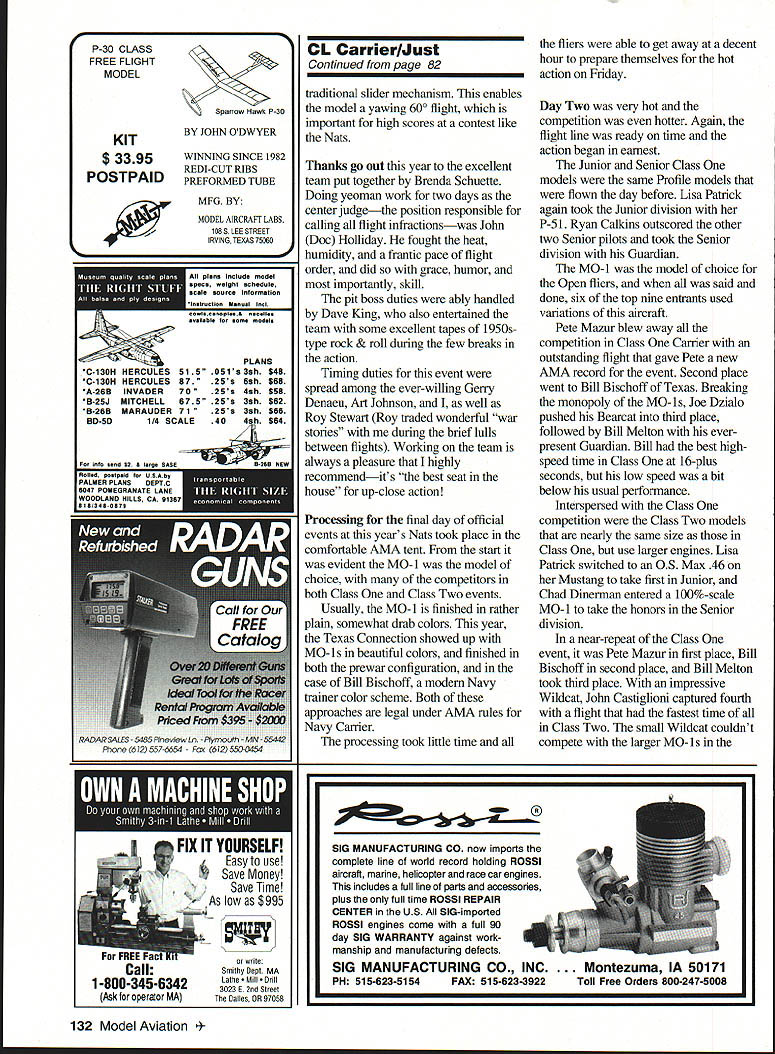
Pete Mazur blew away all the competition in Class One Carrier with an outstanding flight that gave Pete a new AMA record for the event. Second place went to Bill Bischoff of Texas. Breaking the monopoly of the MO-1s, Joe Dzialo pushed his Bearcat into third place, followed by Bill Melton with his ever-present Guardian. Bill had the best high-speed time in Class One at 16-plus seconds, but his low speed was a bit below his usual performance.
Interspersed with the Class One competition were the Class Two models that are nearly the same size as those in Class One but use larger engines. Lisa Patrick switched to an O.S. Max .46 on her Mustang to take first in Junior, and Chad Dinerman entered a 100%-scale MO-1 to take the honors in the Senior division.
In a near-repeat of the Class One event, it was Pete Mazur in first place, Bill Bischoff in second place, and Bill Melton in third. With an impressive Wildcat, John Castiglioni captured fourth with a flight that had the fastest time of all in Class Two. The small Wildcat couldn't compete with the larger MO-1s in the slow portion, or John might have placed higher, as he was just a few points off the pace.
With the heat, humidity, and the large entry in the two classes, the deck was busy with flight after flight. Each flight went off with precision on the part of the event team. Competitors and the working team helped to make the day move along well.
At the end of the official flights, it was obvious that Pete Mazur had again won the NCS Eugene Ely Award. The award is given each year to the competitor who garners the highest cumulative scores in the three Carrier events. This is the seventh time that Pete has won the award.
Banquet and Unofficial Events
On Friday night the membership and guests of the Navy Carrier Society met for its annual banquet and business meeting. Awards for all classes were given out and the annual meeting, in its usual spirited manner, brought all Carrier fliers up to date on in-house issues.
On Saturday we all met at the Carrier site—this time in a laid-back mode—to run the unofficial Carrier events: the Sportsman, the Sig Skyray, and the .15 Carrier contests. It was hot again, and with a great deal of help, the event ended before its appointed time—again showing how well the Carrier committee can work together.
- Sportsman winner: John Holliday
- Sig Skyray Carrier winner: Bill Bischoff
- .15 Carrier winner: Bill Bischoff
Twelve fliers entered the .15 Carrier event—that may be a record. In its yearly show of comradeship, the entire group took a few minutes to tear down AMA's deck and support equipment for storage until 1994.
Conclusion
Suddenly, it was all over. The heat and frustrations were forgotten, and all that remained of the Carrier events at this year's Nats was left looking somewhat sad, knowing that it was over until 1994. The unique feeling that only happens once a year was passing, and was soon to become a memory.
We had met in competition, some with determination to win it all. A few did win prizes; most didn't. I looked at old friends, knowing that I wouldn't see them all together until next year. As I left, I could only think of my comment to the young traveler I had briefly met at the beginning of this adventure: "We do this because we love it!"
Transcribed from original scans by AI. Minor OCR errors may remain.

