
CONTROL LINE NAVY CARRIER
Dick Perry 31010 East Sunset Drive North, Redlands, CA 92373-7453
Synopsis
This month's offering includes a report on the Black Sheep Navy Carrier Revival, additional information on autogiros in Carrier, Pete Mazur's new record, the final word on the Magnum .36, and a few other, lesser topics.
Moving news
As I write this, the move I mentioned in my last column has occurred. Susan and I are installed in our Albuquerque home. I can't say we've really moved in, because I've been traveling for the Air Force for three of the four weeks since the actual move-in date. Susan has done wonders in my absence, transforming jumbled rooms into a home and turning packed boxes into neat piles of cardboard in the garage. Maybe in a week or two I'll even have some of my modeling paraphernalia unpacked and sorted.
If the preceding paragraph seems a little outdated—particularly to those of you who have talked or written to me recently—don't be concerned. As you read this, I'm enjoying the beginning of the winter building season right along with you.
Trimming Carrier models
In my last column I mentioned Bill Bischoff's article, which appeared in the Navy Carrier Society newsletter. Bill discussed trimming CL Navy Carrier models, summarizing his observations into five pearls of wisdom:
- It is possible to build Carrier models too light.
- There is a practical limit to how close to the fuselage the line guide can be. While a mid-span location may work on a larger model, it won't work with a .15.
- It is essential that the engine and throttle control work properly to get any meaningful results from test flying. If you are fighting the engine as well as the airplane, it is difficult to determine what is happening.
- Change only one thing at a time in order to evaluate the results of the change.
- As long as an airplane is reasonably straight and structurally sound, you can eventually get it "straighten up and fly right!"
I back Bill's observations. I don't believe that lightweight models are necessarily evil, or that inboard leadout guides can't work on smaller models. I have found, however, that in both cases models are sensitive to disturbance, and changes need to be applied gradually and carefully. There's a much narrower range of acceptable tip weights, for example; models react radically to abrupt control or engine response. Excess tip weight can produce instability. Lighter overall weight reduces inertia effects and can exaggerate model reactions. Heavier models are definitely easier to trim and fly at low speeds.
Dave Wallick's heavier Class II Guardian weighed right at the four-pound limit; however, Dave's slow flights were the best part. Lower wing loading produces slower speeds and keeps models under complete control much of the time. Dave is a master at controlling slow speeds; weight in the models helped.
Black Sheep Carrier Revival
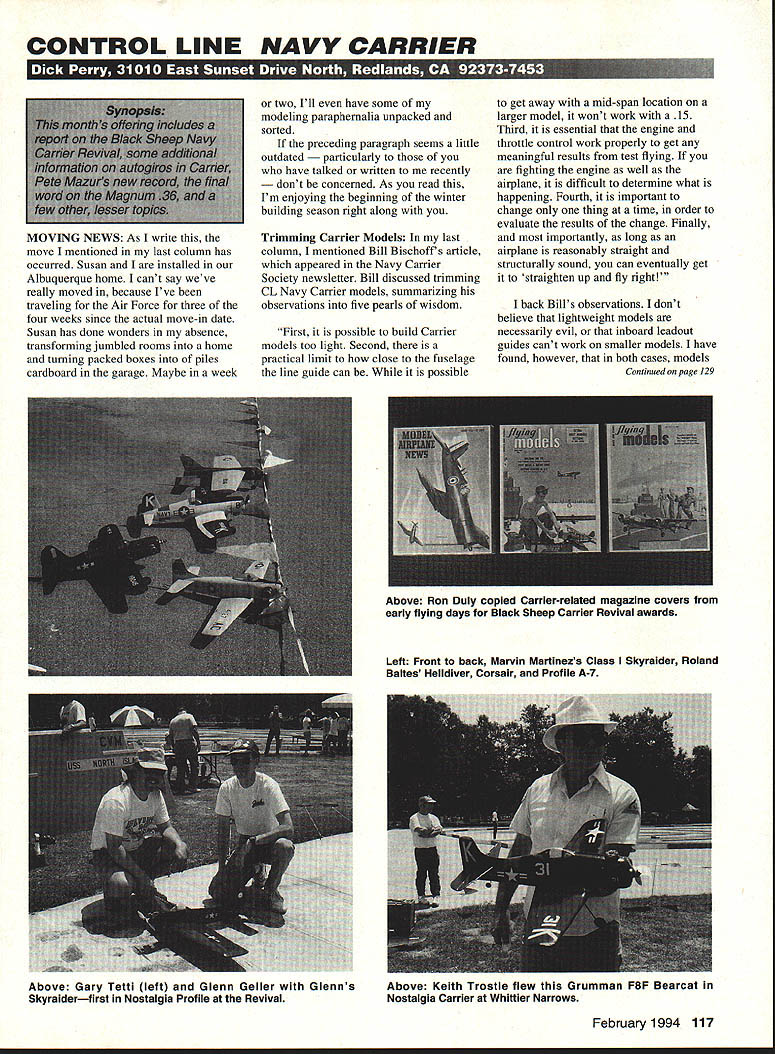
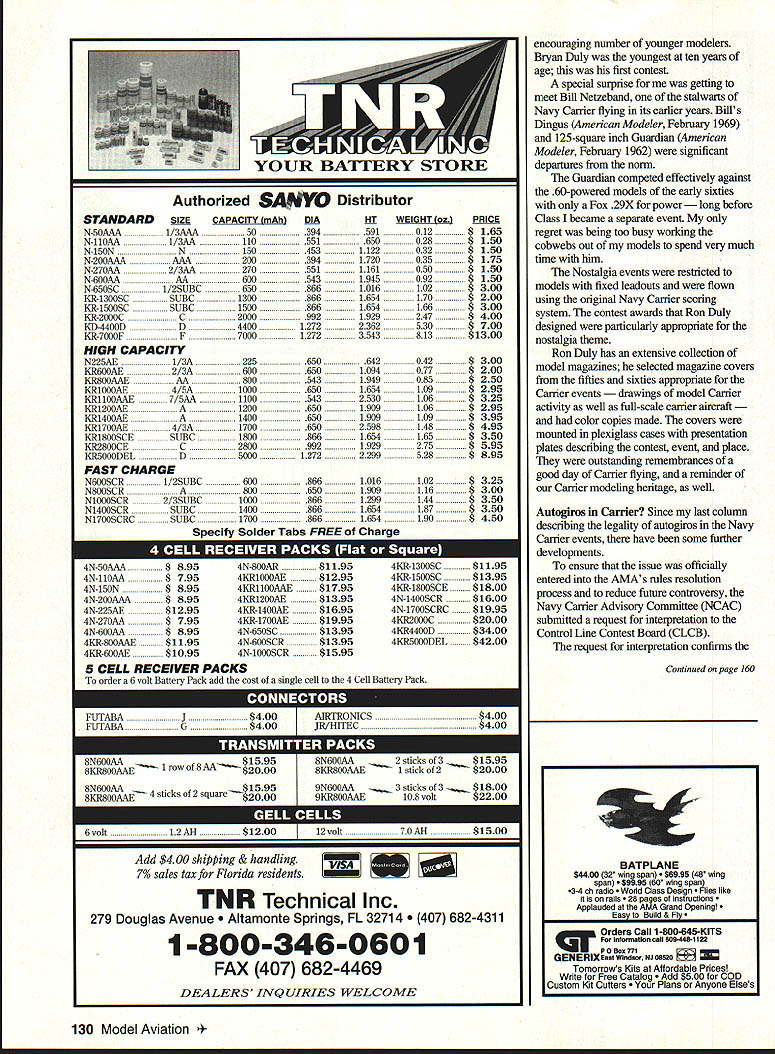
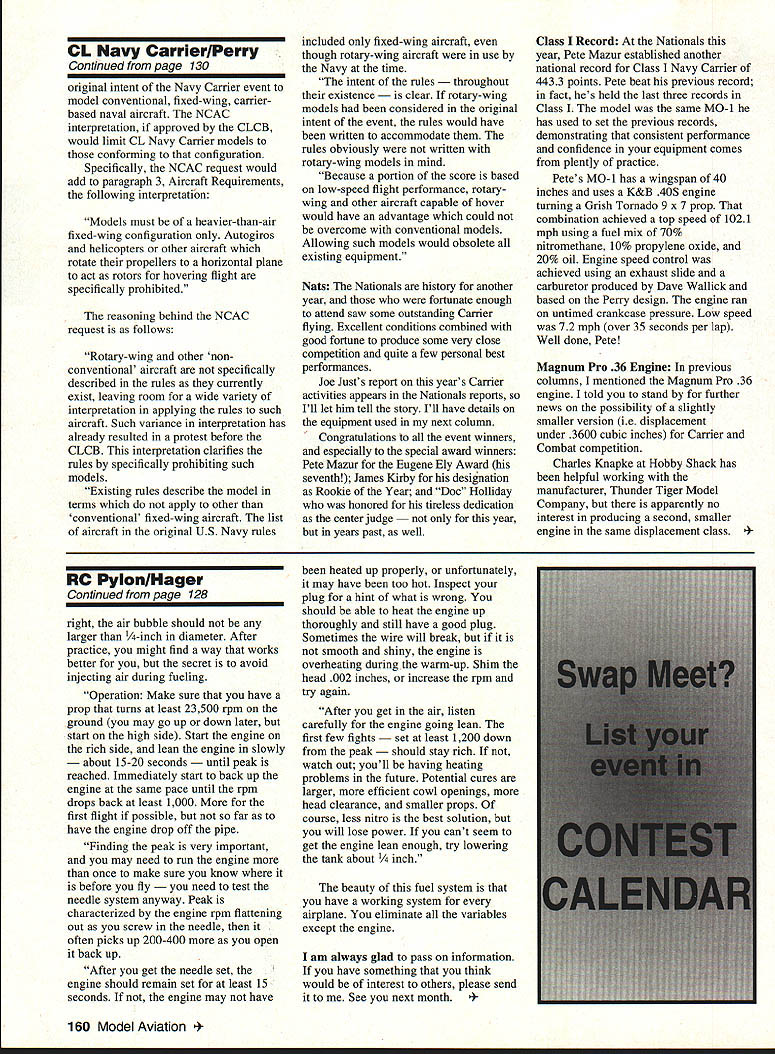
I mentioned in earlier columns that the Black Sheep Exhibition Squadron sponsored a Navy Carrier Revival on June 13 at Whittier Narrows, California. It promised fun and good flying, and those who attended were not disappointed. Many modelers from earlier years of Carrier competition in the Southwest were there—many with older models that had been flown under the old rules.
Roland Baltes brought his Corsair and Helldiver, both Class II models. Marvin Martinez made the trip from Phoenix and brought along his Skyralder (Model Airplane News, February 1977). Keith Trostle had his Class I Bearcat there, and Tony Naccarato flew his original Me 109 in profile. Ron Duly was there rooting for his son, Bryan, and Jay Hayes helped run the contest, though neither had models at the field.
Other modelers who have recently started flying Carrier competed as well, including an encouraging number of younger modelers. Bryan Duly was the youngest at ten years of age; this was his first contest.
A special surprise for me was getting to meet Bill Netzeband, one of the stalwarts of Navy Carrier flying in its earlier years. Bill's Dingus (American Modeler, February 1969) and 125-square-inch Guardian (American Modeler, February 1962) were significant departures from the norm. The Guardian competed effectively against the .60-powered models of the early sixties with only an F/W .29X for power—long before Class I became a separate event. My only regret was being too busy working the cobwebs out of my models to spend very much time with him.
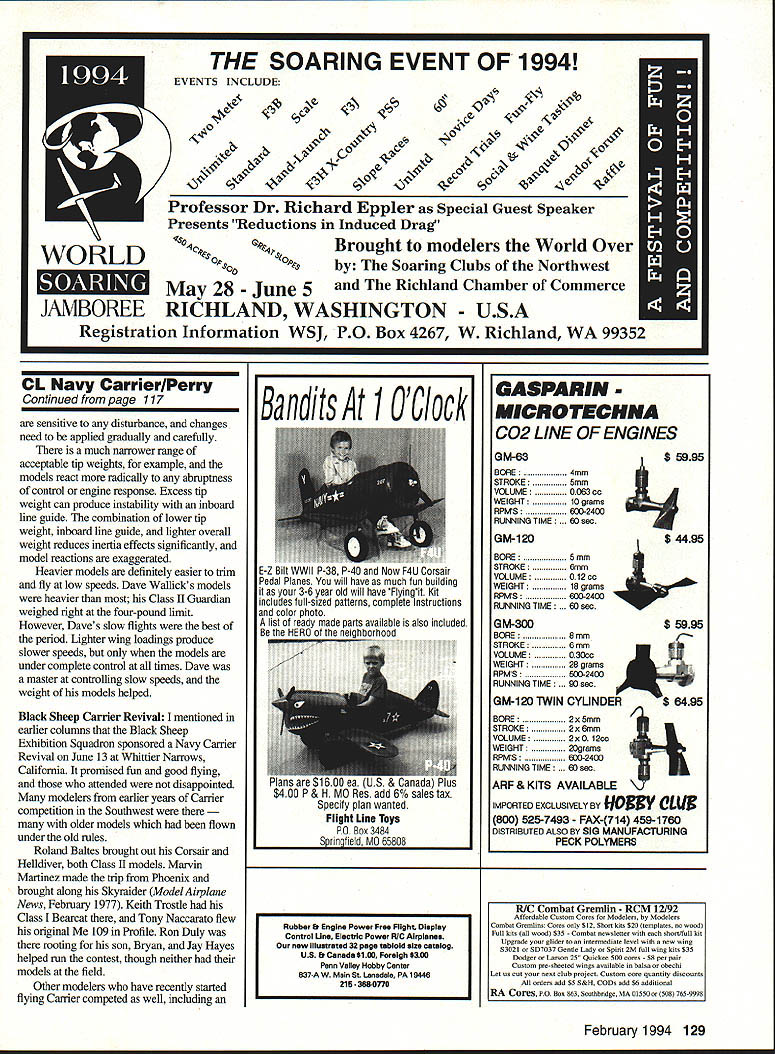
The Nostalgia events were restricted to models with fixed features and were flown using the original Navy Carrier scoring system. The contest awards that Ron Duly designed were particularly appropriate for the nostalgia theme. Ron has an extensive collection of model magazines; he selected magazine covers from the fifties and sixties appropriate for the Carrier events—drawings of model Carrier activity as well as full-scale carrier aircraft—and had color copies made. The covers were mounted in plexiglass cases with presentation plates describing the contest, event, and place. They were outstanding remembrances of a good day of Carrier flying, and a reminder of our Carrier modeling heritage.
Autogrids in Carrier?
Since my last column describing the legality of autogrids in the Navy Carrier events, there have been further developments. The issue was officially entered into the AMA's rules resolution process and, to reduce future controversy, the Navy Carrier Advisory Committee (NCAC) submitted a request for interpretation to the Control Line Contest Board (CLCB).
The request for interpretation confirms the original intent of the Navy Carrier event to model conventional, fixed-wing, carrier-based naval aircraft. The NCAC interpretation, if approved by the CLCB, would limit CL Navy Carrier models to those conforming to that configuration.
Specifically, the NCAC request would add to paragraph 3, Aircraft Requirements, the following interpretation:
"Models must be of a heavier-than-air, fixed-wing configuration only. Autogiros and helicopters or other aircraft which rotate their propellers to a horizontal plane to act as rotors for hovering flight are specifically prohibited."
The reasoning behind the NCAC request is as follows:
- Rotary-wing and other non-conventional aircraft are not specifically described in the rules as they currently exist, leaving room for a wide variety of interpretation in applying the rules to such aircraft. Such variance in interpretation has already resulted in a protest before the CLCB. This interpretation clarifies the rules by specifically prohibiting such models.
- Existing rules describe the model in terms that do not apply to other than conventional fixed-wing aircraft. The list of aircraft in the original U.S. Navy rules included only fixed-wing aircraft, even though rotary-wing aircraft were in use by the Navy at the time.
- The intent of the rules—throughout their existence—is clear. If rotary-wing models had been considered in the original intent of the event, the rules would have been written to accommodate them. The rules obviously were not written with rotary-wing models in mind.
- Because a portion of the score is based on low-speed flight performance, rotary-wing and other aircraft capable of hover would have an advantage which could not be overcome with conventional models. Allowing such models would obsolete all existing equipment.
Nats
The Nationals are history for another year, and those who were fortunate enough to attend saw some outstanding Carrier flying. Excellent conditions combined with good fortune to produce some very close competition and quite a few personal best performances.
Joe Juntz's report on this year's Carrier activities appears in the Nationals reports, so I'll let him tell the story. I'll have details on the equipment used in my next column.
Congratulations to all the event winners, and especially to the special award winners:
- Pete Mazur for the Eugene Ely Award (his seventh)
- James Kirby for his designation as Rookie of the Year
- "Doc" Holliday, honored for his tireless dedication as the center judge—not only for this year, but in years past as well
Class I record
At the Nationals this year Pete Mazur established another national record for Class I Navy Carrier of 443.3 points. Pete beat his previous record; in fact, he's held the last three records in Class I. The model was the same MO-1 he has used to set the previous records, demonstrating that consistent performance and confidence in your equipment comes from plenty of practice.
Pete's MO-1 has a wingspan of 40 inches and uses a K&B .049 engine turning a Grishorn Tornado 9 x 7 prop. That combination achieved a top speed of 102.1 mph using a fuel mix of 70% nitromethane, 10% propylene oxide, and 20% oil. Engine speed control was achieved using an exhaust slide and a carburetor produced by Dave Wallick and based on the Perry design. The engine ran on untuned crankcase pressure. Low speed was 7.2 mph (over 35 seconds per lap). Well done, Pete!
Magnum Pro .36 engine
In previous columns I mentioned the Magnum Pro .36 engine and asked you to stand by for further news on the possibility of a slightly smaller version (i.e., displacement under .360 cubic inches) for Carrier and Combat competition.
Charles Knapke at Hobby Shack has been helpful working with the manufacturer, Thunder Tiger Model Company, but there is apparently no interest in producing a second, smaller engine in the same displacement class.
Transcribed from original scans by AI. Minor OCR errors may remain.

