
CONTROL LINE NAVY CARRIER
Dick Perry, 7005 Del Oso Court, Albuquerque, NM 87109-2930
Synopsis
This month's offering includes an analysis of the models used in the 1993 Nationals, information on new engines and foam wing cores for Carrier models, further notes on the autogiro question, and a calculator program approach for scoring the Carrier events.
Nationals Carrier (1993)
Having spoken with Joe Just and others who attended the 1993 Nationals, it was clearly a standout year. Scores were close; many modelers achieved personal bests and Pete Mazur set a new record in Class I.
Highlights:
- High speeds increased across all classes and were better than in any of the previous four years.
- Profile: Bill Melton and Pete Mazur topped 90 mph. Four Profile (Class I) models exceeded 100 mph. Bill Melton reached 107.1 mph with a SuperTigre .40; Joe Dzialo, Pete Mazur, and Brian Silversmith were in the 102-mph range.
- Class II: John Castiglioni, Bill Melton, and Pete Mazur topped 105 mph.
- Overall top speed: John Castiglioni's Rossi .65-powered Grumman F4F-3 Wildcat reached 112.9 mph using a Rev-Up 11 x 8 prop (model wing area 210 sq in).
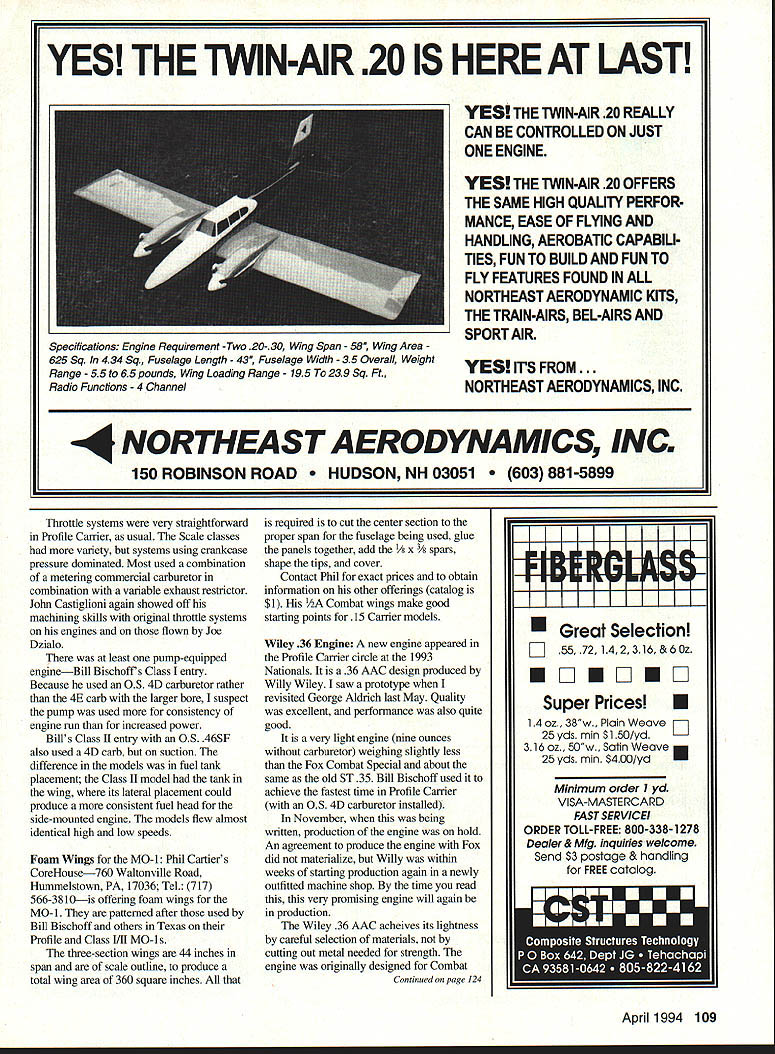
- Profile Carrier top times: Bill Bischoff achieved the best overall time using a Wiley .36 engine and an APC prop; Bill Melton’s Nelson .36 was only 0.1 mph slower.
- Slow-flight performance was exceptional: three Class IIs and six Class Is exceeded three minutes; five Profiles exceeded four minutes. Winner Bill Melton recorded a slow-flight time of 309.5 seconds (over five minutes).
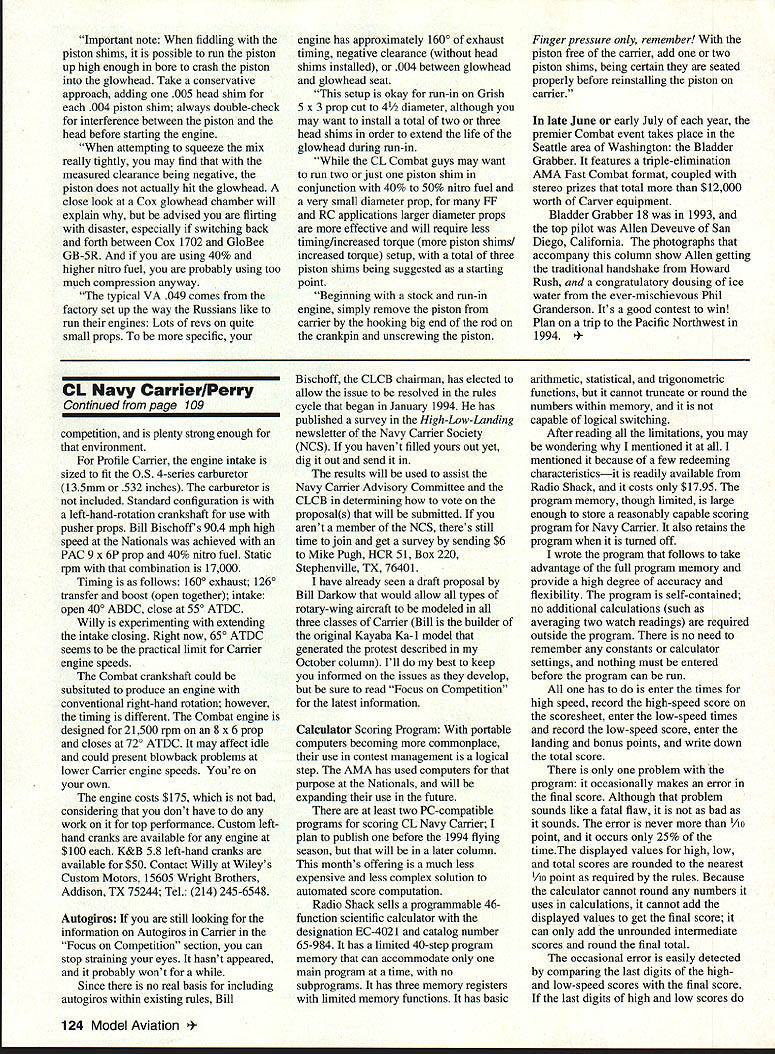
- Larger aircraft with lighter wing loading dominated slow-flight in the Scale classes, with the notable exception of Joe Dzialo’s Class II Bearcat (3 lb 10 oz) which still exceeded three minutes.
Model types:
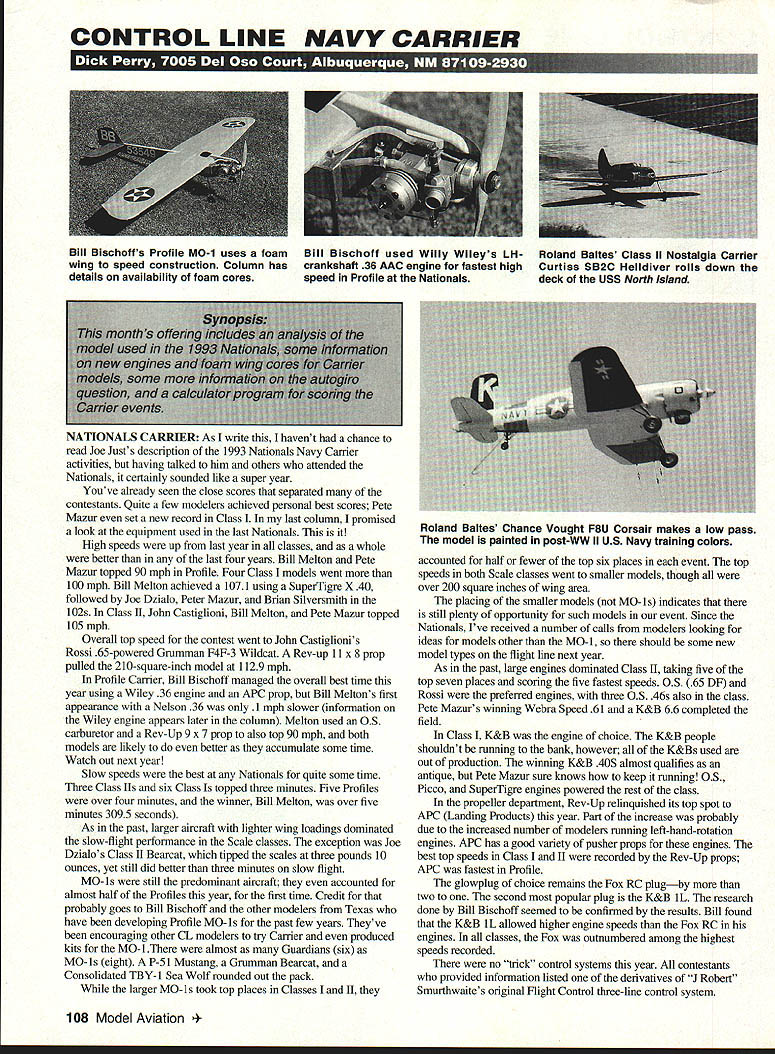
- MO-1s were predominant and accounted for almost half of the Profiles for the first time, likely due to development work by Bill Bischoff and other Texas modelers. There were eight MO-1s and six Guardians, plus a P-51 Mustang, a Grumman Bearcat, and a Consolidated TBY-1 Sea Wolf.
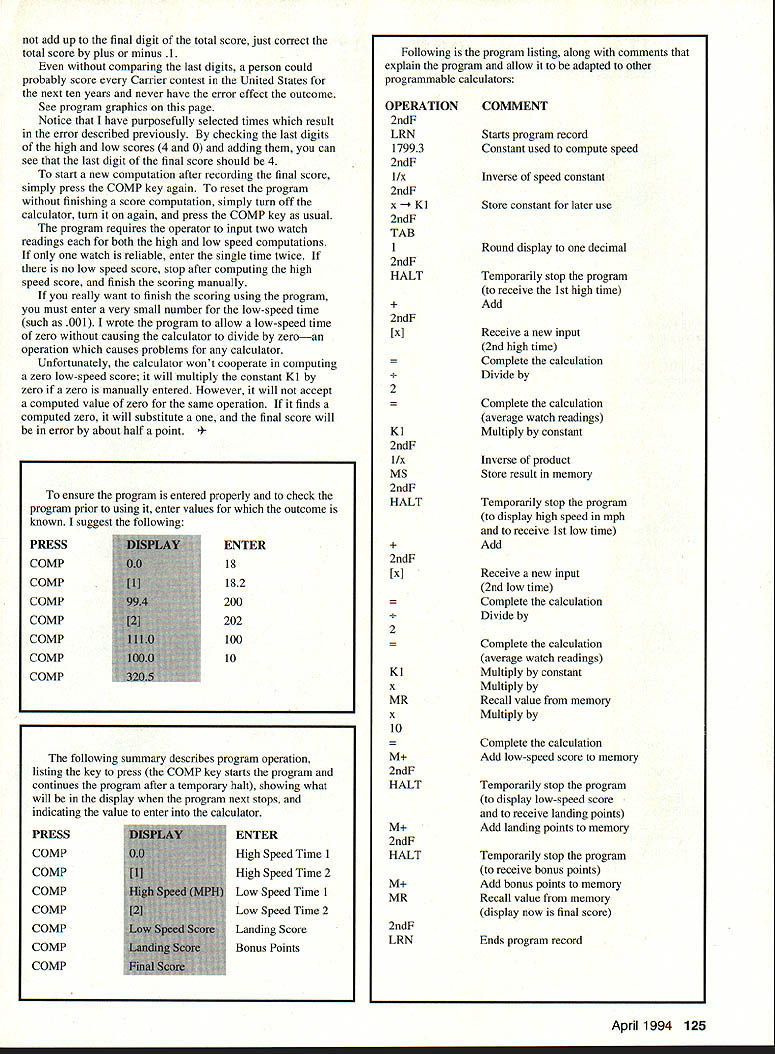
- Although larger MO-1s took top places in Classes I and II, smaller non–MO-1 models still placed among the top six, indicating continued opportunity for diverse model designs.
Equipment and Engine Summary
- Class II: Large engines dominated, taking five of the top seven places and five of the fastest speeds. Preferred engines included O.S. (.65 DF) and Rossi; three O.S. .46s were present. Pete Mazur won with a Webra Speed .61; a K&B .66 rounded out the top speeds.
- Class I: K&B engines were common (noting most K&Bs in use are out of production). The winning K&B .40S is an older model but still competitive. Other engines used included O.S., Picco, and SuperTigre.
- Props: APC (Landing Products) displaced Rev-Up as the most common props in 1993, partly due to more left-hand-rotation engines requiring pusher props. Despite APC’s prevalence, the fastest top speeds in Class I and II were recorded on Rev-Up props; APC was fastest in Profile.
- Glowplugs: Fox RC remained the most popular plug by more than two to one. K&B IL was the second most popular. Bill Bischoff’s research indicated K&B IL allowed higher engine speeds than Fox RC in some engines; among the highest speeds recorded, the Fox was outnumbered.
- Control systems: No novel or “trick” control systems were reported; all contestants who provided information used derivatives of J. Robert Smurthwaite’s Flight Control three-line control system.
- Throttle systems: Profile Carrier throttle systems were straightforward. Scale classes showed more variety, but crankcase-pressure-based systems dominated, often using a metering commercial carburetor with a variable exhaust restrictor.
- Tanking and pump notes:
- At least one pump-equipped engine was flown (Bill Bischoff’s Class I entry). Because a 4D O.S. carburetor (smaller bore than the 4E) was used, the pump likely improved run consistency rather than raw power.
- Bill’s Class II entry used an O.S. .46SF with a 4D carb on suction; the main difference between his Class I and Class II models was tank placement—the Class II tank was in the wing to provide a more consistent lateral fuel head for a side-mounted engine. Both models had nearly identical high and low speeds.
Foam Wings for the MO-1
Phil Cartier’s CoreHouse is offering foam wings for the MO-1, patterned after the wings used by Bill Bischoff and others on Profile and Class I MO-1s.
Details:
- Vendor: CoreHouse, 760 Waltonville Road, Hummelstown, PA 17036. Tel: (717) 566-3810.
- Wing specifications: three-section wings, 44 in span (total), scale outline, total wing area 360 sq in. Panels are supplied; builder must cut the center section to fit the fuselage, glue panels, add 1/8 x 3/8 spars, shape tips, and cover.
- Additional: Contact Phil for current prices and his catalog (catalog $1). His 1/2A Combat wings can serve as good starting points for .15 Carrier models.
Wiley .36 Engine
A new .36 AAC engine by Willy Wiley made an appearance at the 1993 Nationals and proved promising.
Key points:
- Weight and design: Very light—about nine ounces without carburetor—slightly lighter than the Fox Combat Special and similar to the old ST .35. Designed originally for Combat competition; built with careful material selection for strength.
- Performance: Bill Bischoff used a Wiley .36 (with an O.S. 4D carburetor installed) to achieve the fastest Profile Carrier time at the Nationals.
- Production status (as of late 1993): Production had been on hold after a proposed Fox manufacturing agreement did not materialize. Willy was preparing to resume production in a newly outfitted machine shop; by the time this is read, the engine may be back in production.
- Intake/carburetor: For Profile Carrier the intake is sized to fit the O.S. 4-series carburetor (13.5 mm / .532 in). The carburetor is not included. Standard configuration is with a left-hand-rotation crankshaft for pusher props.
- Example performance: Bill Bischoff’s 90.4 mph high speed at Nationals was achieved with a PAC 9 x 6P prop and 40% nitro; static rpm with that combination was about 17,000.
- Timing (Wiley .36 AAC Carrier configuration): 160° exhaust; transfer and boost open together at 126°; intake: open 40° ABDC, close at 55° ATDC. Wiley is experimenting with extending intake closing; 65° ATDC is cited as a practical limit for Carrier success.
- Combat configuration: A Combat crankshaft can be substituted for conventional right-hand rotation, but timing differs (Combat designed for ~21,500 rpm on an 8 x 6 prop, closing at 72° ATDC). This may affect idle and cause blowback at lower Carrier speeds—care advised.
- Pricing and contact: Engine cost $175. Custom left-hand cranks available for $100; K&B 5.8 left-hand cranks available for $50. Contact Wiley’s Custom Motors, 15005 Wright Brothers, Addison, TX 75244; Tel.: (214) 245-6548.
Autogiros (Autogyros) in Carrier
The autogiro issue has not yet been resolved in the rules. Because there is no clear basis for including autogiros under existing rules, Bill Bischoff (CLCB chairman) elected to allow the issue to be addressed in the rules cycle beginning January 1994.
- A survey was published in the High-Low-Landing newsletter of the Navy Carrier Society (NCS). Results will inform the Navy Carrier Advisory Committee and the CLCB when voting on proposals.
- If you have not returned your survey, please do so. If you are not a member of the NCS and want a survey, join the NCS by sending $6 to: Mike Pugh, HCR 51, Box 220, Stephenville, TX 76401.
- A draft proposal by Bill Darkow (builder of the original Kayaba Ka-1 that generated prior protest) would allow all rotary-wing aircraft types in all three Carrier classes. Follow "Focus on Competition" for the latest developments.
Calculator Scoring Program (Practical Low-Cost Solution)
With portable computers becoming common, computerized scoring is logical. There are PC-compatible scoring programs for CL Navy Carrier; a simple, low-cost alternative can be implemented on a programmable scientific calculator.
Hardware:
- Radio Shack EC-4021 (catalog no. 65-984) — a 46-function programmable scientific calculator. It costs approximately $17.95 and retains programs when turned off.
- Limitations: 40-step program memory, three memory registers with limited functions, no truncation or rounding of numbers within memory, and no logical switching.
Program approach:
- The program uses the calculator’s full program memory to compute Carrier scores without external storage. No need to remember constants or addresses—only enter the high-speed recorded time, the low-speed time, landing points, and any bonus points; the calculator computes the rest automatically.
- Because the calculator cannot round intermediate values stored in memory, final results are computed from unrounded intermediate values and then rounded for display. This leads to a small occasional discrepancy.
Known issue and workaround:
- The program occasionally (about 25% of the time) yields a final score that is off by 0.1 point. The error never exceeds 0.1 point.
- Detection and fix: Compare the last digits of the high- and low-speed scores with the last digit of the final score. If the last digits of the high and low scores do not equal the last digit of the final score, add 0.1 to the final score. If they do match, the final score is correct.
Practical note:
- Despite limitations, the calculator method is a cheap and portable way to automate scoring for Carrier events when a PC-based system is not available.
Closing
Watch for further columns with a PC-compatible scoring program and additional developments on engines, model designs, and rules issues as they arise.
Transcribed from original scans by AI. Minor OCR errors may remain.

