
CONTROL LINE NAVY CARRIER
By Dick Perry
7005 Del Oso Court, Albuquerque, NM 87109-2930
Overview
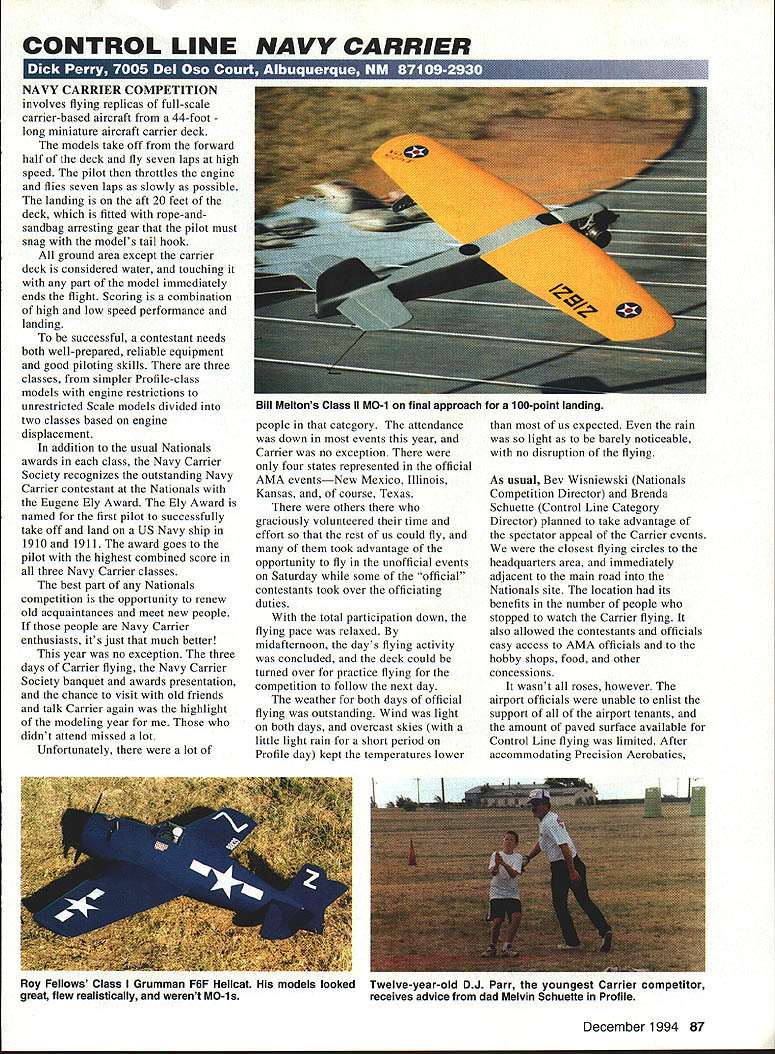
NAVY CARRIER COMPETITION involves flying replicas of full-scale carrier-based aircraft from a 44-foot-long miniature aircraft carrier deck. Models take off from the forward half of the deck and fly seven laps at high speed. The pilot then throttles the engine and flies seven laps as slowly as possible. Landing takes place on the aft 20 feet of the deck, which is fitted with rope-and-sandbag arresting gear that the pilot must snag with the model's tail hook.
All ground area except the carrier deck is considered water; touching it with any part of the model immediately ends the flight. Scoring is a combination of high- and low-speed performance and landing.
To be successful, a contestant needs both well-prepared, reliable equipment and good piloting skills.
Classes and Awards
- Three classes:
- Profile class: simpler models with engine restrictions.
- Scale models: unrestricted, divided into two classes based on engine displacement.
- Eugene Ely Award: presented by the Navy Carrier Society to the outstanding Navy Carrier contestant at the Nationals. Named for the first pilot to successfully take off and land on a U.S. Navy ship (1910–1911). The award goes to the pilot with the highest combined score in all three Navy Carrier classes.
- Rookie of the Year: trophy awarded to the first-time Nationals Carrier competitor who displays the best combination of competitive spirit, sportsmanship, and enthusiasm.
Nationals experience and attendance
The best part of any Nationals competition is renewing old acquaintances and meeting new people. This year was no exception: the three days of Carrier flying, the Navy Carrier Society banquet and awards presentation, and the chance to visit with friends and talk Carrier again were highlights of the modeling year. Unfortunately, overall attendance was down and Carrier was no exception. Only four states were represented in the official AMA events: New Mexico, Illinois, Kansas, and Texas.
Several volunteers stepped in to officiate so others could fly, and many of those volunteers flew in the unofficial events on Saturday while official contestants covered officiating duties. With lower participation the flying pace was relaxed; by midafternoon each day the official flying was concluded and the deck could be turned over for practice.
Site and weather
The weather for both days of official flying was outstanding: light wind and overcast skies (with a little light rain for a short period on Profile day) kept temperatures lower than expected. The light rain was barely noticeable and did not disrupt flying.
Bev Wisniewski (Nationals Competition Director) and Brenda Schuette (Control Line Category Director) placed Carrier close to the headquarters area and adjacent to the main road into the Nationals site to take advantage of spectator appeal. The location brought many casual spectators and gave contestants easy access to AMA officials, hobby shops, food, and concessions.
However, airport officials were unable to enlist all tenants, limiting the paved surface available for control line flying. After accommodating Precision Aerobatics and Profile Speed Racing, no room remained for other events. Carrier events were moved to pavement on the airport parking ramp and to a grass area opposite the headquarters.
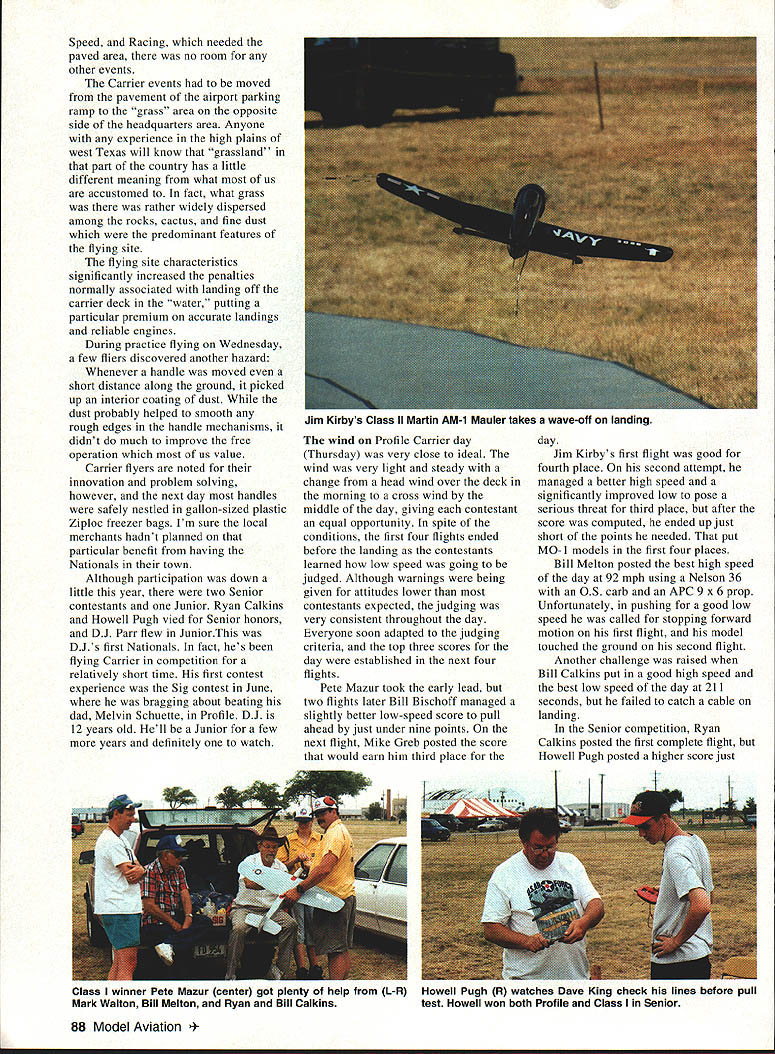
The west Texas "grass" was mostly fine dust with widely dispersed rocks and cactus. The dusty flying site increased penalties for landing off the carrier deck (considered water), putting a premium on accurate landings and reliable engines. During practice a dust coating collected inside handles when they were slid along the ground, impairing smooth operation; many flyers protected handles in gallon-sized Ziploc freezer bags.
Competitors
Although participation was down, there were two Senior contestants and one Junior:
- Seniors: Ryan Calkins and Howell Pugh.
- Junior: D.J. Parr (12 years old). This was D.J.'s first Nationals; he had begun competing earlier in the year and is one to watch.
Profile Carrier (Thursday)
Profile Carrier day featured very light, steady wind with a morning headwind over the deck shifting to a crosswind by midday, giving each contestant an equal opportunity. Despite the favorable conditions, the first four flights ended before landing as contestants learned how strictly low-speed attitudes would be judged. Judging was consistent, and top scores were established in the subsequent flights.
Key performers and events:
- Pete Mazur took an early lead.
- Bill Bischoff later edged ahead by just under nine points with a slightly better low-speed score.
- Mike Greb posted a score that would earn him third place for the day.
- Jim Kirby initially placed fourth; his second flight improved his high and low speeds and nearly moved him into third, but he fell just short.
- MO-1 models swept the first four places.
Notable specifics:
- Bill Melton posted the best high speed of the day at 92 mph using a Nelson 36 with an O.S. carb and an APC 9x6 prop. He was called for stopping forward motion on his first flight, and his model touched the ground on his second flight.
- Bill Calkins recorded a very good high speed and the best low speed of the day (211 seconds) but failed to catch a cable on landing.
- In Senior competition, Ryan Calkins posted the first complete flight, but Howell Pugh posted a higher score shortly thereafter, moving into first place before the lunch break.
- Of 13 models entered in Profile, there were three Guardians, a Skyraider by Roy Fellows, and an original foam-wing F4F Wildcat built by Terry Kirby, but MO-1s dominated the top places.
Scale classes (Class I and Class II)
The wind shifted for the scale classes, requiring the deck to be moved before competition began. Winds stayed from the southwest throughout the day but varied in intensity from calm to about seven knots with occasional mild gusts as the sun came in and out from the clouds. These variations increased the challenge of low-speed flight.
Highlights:
- Pete Mazur won the first-flight lottery and posted a high speed over 100 mph. His low speed of just over three minutes and a perfect landing set a high standard.
- Bill Bischoff was within a second of Pete's high speed and flew the best low speed of the day. In both official flights he fell seven points short and took second place.
- Bill Melton, Mike Greb, and I (the author) battled for the next three places; each took multiple attempts to post best scores. Mike and I were separated by very small margins in high speed; low speeds were virtually identical.
- With Profile and Class I scores posted, Bill Bischoff and Pete Mazur had each placed first and second in one event. Bill was ahead in the running for the Eugene Ely Award by less than two points out of 700.
- Pete flew first in Class II and posted an outstanding score with a top speed over 100 mph and a solid low speed. Bill Melton later achieved the best high speed of the contest at 111.5 mph and a low-speed time of 149 seconds, putting him within striking distance of Pete.
- Bill Bischoff, flying a smaller O.S. .45SF, was disadvantaged against competitors with larger engines (Webra .61, Rossi .65) and needed a superior low speed to win. After waiting until after lunch for better conditions and practicing, wind conditions became more erratic and the needed low speed proved out of reach; Bill finished third in Class II.
Awards and banquet
At the Navy Carrier Society banquet Friday evening:
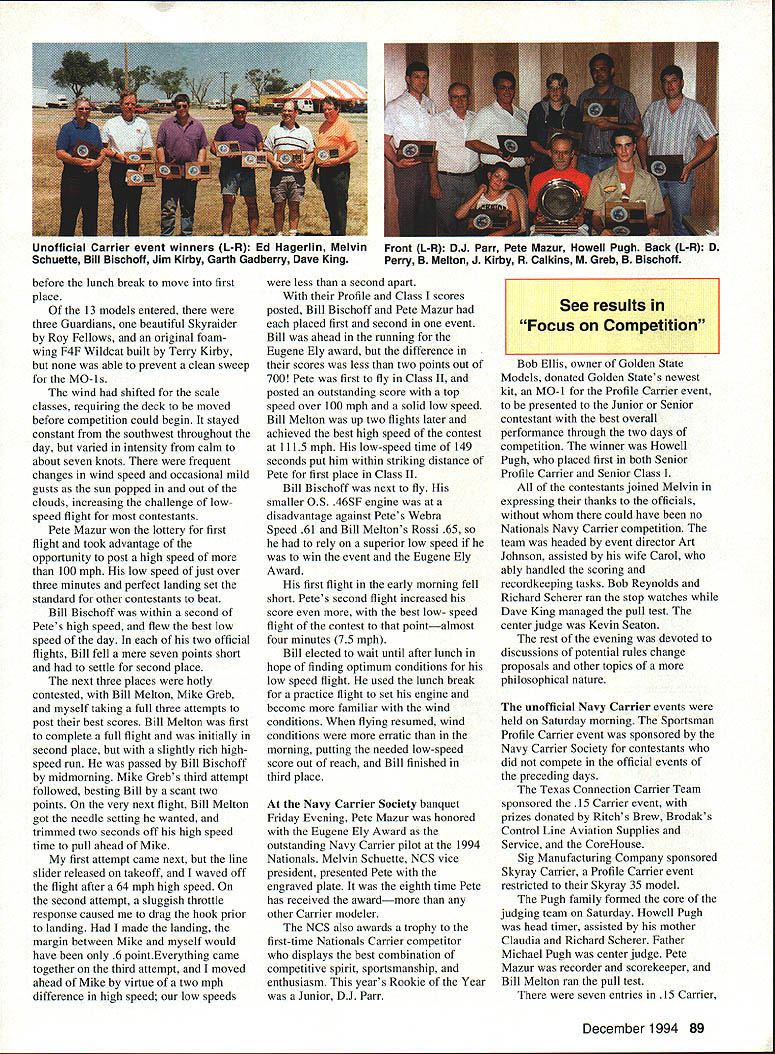
- Pete Mazur was honored with the Eugene Ely Award as outstanding Navy Carrier pilot at the 1994 Nationals. Melvin Schuette, NCS vice president, presented Pete with the engraved plate. This was Pete's eighth Ely Award—more than any other Carrier modeler.
- Rookie of the Year: D.J. Parr (Junior).
- Golden State Models (Bob Ellis) donated a new MO-1 kit for the Profile Carrier event; the kit was awarded to Howell Pugh, the Junior or Senior contestant with the best overall performance through the two days of competition. Howell placed first in both Senior Profile Carrier and Senior Class I.
Officials and volunteers:
- Event director: Art Johnson.
- Scoring and recordkeeping: Carol Johnson.
- Stopwatches: Bob Reynolds and Richard Scherer.
- Pull test: Dave King.
- Center judge: Kevin Seaton.
The banquet also included discussions of potential rule changes, proposals, and other topics.
Unofficial events (Saturday)
The unofficial Navy Carrier events were held Saturday morning.
- Sportsman Profile Carrier: sponsored by the Navy Carrier Society for contestants who did not compete in the official events.
- .15 Carrier: sponsored by the Texas Connection Carrier Team. Prizes donated by Ritch's Brew, Brodak's Control Line Aviation Supplies and Service, and Sig Manufacturing Company.
- Skyrazer Carrier: a Profile Carrier event restricted to the Sig Skyrazer .35 model and sponsored by Sig Manufacturing.
Judging team (Saturday):
- Head timekeeper: Howell Pugh.
- Assistants: Claudia Pugh and Richard Scherer.
- Center judge: Michael Pugh.
- Recorder and scorekeeper: Pete Mazur.
- Pull test: Bill Melton.
Results:
- .15 Carrier (seven entries; competition extremely close):
- Bill Bischoff — 191.9 points
- Jim Kirby — 191.5 points
- Melvin Schuette — 188.3 points
Notable model: Jim Kirby's entry had a foam wing of 210 square inches, a very long fuselage with a one-piece stabilator, and was powered by an O.S. .20 FS four-stroke.
- Skyrazer Carrier (six entries):
- Bill Bischoff — 217.5 points
- Close pursuers: Melvin Schuette, Jim Kirby, and John Holliday (scores grouped between 190.9 and 185.7).
- Sportsman Profile Carrier:
- Ed Hagerlin — flew a Ju-88 Stuka bomber
- Dave King
- Garth Gadberry (a newcomer who borrowed an airplane and is likely to return)
Conclusion
Overall, the Navy Carrier competition at this year's Nationals was a great experience. Despite slightly adverse site conditions and lower participation, the event provided excellent flying, good competition, and the camaraderie that makes Carrier events special. Everyone left looking forward to getting together again in 1995.
Transcribed from original scans by AI. Minor OCR errors may remain.

