
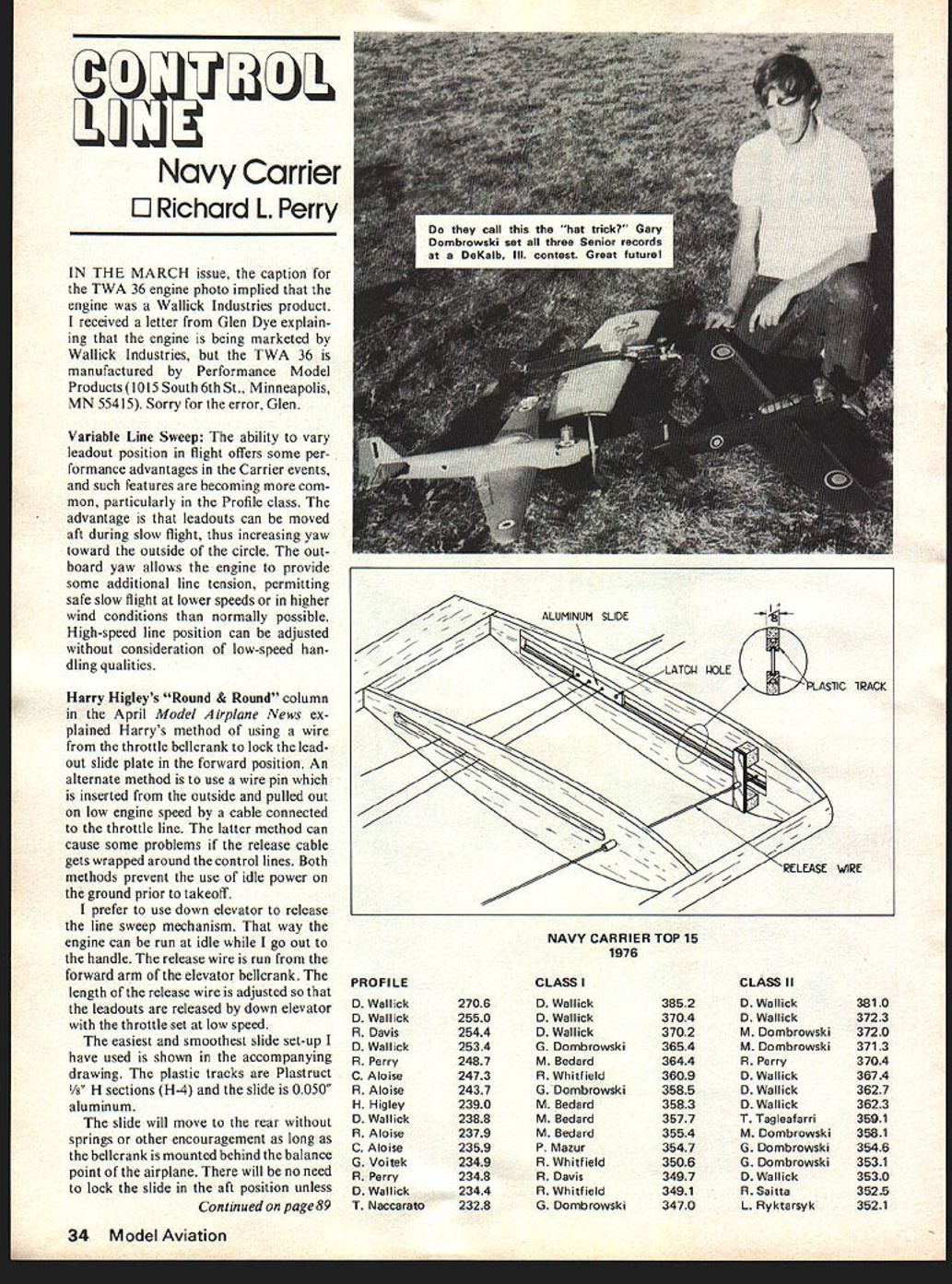
Control Line: Navy Carrier
Richard L. Perry
IN THE MARCH issue, the caption for the TWA 36 engine photo implied that the engine was a Wallick Industries product. I received a letter from Glen Dye explaining that the engine is being marketed by Wallick Industries, but the TWA 36 is manufactured by Performance Model Products (1015 South 6th St., Minneapolis, MN 55415). Sorry for the error, Glen.
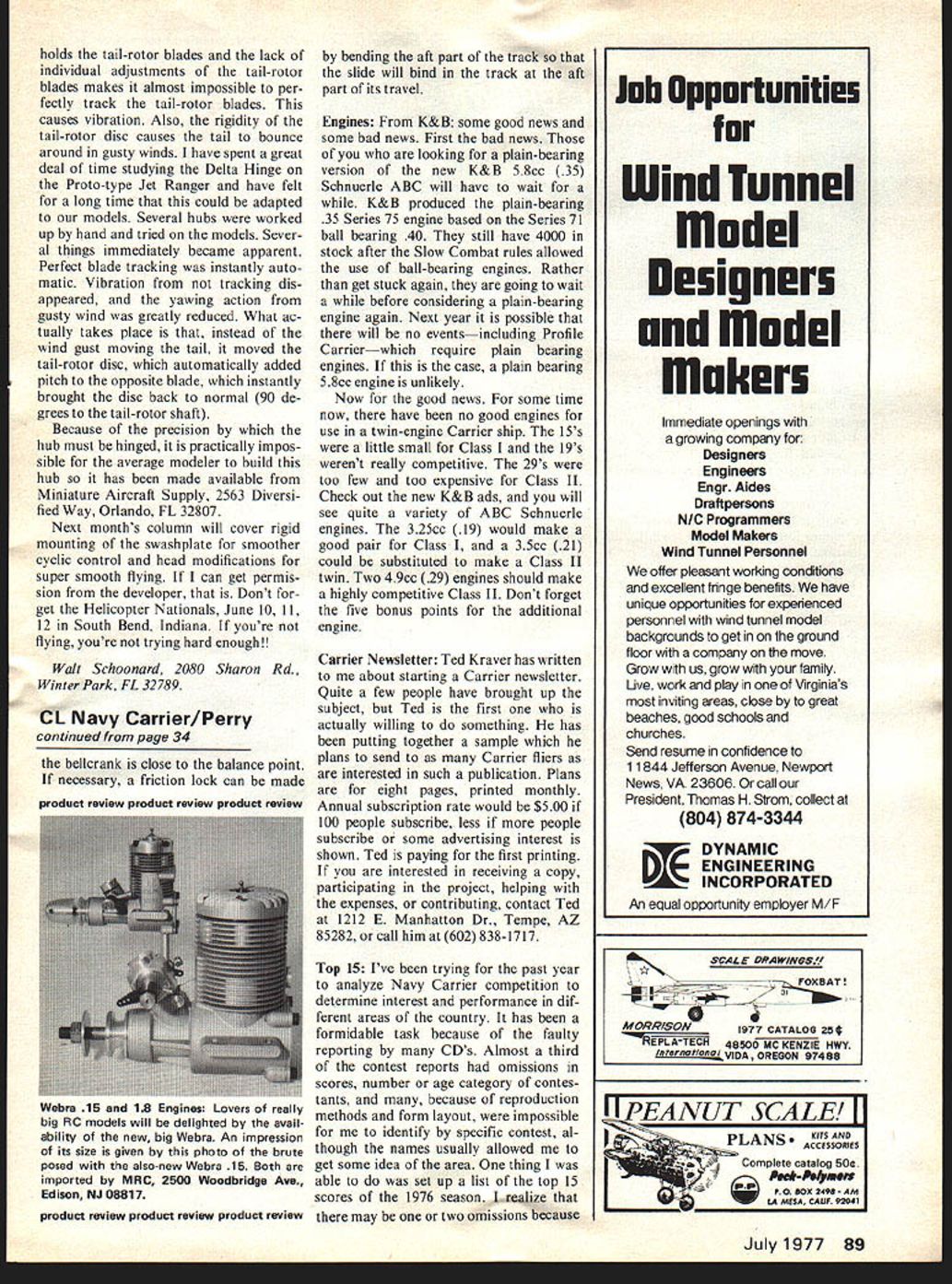
Variable Line Sweep: The ability to vary leadout position in flight offers some performance advantages in the Carrier events, and such features are becoming more common, particularly in the Profile class. The advantage is that leadouts can be moved aft during slow flight, thus increasing yaw toward the outside of the circle. The outboard yaw allows the engine to provide some additional line tension, permitting safe slow flight at lower speeds or in higher wind conditions than normally possible. High-speed line position can be adjusted without consideration of low-speed handling qualities.
Harry Higley's "Round & Round" column in the April Model Airplane News explained Harry's method of using a wire from the throttle bellcrank to lock the leadout slide plate in the forward position. An alternate method is to use a wire pin which is inserted from the outside and pulled out on low engine speed by a cable connected to the throttle line. The latter method can cause some problems if the release cable gets wrapped around the control lines. Both methods prevent the use of idle power on the ground prior to takeoff.
I prefer to use down elevator to release the line sweep mechanism. That way the engine can be run at idle while I go out to the handle. The release wire is run from the forward arm of the elevator bellcrank. The length of the release wire is adjusted so that the leadouts are released by down elevator with the throttle set at low speed.
The easiest and smoothest slide set-up I have used is shown in the accompanying drawing. The plastic tracks are Plastruct 1/8" H sections (H-4) and the slide is 0.050" aluminum.
The slide will move to the rear without springs or other encouragement as long as the bellcrank is mounted behind the balance point of the airplane. There will be no need to lock the slide in the aft position unless the bellcrank is close to the balance point. If necessary, a friction lock can be made by bending the aft part of the track so that the slide will bind in the track at the aft part of its travel.
Engines: From K&B: some good news and some bad news. First the bad news. Those of you who are looking for a plain-bearing version of the new K&B 5.8cc (.35) Schnuerle ABC will have to wait for a while. K&B produced the plain-bearing .35 Series 75 engine based on the Series 71 ball bearing .40. They still have 4000 in stock after the Slow Combat rules allowed the use of ball-bearing engines. Rather than get stuck again, they are going to wait a while before considering a plain-bearing engine again. Next year it is possible that there will be no events — including Profile Carrier — which require plain bearing engines. If this is the case, a plain bearing 5.8cc engine is unlikely.
Now for the good news. For some time now, there have been no good engines for use in a twin-engine Carrier ship. The 15's were a little small for Class I and the 19's weren't really competitive. The 29's were too few and too expensive for Class II. Check out the new K&B ads, and you will see quite a variety of ABC Schnuerle engines. The 3.25cc (.19) would make a good pair for Class I, and a 3.5cc (.21) could be substituted to make a Class II twin. Two 4.9cc (.29) engines should make a highly competitive Class II. Don't forget the five bonus points for the additional engine.
Carrier Newsletter: Ted Kraver has written to me about starting a Carrier newsletter. Quite a few people have brought up the subject, but Ted is the first one who is actually willing to do something. He has been putting together a sample which he plans to send to as many Carrier fliers as are interested in such a publication. Plans are for eight pages, printed monthly. Annual subscription rate would be $5.00 if 100 people subscribe, less if more people subscribe or some advertising interest is shown. Ted is paying for the first printing. If you are interested in receiving a copy, participating in the project, helping with the expenses, or contributing, contact Ted at 1212 E. Manhattan Dr., Tempe, AZ 85282, or call him at (602) 838-1717.
Top 15: I've been trying for the past year to analyze Navy Carrier competition to determine interest and performance in different areas of the country. It has been a formidable task because of the faulty reporting by many CD's. Almost a third of the contest reports had omissions in scores, number or age category of contestants, and many, because of reproduction methods and form layout, were impossible for me to identify by specific contest, although the names usually allowed me to get some idea of the area. One thing I was able to do was set up a list of the top 15 scores of the 1976 season. I realize that there may be one or two omissions because of late reporting but the list is fairly accurate. Here are the top 15 Navy Carrier scores for 1976.
NAVY CARRIER TOP 15 — 1976 PROFILE
CLASS I
- 2706 - D. Wallick
- 2550 - D. Wallick
- 2544 - R. Davis
- 2534 - D. Wallick
- 2487 - R. Perry
- 2473 - C. Aloise
- 2437 - R. Aloise
- 2390 - H. Higley
- 2388 - D. Wallick
- 2379 - R. Aloise
- 2359 - C. Aloise
- 2349 - G. Voitek
- 2348 - R. Perry
- 2344 - D. Wallick
- 2328 - T. Naccarato
CLASS II
- 3810 - D. Wallick
- 3723 - D. Wallick
- 3720 - M. Dombrowski
- 3713 - M. Dombrowski
- 3704 - R. Perry
- 3674 - D. Wallick
- 3627 - D. Wallick
- 3623 - D. Wallick
- 3591 - T. Tagleafarri
- 3581 - M. Dombrowski
- 3546 - G. Dombrowski
- 3531 - G. Dombrowski
- 3530 - D. Wallick
- 3525 - R. Saitta
- 3521 - L. Ryktarsyk
some reports had no scores, but this should still give an idea of who are the top dogs. If your name should be on the list but isn't, don't blame me; talk to the CD who didn't report your score!
It is particularly encouraging to see Junior and Senior modelers in the list. Richard Aloise (Jr.), and Gary Dombrowski (Sr.) are right in there with the older modelers and deserve a real pat on the back for their performance. Had each list been five names longer, Otto Graf (Sr.), Louis Matusik, and Robert Dombrowski (Jr.) also would have been included.
If these scores seem out of reach to some of you, don't despair. There are a lot of first-place scores that did not make the list, just as there are a few second- and third-place scores on the list. It takes excellent flight conditions as well as good equipment and skill to set a record or make a list such as this. The pressure of competition in one area will tend to produce higher scores than in an area where competition is more informal or where an event is relatively new. Work and experience are the foundation upon which consistent, winning performance is built.
Richard L. Perry, 5016 Angelita Ave., Dayton, OH 45424.
Transcribed from original scans by AI. Minor OCR errors may remain.

