
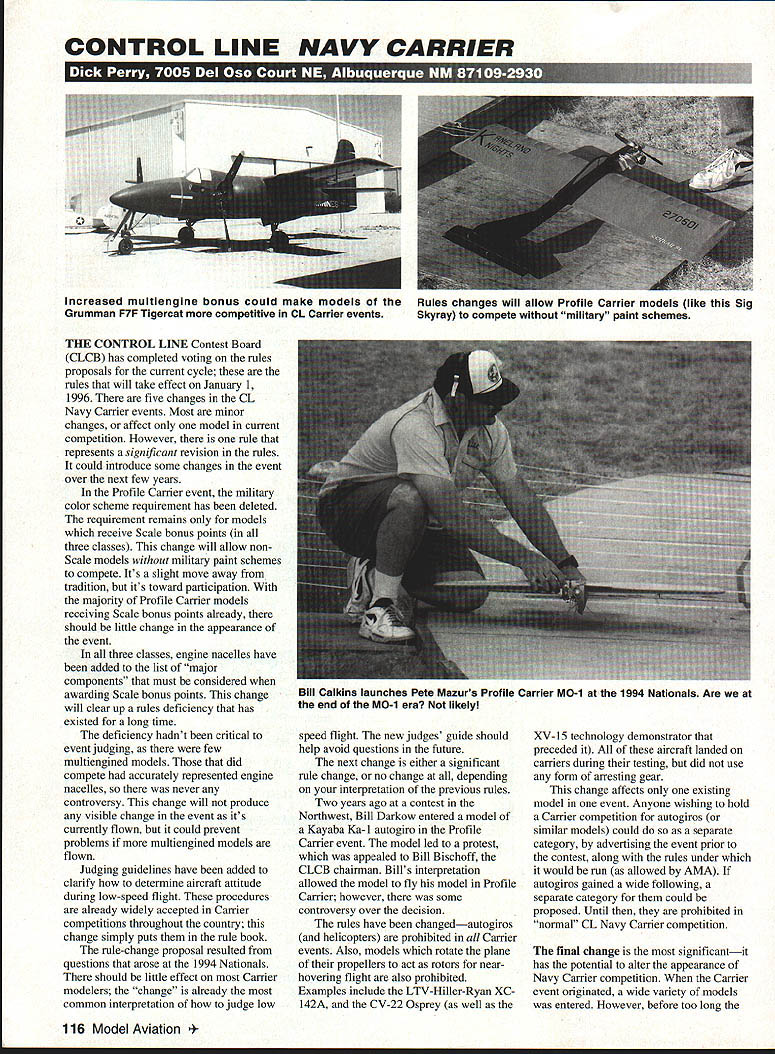
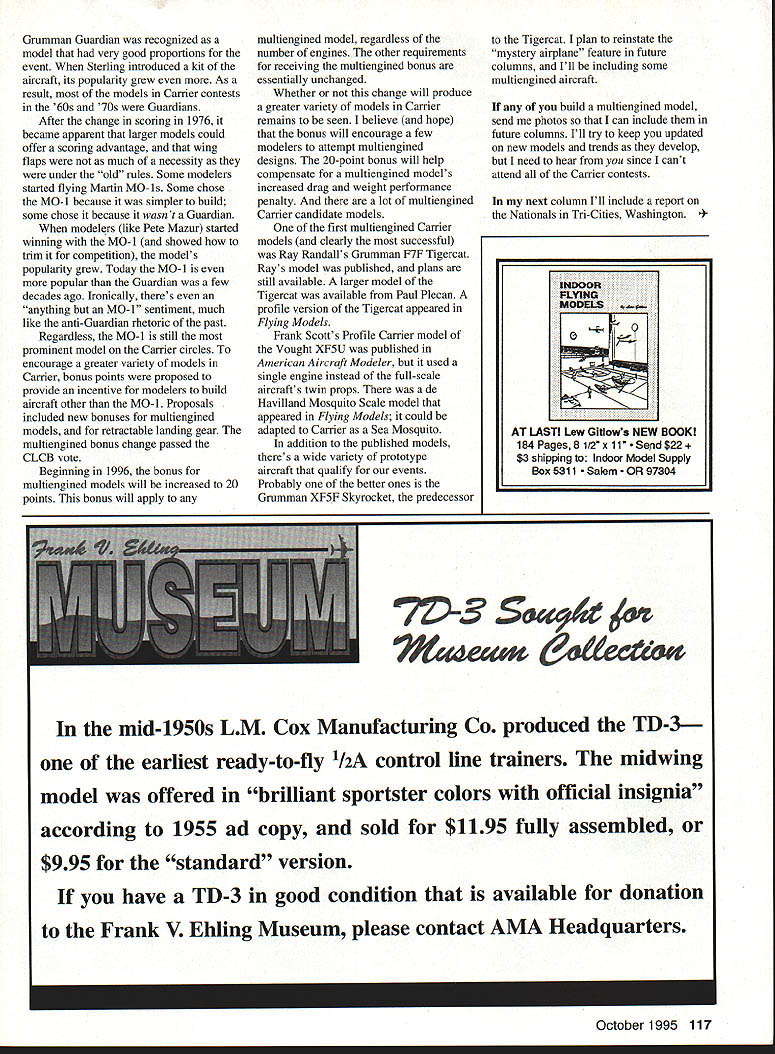
Control Line: Navy Carrier
By Dick Perry, 7005 Del Oso Court NE, Albuquerque NM 87109-2930
The Control Line Contest Board (CLCB) has completed voting on rules proposals for the current cycle; these rules will take effect on January 1, 1996. There are five changes in the CL Navy Carrier events. Most are minor or affect only one model in current competition. However, one rule represents a significant revision and could introduce changes in the event over the next few years.
Summary of the five changes
- Profile Carrier military color scheme requirement removed (except for models receiving Scale bonus points).
- The military color requirement remains only for models that receive Scale bonus points in all three classes. This allows non-scale models without military paint schemes to compete. Since the majority of Profile Carrier models already receive Scale bonuses, little change in appearance is expected.
- Engine nacelles added to list of "major components" for Scale bonus consideration.
- This corrects a longstanding rules deficiency and clarifies judging for multi-engined models. There were few multi-engined entries previously and no controversy, but the rule prevents future problems if more such models appear.
- Judging guidelines added for determining aircraft attitude during low-speed flight.
- These procedures are already widely accepted in Carrier competitions nationwide; the rule change documents them in the rule book. The proposal resulted from questions at the 1994 Nationals and should have little effect on most Carrier modelers, as it formalizes common practice.
- Autogiros, helicopters, and models that rotate propeller planes to act as rotors for near-hovering flight are prohibited in all Carrier events.
- Examples include the Kayaba Ka-1 autogiro, the LTV-Hiller-Ryan XC-142A, the CV-22 Osprey, and the XV-15 technology demonstrator. Although some of these aircraft landed on carriers during testing, they did not use arresting gear. This change affects only one existing model in the event. Organizers may run a separate category for autogiros or similar models if advertised prior to the contest and run under AMA-allowed rules. If autogiros gain popularity, a separate category could be proposed.
- Multiengined bonus increased to 20 points.
- To encourage variety and compensate for added drag and weight penalties of multi-engined designs, the bonus for multi-engined models will be increased to 20 points beginning in 1996. The bonus applies regardless of the number of engines. Other requirements for receiving the bonus are essentially unchanged.
Autogiros and rotorcraft
Two years ago, a Kayaba Ka-1 autogiro was entered in Profile Carrier, which led to a protest and appeal. The new rule explicitly prohibits autogiros and helicopters, and also forbids airplanes that rotate their propeller planes to act as rotors for near-hovering flight. Contest directors may run separate events for such craft if they so choose and provide advance notice and rules.
Multiengined bonus: background and intent
When Carrier competition began, a variety of models were entered. Over time the Grumman Guardian became popular; Sterling produced a kit and Guardians dominated contests in the 1960s and ’70s. After the 1976 scoring change, larger models (e.g., the Martin MO-1) gained a scoring advantage and became popular in turn. To encourage greater variety, a proposal to increase bonuses for multi-engined models passed. The 20-point bonus is intended to incentivize modelers to try multi-engined Carrier designs and to offset their performance penalties.
Examples and candidate designs
There are several published and prototype multi-engined models that could be adapted for Carrier events:
- Ray Randall’s Grumman F7F Tigercat (plans published; larger version by Paul Plecan).
- A profile Tigercat that appeared in Flying Models.
- Frank Scott’s profile Vought XF5U (published in American Aircraft Modeler) — note his version used a single engine instead of the full-scale twin props.
- A de Havilland Mosquito Scale model (appeared in Flying Models) that could be adapted as a Sea Mosquito.
- Grumman XF5F Skyrocket — a good prototype candidate and predecessor to the Tigercat.
I plan to reinstate the "mystery airplane" feature in future columns and will include some multi-engined aircraft.
Call for submissions
If you build a multi-engined model, please send photos so I can include them in future columns. I’ll try to keep readers updated on new models and trends, but I need input since I can’t attend all Carrier contests.
Next column
My next column will include a report on the Nationals in Tri-Cities, Washington.
Transcribed from original scans by AI. Minor OCR errors may remain.

