
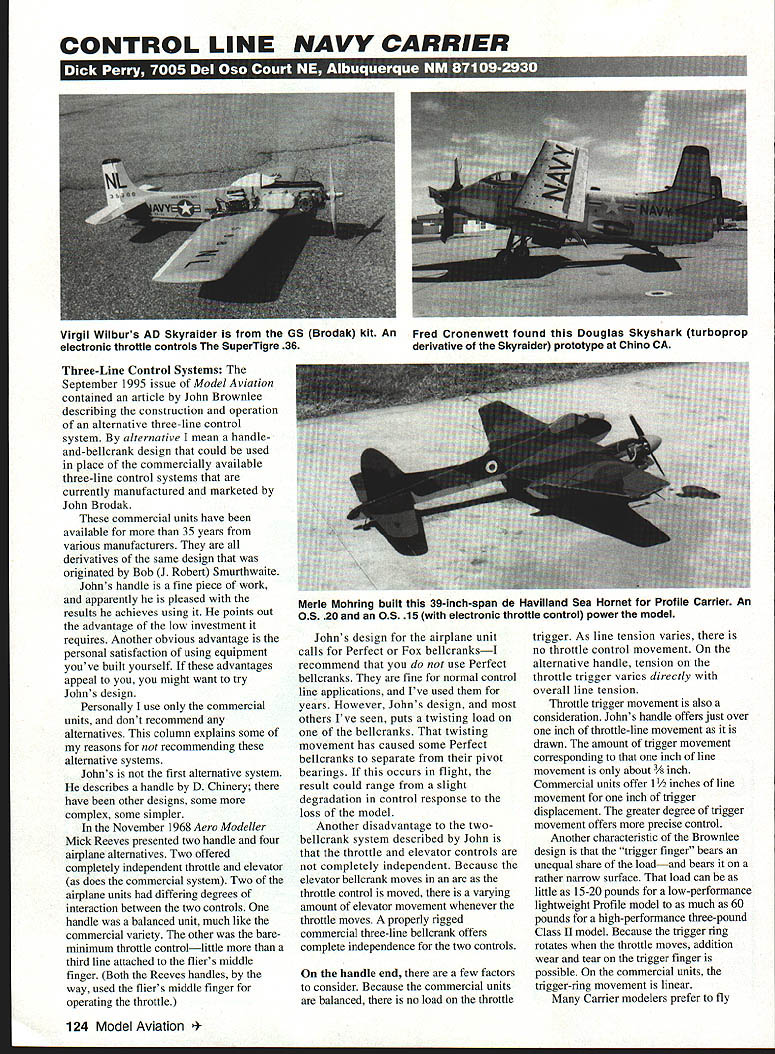
CONTROL LINE: NAVY CARRIER
Dick Perry 7005 Del Oso Court NE, Albuquerque, NM 87109-2930
Three-Line Control Systems
The September 1995 issue of Model Aviation contained an article by John Brownlee describing the construction and operation of an alternative three-line control system. By "alternative" I mean a handle-and-bellcrank design that could be used in place of the commercially available three-line control systems currently manufactured and marketed by John Brodak.
These commercial units have been available for more than 35 years from various manufacturers. They are all derivatives of the same design originated by Bob (J. Robert) Smurthwaite.
John's handle is a fine piece of work, and he is apparently pleased with the results he achieves using it. He points out the advantage of the low investment it requires. Another obvious advantage is the personal satisfaction of using equipment you've built yourself. If those advantages appeal to you, you might want to try John's design.
Personally, I use only the commercial units and do not recommend any alternatives. This column explains some of my reasons for not recommending these alternative systems.
John's is not the first alternative system. He describes a handle by D. Chinery; there have been other designs, some more complex, some simpler. In the November 1968 Aero Modeller Mick Reeves presented two-handle and four-airplane alternatives. Two offered completely independent throttle and elevator (as does the commercial system). Two of the airplane units had differing degrees of interaction between the two controls. One handle was a balanced unit, much like the commercial variety. The other was the bare-minimum throttle control—little more than a third line attached to the flier's middle finger. (Both the Reeves handles, by the way, used the flier's middle finger for operating the throttle.)
John's design for the airplane unit calls for Perfect or Fox bellcranks—I recommend that you do not use Perfect bellcranks. They are fine for normal control-line applications, and I've used them for years. However, John's design, and most others I've seen, puts a twisting load on one of the bellcranks. That twisting movement has caused some Perfect bellcranks to separate from their pivot bearings. If this occurs in flight, the result could range from a slight degradation in control response to the loss of the model.
Another disadvantage to the two-bellcrank system described by John is that the throttle and elevator controls are not completely independent. Because the elevator bellcrank moves in an arc as the throttle control is moved, there is a varying amount of elevator movement whenever the throttle moves. A properly rigged commercial three-line bellcrank offers complete independence for the two controls.
On the handle end, there are a few factors to consider. Because the commercial units are balanced, there is no load on the throttle trigger as line tension varies. On the alternative handle, tension on the throttle trigger varies directly with overall line tension.
Throttle trigger movement is also a consideration. John's handle offers just over an inch of throttle-line movement as drawn; the amount of trigger movement corresponding to that one inch of line movement is about 3/8 inch. Commercial units offer 1-1/2 inches of line movement and 1/2 inch of trigger displacement. The greater degree of trigger movement offers more precise control.
Another characteristic of the Brownlee design is that the "trigger finger" bears an unequal share of the load—and bears it on a rather narrow surface. That load can be as little as 15–20 pounds for a low-performance lightweight profile model to as much as 60 pounds for a high-performance three-pound Class II model. Because the trigger ring rotates when the throttle moves, additional wear and tear on the trigger finger is possible. On the commercial units, the trigger movement is linear.
Some pilots prefer to fly with the throttle trigger aft during the high-speed flight segment. If you elect to use the forward position for high speed, it's possible to rig the handle and airplane unit so the third-line control rests against a stop on the handle during high-speed flight. This configuration relieves the finger from that load—at least until you want to close the throttle.
The potential problem in this case is that the airplane unit can't also be against a stop. If it is, the line loads won't be balanced. In such a case, there is the potential for a pull-test official to rule that the control system only has two lines bearing the load of the model in flight. Such a ruling occurred at a recent Northwest Regionals.
Another point worth mentioning concerns the photos that accompanied John's article. I'm sure the Perfect clips shown in the photos were used only for demonstration, but there are still instances of modelers using the old-style Perfect clips (or similar fishing connectors) as line connectors.
The rules are quite specific about the load-carrying capacity required for line clips, and the old Perfect clips are too weak for anything but the lightest profile models. Single-piece clips (without a separate clasp) are the only commercial clips that are rated strong enough for most Carrier applications. They are available from Perfect and Pylon.
New Rules Cycle
By the time you read this, the Executive Council and the chairmen of the Contest Boards will have met to work out the new schedule and procedures for submitting and approving rules change proposals. The meeting was still a month away as I wrote this column, so watch "Focus on Competition" for details.
Now is the time to consider submitting any rules change proposals you've been thinking of. Take the time to talk them over with your fellow modelers, or submit them to the Hi-Low Landings newsletter to encourage discussion among Navy Carrier Society members. The more thought and discussion that goes into a proposal, the easier it is to present strong arguments in favor of adopting it, and the more likely it is to pass.
Roland Baltes Memorial
The second annual Roland Baltes Memorial Carrier Contest will be held in March at Whittier Narrows, California. Check the "Contest Calendar" for the exact date. Contest details can be obtained from:
- Virgil Wilbur, 9984 Cedardale Drive, Santa Fe Springs, CA 90670
- Fred Cronenwett, 7352 Independence Avenue, Apt. 201, Canoga Park, CA 91303
Virgil and Fred are working hard to revive Carrier flying in Southern California. The Whittier Narrows facility is excellent for Carrier flying; there's potential for this to be a fine contest. I hope you'll support them in bringing Carrier back to that part of the country.
Transcribed from original scans by AI. Minor OCR errors may remain.

