
CONTROL LINE NAVY CARRIER
Dick Perry 7005 Del Oso Court NE, Albuquerque, NM 87109-2930
North American PBJ-1H
If you're familiar with U.S. Navy aircraft designations, PBJ-1H breaks down easily: PBJ-1 is a patrol bomber — the Navy designation for the North American B-25 Mitchell. Patrol bombers were almost exclusively shore-based and generally too large for World War II‑era carrier operations, so the idea of a carrier-based B-25 seems unlikely at first glance.
Many will recall the Doolittle Raid of 1942 when B-25s took off from the carrier Hornet, but that mission involved catapult launches and no carrier landings, so it did not qualify the type for carrier service. The Navy purchased 706 B-25s in five variants and used them as shore-based patrol bombers; none saw regular carrier service.
In 1944 the Navy acquired B-25H serial 43-4700 (BuAer 35277) from the Army, modified it for catapult launching and arrested landings at the Naval Air Material Center in Philadelphia, and conducted qualifications aboard USS Shangri-La on November 15, 1944. On that busy day the Navy also qualified the new Grumman F7F Tigercat and a carrier-modified P-51D. The carrier‑qualified Mitchell received the Navy designation PBJ-1H.
Carrier Hardware
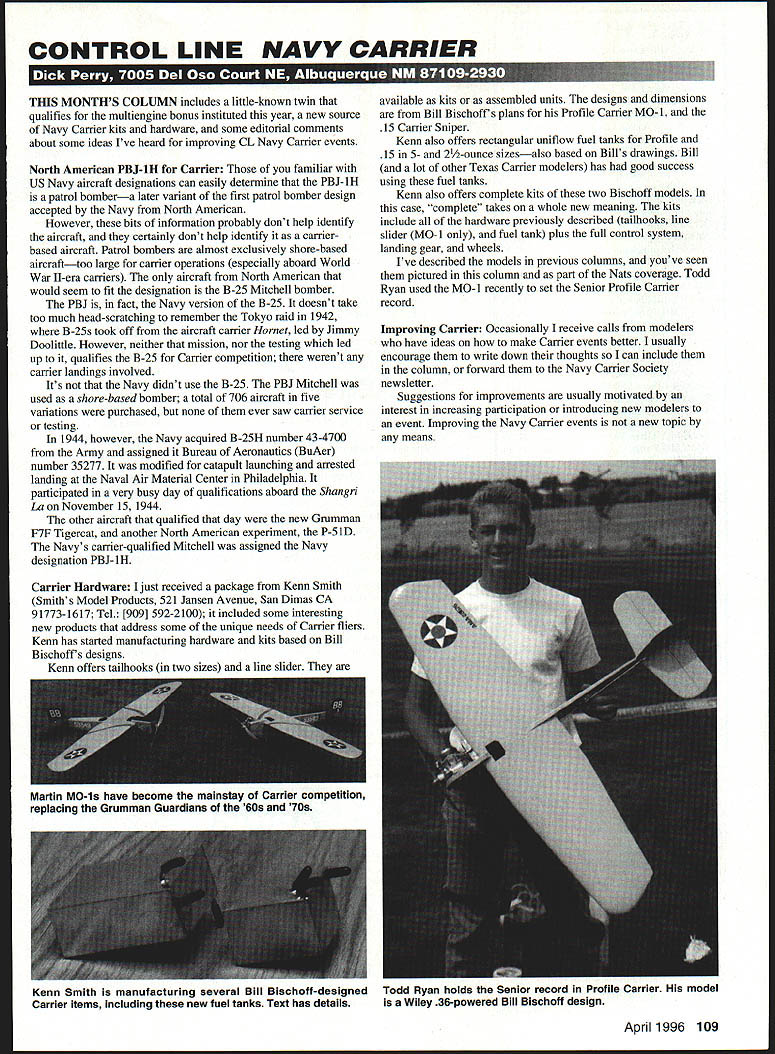
I recently received a package from Kenn Smith, Smith's Model Products, 521 Jansen Avenue, San Dimas, CA 91773-1617; Tel: (909) 592-2100. Kenn has started manufacturing hardware and kits based on Bill Bischoff's designs that address several unique needs of Carrier fliers.
- Tailhooks in two sizes (kits or assembled units).
- Line slider (available for MO-1; kits or assembled units).
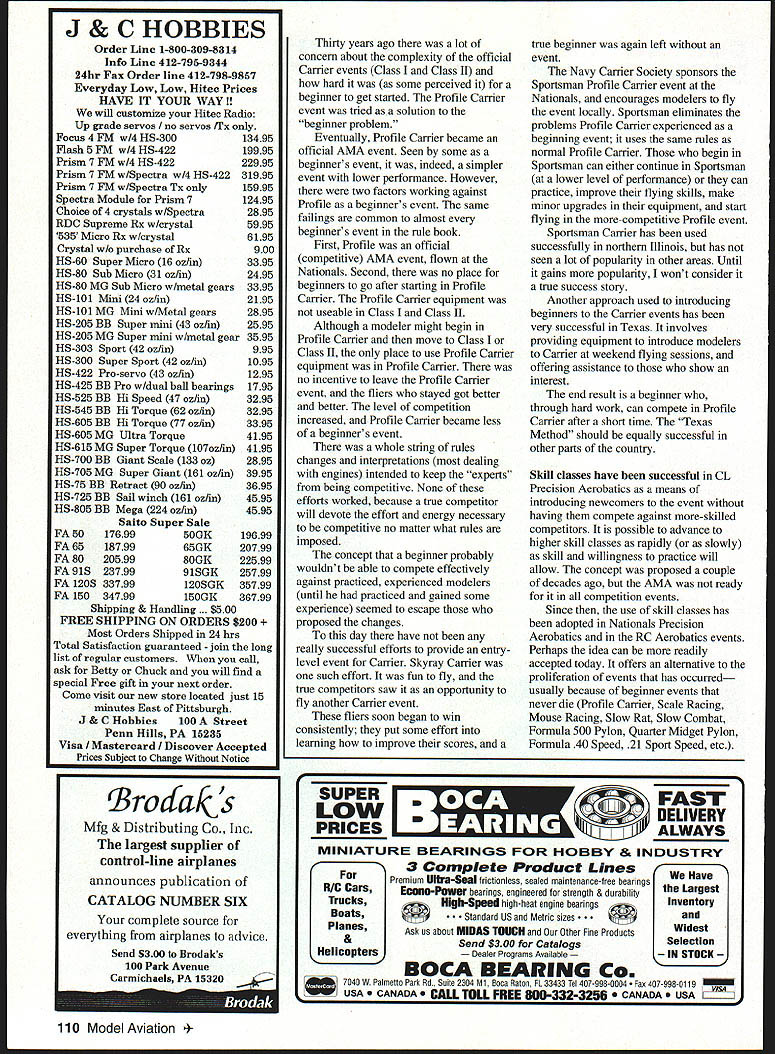
- Rectangular uniflow fuel tanks for Profile and .15 Carrier in 5- and 2-1/2-ounce sizes, based on Bill Bischoff's drawings.
- Complete kits of two Bischoff models (Profile Carrier MO-1 and .15 Carrier Sniper). These "complete" kits include the tailhooks, line slider (MO-1 only), fuel tank, full control system, landing gear, and wheels.
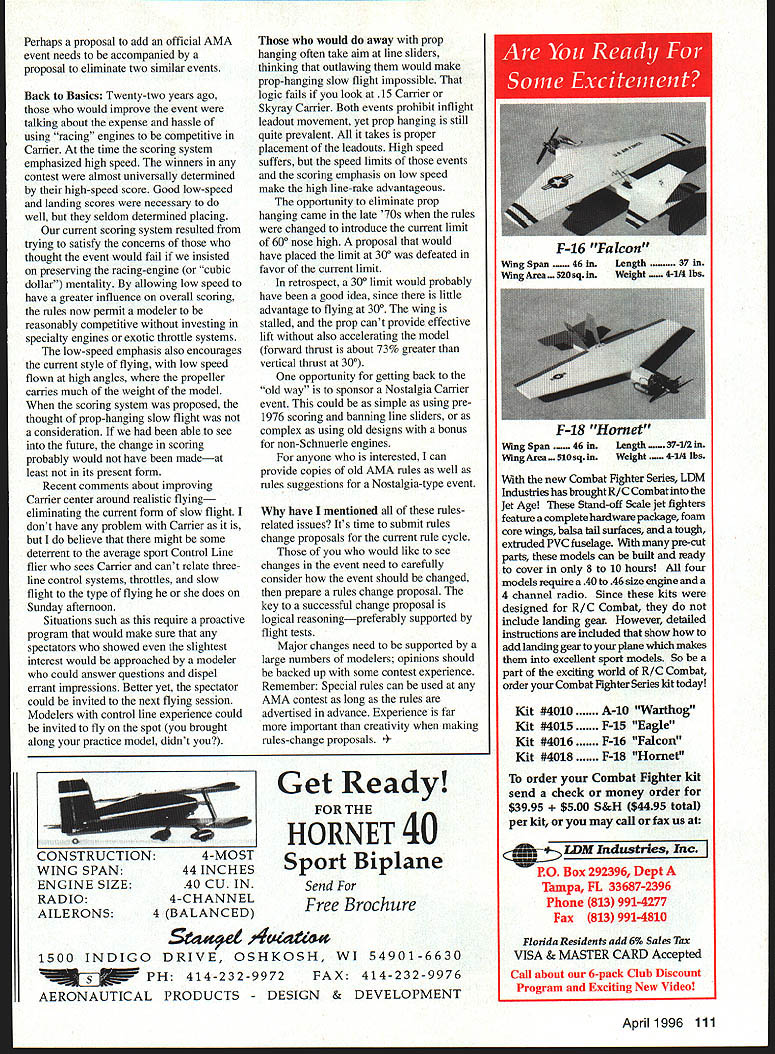
Bill Bischoff's plans have been widely used with good success by Texas Carrier modelers. I've described the models in earlier columns and they've appeared in Nationals coverage. Todd Ryan recently used an MO-1 to set the Senior Profile Carrier record.
Improving Carrier
Occasionally I receive calls and letters from modelers with ideas to improve Carrier events. Suggestions typically aim to increase participation or introduce new modelers. Below are issues, approaches that have been tried, and some suggestions for moving forward.
Beginner events and Profile Carrier
Thirty years ago there was concern that the official Carrier events (Class I and Class II) were too complex for beginners. Profile Carrier was introduced as a simpler, lower-performance alternative and eventually became an official AMA event. Two factors undermined its role as a beginner entry point:
- Profile Carrier was a national, competitive AMA event flown at the Nationals, attracting serious competitors.
- Profile equipment was not usable in Class I or Class II, so there was no natural progression for participants.
As a result, participants who started in Profile often stayed and became increasingly competitive, driving up the event's performance level and making it less suitable as an entry-level class. Rule changes aimed at keeping experts out (mostly involving engine restrictions) ultimately failed because dedicated competitors adapt to rules.
Skyray Carrier and other beginner-focused events suffered similarly: they were fun at first, but experienced fliers soon dominated. The Navy Carrier Society later sponsored Sportsman Profile Carrier at the Nationals and encouraged local use. Sportsman Profile carries the same rules as standard Profile but provides a lower-performance class that beginners can remain in or use as a stepping stone to Profile. Sportsman has seen success in northern Illinois but has not gained broad popularity.
Successful local approaches
A very successful approach in Texas has been to supply equipment to newcomers and send experienced fliers to help them. With hands-on assistance and available gear, beginners have been able to reach competitive Profile Carrier performance quickly. This "Texas Method" could work well elsewhere.
Skill classes have worked in CL Precision Aerobatics and have been adopted in Nationals Precision Aerobatics and RC Aerobatics. Skill classes let newcomers compete without facing top-tier competitors and allow advancement based on ability and practice. This concept might be more acceptable now than in the past and offers an alternative to proliferating new events that rarely catch on.
Back to basics — scoring and slow flight
Twenty-two years ago much of the debate centered on the expense and hassle of using racing engines to be competitive. At that time scoring emphasized high speed, and winners were typically those with the highest speed scores. To address concerns, the scoring system was changed to give low speed a greater influence on overall results, allowing modelers to be competitive without specialty racing engines and encouraging a low-speed flying style where the prop provides significant lift.
An unintended consequence has been widespread prop-hanging slow flight. If the scoring had sought to avoid that style, different limits might have been set. For example, a 30° nose-high limit (proposed in the late '70s but defeated in favor of the current 60° limit) would have reduced the advantage of prop hanging; at 30° the wing is stalled and the prop cannot provide effective vertical lift without forward acceleration.
Some propose banning line sliders to eliminate prop hanging. That rarely works: even events that prohibit in-flight leadout movement (like .15 Carrier or Skyway Carrier) still see prop hanging when leadouts are positioned advantageously. High speed suffers, but scoring systems that favor low speed make high line rake beneficial.
Nostalgia Carrier and other options
One way to encourage more traditional Carrier flying is to sponsor a Nostalgia Carrier event. Options include:
- Using pre-1976 scoring and banning line sliders.
- Restricting designs to older types, with bonuses for non-Schnerle engines.
- Adopting other historical rule sets and aircraft restrictions.
If anyone is interested, I can provide copies of older AMA rules and suggested rules for a Nostalgia event.
Rules changes — practical advice
It's time to prepare rules-change proposals for the current cycle. If you want changes, carefully consider how to change the event and prepare a proposal supported by logical reasoning and, ideally, flight tests. Major changes need broad support and contest experience to be persuasive.
Remember: special rules can be used at any AMA contest so long as they are advertised in advance. Practical experience is more important than creative ideas when proposing rule changes.
Closing note
Kenn Smith's manufacturing of Bischoff-designed hardware and kits is timely. The availability of ready-made tailhooks, sliders, fuel tanks, and complete kits lowers the barrier to entry and supports both beginners and existing competitors.
Transcribed from original scans by AI. Minor OCR errors may remain.

