
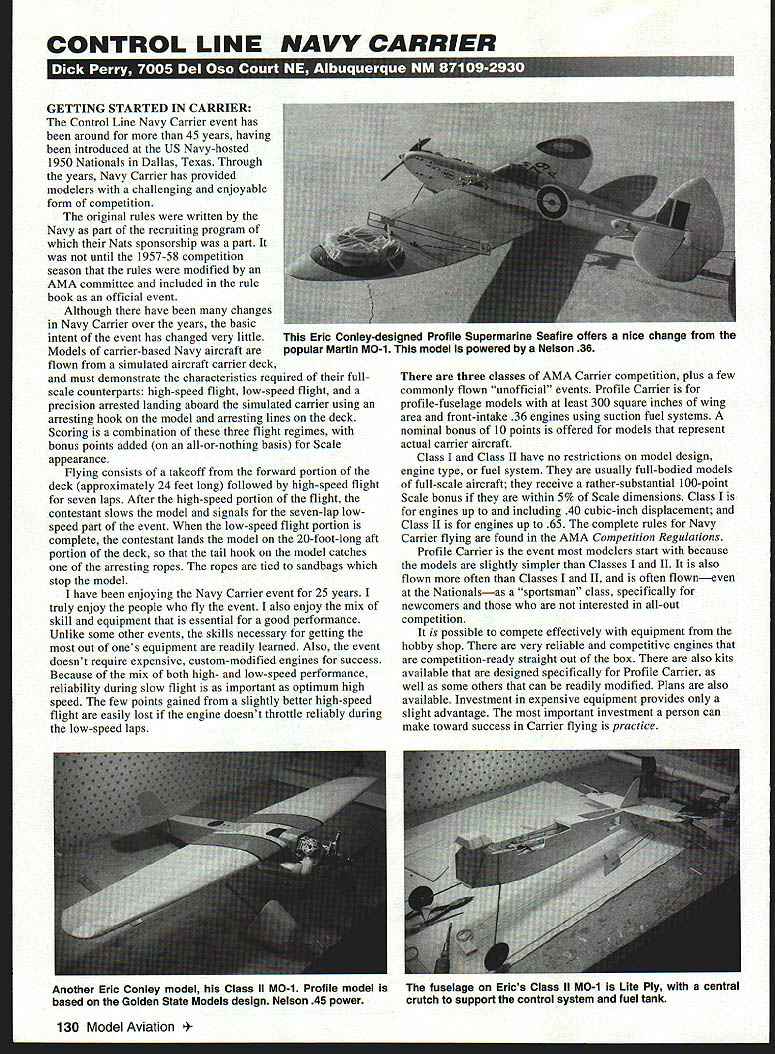
CONTROL LINE NAVY CARRIER
Dick Perry 7005 Del Oso Court NE Albuquerque, NM 87109-2930
Getting Started in Carrier
The Control Line Navy Carrier event has been around for more than 45 years, having been introduced at the US Navy–hosted 1950 Nationals in Dallas, Texas. Through the years, Navy Carrier has provided modelers with a challenging and enjoyable form of competition.
The original rules were written by the Navy as part of the recruiting program associated with their Nationals sponsorship. It was not until the 1957–58 competition season that the rules were modified by an AMA committee and included in the rule book as an official event.
Although there have been many changes in Navy Carrier over the years, the basic intent of the event has changed very little. Models of carrier-based Navy aircraft are flown from a simulated aircraft carrier deck, and must demonstrate the characteristics required of their full-scale counterparts: high-speed flight, low-speed flight, and a precision arrested landing aboard the simulated carrier using an arresting hook on the model and arresting lines on the deck. Scoring is a combination of these three flight regimes, with bonus points added (on an all-or-nothing basis) for scale appearance.
Flight sequence
Flying consists of a takeoff from the forward portion of the deck (approximately 24 feet long) followed by high-speed flight for seven laps. After the high-speed portion of the flight, the contestant slows the model and signals for the seven-lap low-speed part of the event. When the low-speed flight portion is complete, the contestant lands the model on the 20-foot-long aft portion of the deck so that the tail hook on the model catches one of the arresting ropes. The ropes are tied to sandbags which stop the model.
I have been enjoying the Navy Carrier event for 25 years. I truly enjoy the people who fly the event and the mix of skill and equipment that is essential for a good performance. Unlike some other events, the skills necessary for getting the most out of one's equipment are readily learned. Also, the event doesn't require expensive, custom-modified engines for success. Because of the mix of both high- and low-speed performance, reliability during slow flight is as important as optimum high speed. The few points gained from a slightly better high-speed flight are easily lost if the engine doesn't throttle reliably during the low-speed laps.
Classes and events
There are three classes of AMA Carrier competition, plus a few commonly flown "unofficial" events:
- Profile Carrier
- For profile-fuselage models with at least 300 square inches of wing area.
- Uses front-intake .36 engines and suction fuel systems.
- A nominal bonus of 10 points is offered for models that represent actual carrier aircraft.
- This is the event most modelers start with because the models are slightly simpler and it is flown more often. It is often used as a "sportsman" class for newcomers and casual flyers.
- Class I
- No restrictions on model design, engine type, or fuel system.
- Usually full-bodied models of full-scale aircraft.
- Engines up to and including .40 cubic-inch displacement.
- Receive a substantial 100-point scale bonus if within 5% of scale dimensions.
- Class II
- Same as Class I but for engines up to .65 cubic-inch displacement.
The complete rules for Navy Carrier flying are found in the AMA Competition Regulations.
Equipment and practice
It is possible to compete effectively with equipment from the hobby shop. There are very reliable and competitive engines that are competition-ready straight out of the box. Kits designed specifically for Profile Carrier are available, and some other kits can be readily modified. Plans are also available. Investment in expensive equipment provides only a slight advantage; the most important investment a person can make toward success in Carrier flying is practice.
There are few secrets to success. The most successful (and plentiful) design, the Martin MO-1, is well understood, and the techniques for trimming it are widely discussed. Engine speed control may seem complex to those who have not tried it, but today's RC engines are easy to use and adjust. The three-line control mechanism that operates the throttle as well as the elevators is available commercially and is easy to install and use.
Class I and II scale events allow pressurized fuel systems, but ordinary RC engines using suction fuel tanks can compete effectively—especially in local competition. For a little additional power without much added complexity, commercially available pump systems are readily adaptable to the event. Currently there aren't many kits directly suited to Class I or Class II competition; however, two Profile MO-1 kits can be readily converted to full-fuselage models for the scale events.
I've often written about the growth of Carrier modeling in Texas. That success is the result of a few modelers taking their models to normal weekend flying sessions and letting people try them out. Once you've tried throttle flying, it's hard to go back to two-line flying.
Although having a mentor to help you get started can make the process a little easier, there are plenty of Carrier modelers who have been successful simply by reading articles on the event and corresponding with experienced Carrier modelers. It is easy to duplicate the equipment the successful modelers use; the only other ingredient for success is practice.
Flying as part of a team of Carrier modelers is a great way to get started; practice is more fun when it is shared. Working with a familiar teammate can be a help at contests. The events are designed so that an individual can compete very effectively. Rather than being tied to a rigid schedule of heats or rounds, a contestant can usually set his own schedule at a contest, making Navy Carrier competition more relaxing and enabling participation in other events as well.
Community and resources
The AMA's Special Interest Group for Navy Carrier flying is the Navy Carrier Society. Their publication, Hit Low Landings, is a good source of information and contacts. Membership can be obtained by sending $6 to:
Bill Bischoff 3734 Truesdell Dallas, TX 75244 Phone: (214) 247-5046
I will provide a listing of potential sources of supplies, kits, engines, and hardware to anyone who sends me a self-addressed, stamped envelope.
Navy Carrier flying is a great way to enjoy control line modeling. Once you try it, you'll be "hooked."
Transcribed from original scans by AI. Minor OCR errors may remain.

