
CONTROL LINE: NAVY CARRIER
Dick Perry 7005 Del Oso Court NE, Albuquerque, NM 87109-2930
F7F Tigercat
By the time you read this month's column, John Brodak will have completed work on his newest model, the Grumman F7F Tigercat, and it should be available direct from Brodak Manufacturing and Distribution Co., 100 Park Ave., Carmichaels, PA 15320.
The model was envisioned by Bob (J. Robert) Smurthwaite when he designed the F4U Corsair, F8F Bearcat, and AD Skyraider kits. These kits are also being manufactured by Brodak. The Tigercat kit did not reach production before Bob encountered health problems and sold his control-line kit production to John Brodak.
John is manufacturing the Corsair, Bearcat, and Skyraider kits as they were originally designed by Bob. The Tigercat, however, has been modified to use more-conventional construction techniques and has been expanded with a larger wing area so it will be better suited to the current style of Carrier flying (as well as other events). The model also has a fully symmetrical airfoil, whereas the other models have cambered sections intended solely for Carrier or Profile Scale.
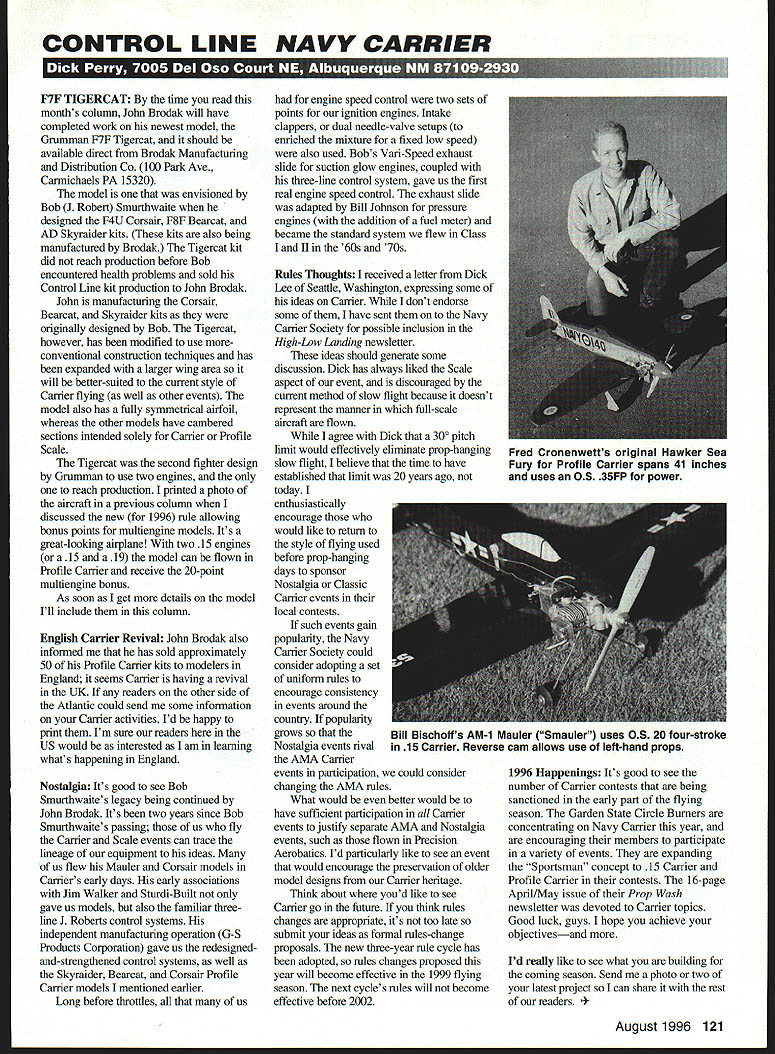
The Tigercat was the second Grumman fighter design to use two engines, and the only one to reach production. I printed a photo of the aircraft in a previous column when I discussed the new (for 1996) rule allowing bonus points for multiengine models. It's a great-looking airplane! With two .15 engines (or a .15 and a .19) the model can be flown in Profile Carrier and receive the 20-point multiengine bonus.
As soon as I get more details on the model I'll include them in this column.
English Carrier Revival
John Brodak also informed me that he has sold approximately 50 of his Profile Carrier kits to modelers in England; it seems Carrier is having a revival in the U.K. If any readers on the other side of the Atlantic can send me information on your Carrier activities, I'd be happy to print it. I'm sure our readers in the U.S. would be as interested as I am in learning what's happening in England.
Nostalgia
It's good to see Bob Smurthwaite's legacy being continued by John Brodak. It's been two years since Bob Smurthwaite's passing; those of us who fly the Carrier and Scale events can trace the lineage of our equipment to his ideas. Many of us flew his Mauler and Corsair models in Carrier's early days. His early associations with Jim Walker and Sturdi-Built not only gave us models, but also the familiar three-line J. Roberts control systems. His independent manufacturing operation (U-S Products Corporation) gave us the redesigned-and-strengthened control systems, as well as the Skyraider, Bearcat, and Corsair Profile Carrier models I mentioned earlier.
Long before throttles, many of us had only two sets of ignition points for engine speed control. Intake clappers, or dual needle-valve setups (to enrich the mixture for a fixed low speed), were also used. Bob's Vari-Speed exhaust slide for suction-glow engines, coupled with his three-line control system, gave us the first real engine speed control. The exhaust slide was adapted by Bill Johnson for pressure engines (with the addition of a fuel meter) and became the standard system we flew in Class I and II in the '60s and '70s.
Rules Thoughts
I received a letter from Dick Lee of Seattle, Washington, expressing some of his ideas on Carrier. While I don't endorse all of them, I have sent them on to the Navy Carrier Society for possible inclusion in the High‑Low Landing newsletter. These ideas should generate some discussion.
Dick has always liked the scale aspect of our event and is discouraged by the current method of slow flight because it doesn't represent the manner in which full-scale aircraft are flown. While I agree with Dick that a 30° pitch limit would effectively eliminate prop-hanging slow flight, I believe the time to have established that limit was 20 years ago, not today. I enthusiastically encourage those who would like to return to the style of flying used before prop‑hanging days to sponsor Nostalgia or Classic Carrier events in their local contests.
If such events gain popularity, the Navy Carrier Society could consider adopting a set of uniform rules to encourage consistency in events around the country. If popularity grows so that the Nostalgia events rival the AMA Carrier events in participation, we could consider changing the AMA rules.
What would be even better would be to have sufficient participation in all Carrier events to justify separate AMA and Nostalgia events, such as those flown in Precision Aerobatics. I'd particularly like to see an event that would encourage the preservation of older model designs from our Carrier heritage.
- Think about where you'd like to see Carrier go in the future.
- If you think rules changes are appropriate, submit your ideas as formal rules-change proposals.
- Note: the new three-year rule cycle has been adopted, so rules changes proposed this year will become effective in the 1999 flying season. The next cycle's rules will not become effective before 2002.
1996 Happenings
It's good to see the number of Carrier contests being sanctioned in the early part of the flying season. The Garden State Circle Burners are concentrating on Navy Carrier this year and are encouraging their members to participate in a variety of events. They are expanding the "Sportsman" concept to .15 Carrier and Profile Carrier in their contests. The 16-page April/May issue of their Prop Wash newsletter was devoted to Carrier topics. Good luck, guys — I hope you have great success and achieve your objectives, and more.
I'd really like to see what you are building for the coming season. Send me a photo or two of your latest project so I can share it with the rest of our readers.
Transcribed from original scans by AI. Minor OCR errors may remain.

