
CONTROL LINE NAVY CARRIER
Dick Perry, 7005 Del Oso Court NE, Albuquerque NM 87109-2930
Overview
When one tries to find a word to describe the Control Line Navy Carrier competition, "Great!" is an obvious first choice. "Fantastic!" is still reserved for the meet that matches the two-decks-all-day-long 1976 Dayton Nats (if any meet can match Dayton). The competition in Muncie was exciting, and the camaraderie outstanding.
There were more contestants than in quite a few years, even though some of the East Coast contingent were unable to attend. In all, 22 contestants entered the three official classes, with some additional modelers participating in the unofficial events on Saturday. The event averaged more than 50 flights per day for three days of intense competition, with close scoring and several personal-best performances.
The International Aeromodeling Center at Muncie offers outstanding facilities for model flying, and they will improve as more construction is completed. In a welcomed change from some past Nats, Navy Carrier was situated adjacent to the Combat, Precision Aerobatics, and Scale circles, and a relatively long distance from the Speed and Racing sites. It was a quieter Carrier Nats, particularly during Class I and II on Friday (Jet Speed and D Speed day).
All of the Control Line events were within walking distance for anyone who wanted to visit other events. We even got a good view of the RC Scale models as they flew over us—the result of the layout of the three paved flying areas and their associated parking. This is a situation that will need addressing as the site develops and more facilities are constructed.
The Navy Carrier circle was grass, well situated for spectator and contestant access. The surface was a little rough, but only bothered those who ended their flights off the deck. When permanent locations for grass CL circles are determined, more attention can be devoted to preparing the surfaces and making them top-notch.
Profile Carrier (Thursday)
As has been the tradition for decades, competition started with Profile Carrier on Thursday. Nineteen contestants flew this year, and many were ready to try the light winds of the early morning. The flight order lottery gave Melvin Schuette the honor of making the first flight off the deck; his flight included a 100-point landing and a 250-point score. Mike Greb followed with his MO-1 and added almost 50 points to the leading score, setting the tone for the competition.
Before the first hour was up, Bill Melton moved Guardian into the lead with a 330 score. His low speed—four minutes 24.9 seconds—was the deciding factor, and his low-speed score would stand for the rest of the day.
There were challenges and the outcome remained uncertain until well after lunch. Highlights and notable competitors:
- Bill Bischoff’s first flight placed his MO-1 third.
- Pete Mazur was one point ahead of Bischoff at that stage.
- Dale Gleason (Valley View, Texas), a relative newcomer to Carrier (started in 1995), brought a very nice fleet of MO-1s and demonstrated excellent flying; his complete flight with a 100-point landing put him in fifth place.
- Bill Calkins’ first flight bettered Dale’s by 10 points and took the last trophy slot.
- Mike Greb suffered mechanical problems: a prop came loose on the left engine and, on his last attempt, a prop nut came loose on the right engine and he lost a carburetor in the takeoff—perhaps due to vibration.
- Gary Hull flew a .05 Dye-powered Kingfisher. His second flight posted a 293 score that would have displaced Calkins; however, Calkins countered with a 302-point flight to move into fourth place ahead of Gary and Mike.
- Marc Warwashana succumbed to variable winds when his engine faltered slightly during low speed on his first flight; on his second flight the winds dropped him toward the water enough to touch the hook and end the flight.
- D.J. Parr competed in the Junior category flying a Sig Skyray.
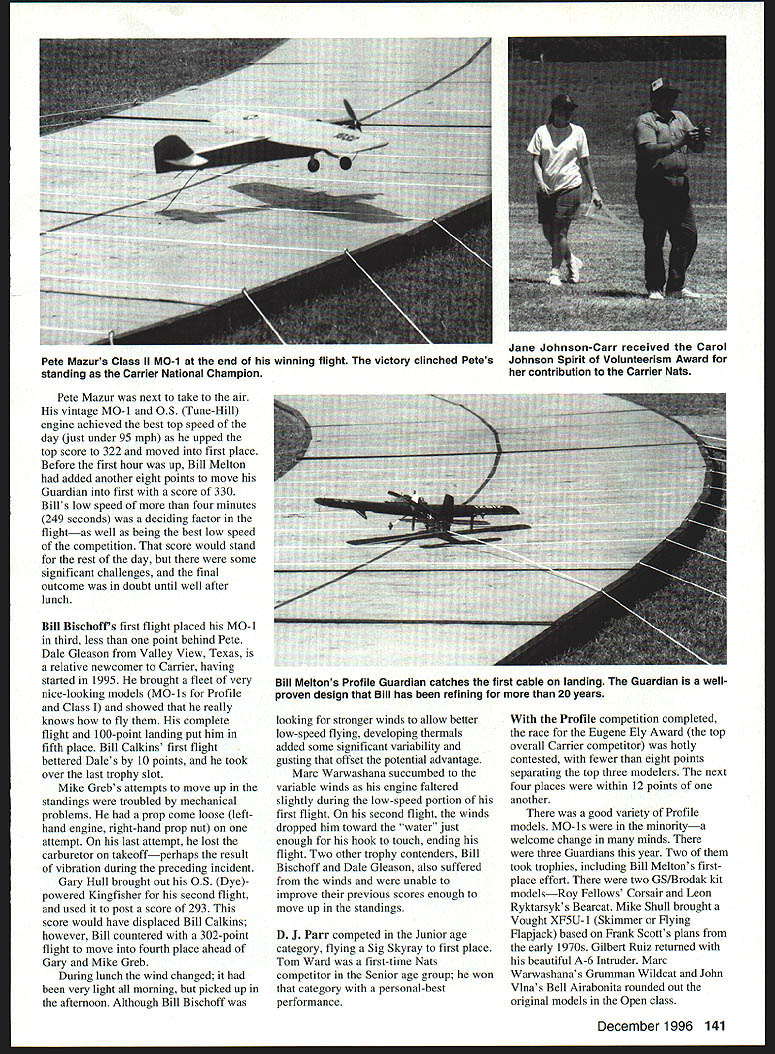
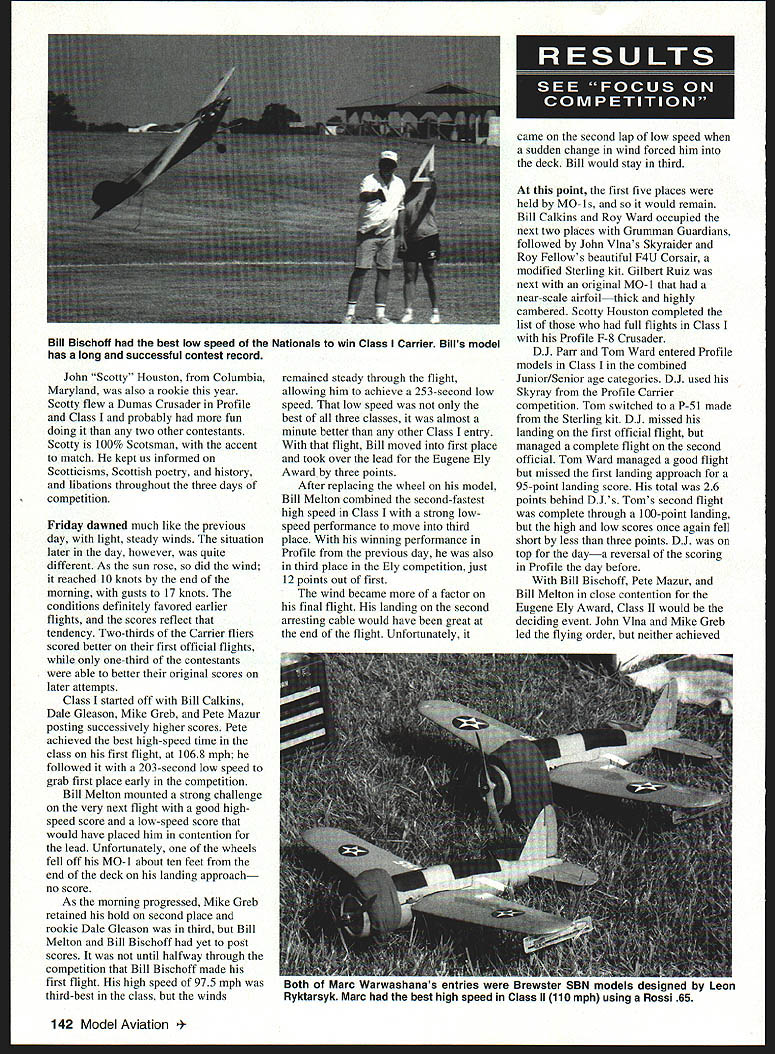
- Tom Ward, a first-time Nats competitor in the Senior category, won his category in Profile Carrier with his MO-1 and achieved a personal best.
With Profile completed, the race for the Eugene Ely Award (top overall Carrier competitor) was hotly contested—fewer than eight points separated the top three modelers, and the next four places were within 12 points of one another.
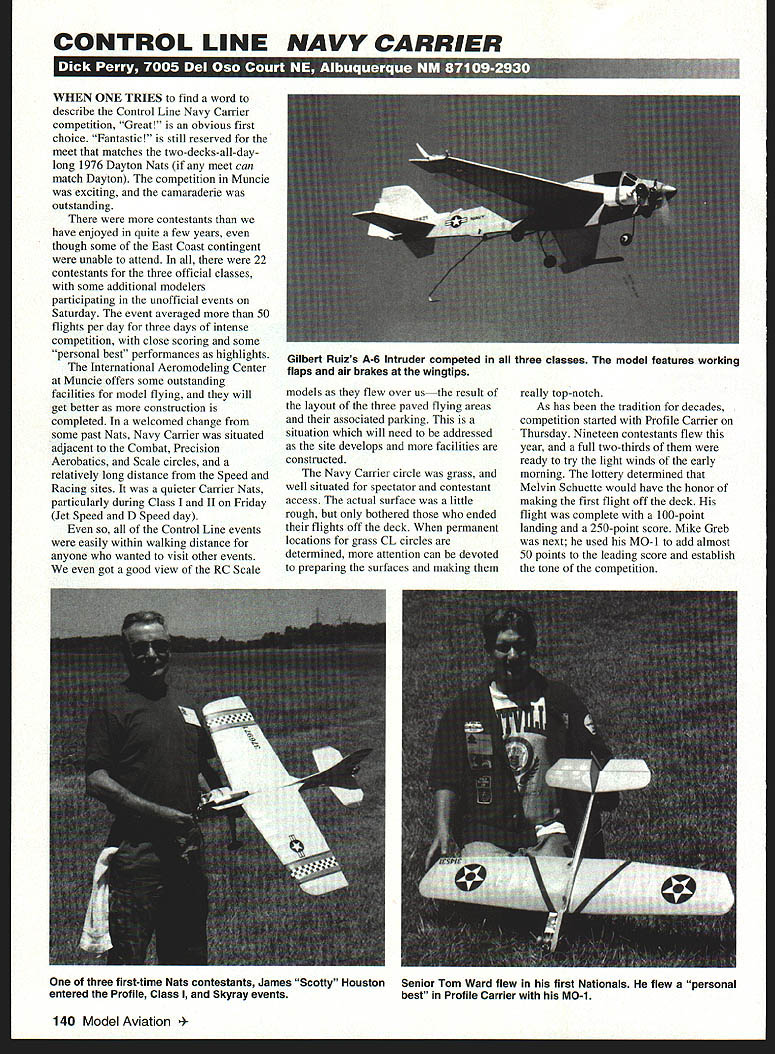
Profile class variety: MO-1s were in the minority (a welcome change). Three Guardians were present (two took trophies, including Bill Melton's first-place). Brodak kit models included Roy Fellows' Corsair and Leon Ryskarsky's Bearcat. Mike Shull brought a Vought XF5U-1 (Skimmer or Flying Flapjack) based on Frank Scott's plans. Gilbert Ruiz returned with a beautiful A-6 Intruder. Marc Warwashana's Grumman Wildcat and John Vilna's Bell Airacobra rounded out the original models in the Open class.
John "Scotty" Houston, from Columbia, Maryland, was a rookie this year. Scotty flew a Dumas Crusader in Profile and Class I and probably had more fun than any two other contestants. He entertained with Scottish anecdotes, poetry, history, and libations throughout the three days.
Class I (Friday)
Friday dawned with light, steady winds, but conditions deteriorated as the day progressed. Winds reached 10 knots by the end of the morning with gusts to 17 knots. Conditions favored earlier flights: two-thirds of Carrier fliers scored better on their first official flights, while only one-third bettered their original scores on later attempts.
Class I unfolded as follows:
- Bill Calkins, Dale Gleason, Mike Greb, and Pete Mazur posted successively higher scores early on. Pete achieved the best high-speed time in the class on his first flight at 106.8 mph and followed it with a 203-second low speed to take an early lead.
- Bill Melton mounted a strong challenge with a good high-speed and a low-speed that would have placed him in contention. Unfortunately, one of his wheels fell off about ten feet from the deck on his landing approach—no score.
- Mike Greb maintained second place while rookie Dale Gleason held third. Bill Melton and Bill Bischoff had yet to post scores.
- Bill Bischoff's first flight (high speed 97.5 mph, third-best in class) produced a 253-second low speed—the best low speed of all three classes and nearly a minute better than any other Class I entry. That flight moved Bill into first in Class I and gave him a three-point lead for the Eugene Ely Award.
- After repairing his wheel, Bill Melton combined the second-fastest high speed in Class I with a strong low-speed to move into third place overall. A sudden wind change on his final flight forced him into the deck on a low-speed lap; he finished third.
- The first five places were held by MO-1s and remained so. Placings included:
- Bill Calkins and Roy Ward with Grumman Guardians
- John Vilna's Skyraider
- Roy Fellows' modified Sterling F4U Corsair
- Gilbert Ruiz with an original MO-1 having a near-scale thick, highly cambered airfoil
- Scotty Houston completed the list of full flights in Class I with his Profile F-8 Crusader.
Junior/Senior combined notes:
- D.J. Parr and Tom Ward entered Profile models in Class I. D.J. used his Skyray from Profile Carrier and missed his first landing but managed a complete second flight. Tom Ward switched to a P-51 from the Sterling kit; his first flight missed the landing for a 95-point landing and finished 2.6 points behind D.J. Tom's second flight was complete with a 100-point landing, but still fell less than three points short. D.J. led for the day—a reversal from Profile.
With Bill Bischoff, Pete Mazur, and Bill Melton in close contention for the Eugene Ely Award, Class II would be decisive.
Class II (Friday)
John Vilna and Mike Greb led the flying order but neither achieved an official flight early on. The first posted score came from Bill Calkins flying his Hawker Sea Fury, which had been repaired and now carried an .61 engine to meet the weight limit.
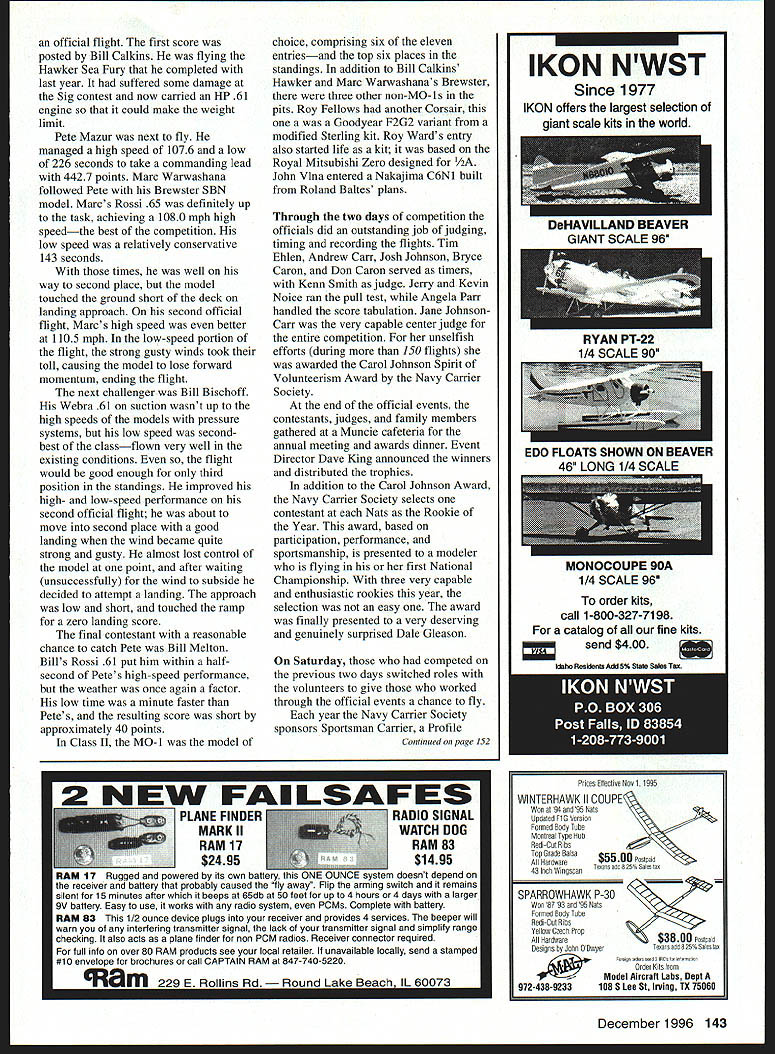
- Pete Mazur posted a high speed of 107.6 mph and a low of 226 seconds to take a commanding lead with 442.7 points.
- Marc Warwashana followed with his Brewster SBN model powered by a Rossi .65. Marc achieved the best high speed of the competition at 108.0 mph on his first flight but touched the ground short of the deck on landing. On his second official flight he improved to 110.5 mph, but gusty winds robbed the model of forward momentum during low speed and ended the flight.
- Bill Bischoff’s Webra .61 on suction could not match the pressure-system high speeds, but his low speed was second-best in the class and flown very well under the conditions. On his second flight, after improving high and low speeds, a sudden gust produced an approach that landed short on the ramp for a zero landing score.
- Bill Melton’s Rossi .61 put him within half a second of Pete's high-speed mark. His low time was a minute faster than Pete's, but his resulting score fell short by approximately 40 points.
Class II entries and models:
- MO-1s were the model of choice in Class II, comprising six of the eleven entries—and the top six places.
- Non-MO-1 entries included Bill Calkins' Hawker Sea Fury, Marc Warwashana's Brewster SBN, Roy Fellows' Goodyear F2G Corsair (modified Sterling kit), Roy Ward’s Royal Mitsubishi Zero-based entry, and John Vilna’s Nakajima C6N1 built from Roland Baltes' plans.
Officials and Awards
Through the two days of competition the officials did an outstanding job judging, timing, and recording flights.
Officials and volunteers:
- Timers: Tim Ehlen, Andrew Carr, Josh Johnson, Bryce Caron, Don Caron
- Judge: Ken Smith
- Pull test: Jerry and Kevin Noice
- Score tabulation: Angela Parr
- Contest director: Jane Johnson-Carr
For her unselfish efforts during more than 150 flights, Jane Johnson-Carr was awarded the Carol Johnson Spirit of Volunteerism Award by the Navy Carrier Society.
At the awards dinner, Event Director Dave King announced winners and distributed trophies. The Navy Carrier Society also selects a Rookie of the Year at each Nats based on participation, performance, and sportsmanship. With three very capable and enthusiastic rookies this year, the selection was difficult; the award was presented to Dale Gleason.
Unofficial Events (Saturday)
On Saturday, those who had competed earlier switched roles with volunteers to give officials a chance to fly. The Navy Carrier Society sponsored Sportsman Carrier; Sig Manufacturing sponsored Skyray Carrier for models built from their Skyray .35 kit; HobbyTown USA provided trophies for the .15 Carrier event.
Weather and setup:
- The weather on Saturday was more threatening and the deck was moved to accommodate a new wind direction. Winds increased rapidly, making flying challenging.
- There were 23 entries across three events: five in Sportsman, eight in Skyray, and ten in .15 Carrier.
Sportsman Carrier:
- 1st: Jane Johnson-Carr
- 2nd: Dave King
- 3rd: Tim Ehlen
- All flew traditional models. Tim Ehlen used an electronic throttle control—a servo controller at the handle driving a servo in the aircraft through the control lines—a system more common in Scale models and used successfully in California.
Skyray Carrier (Sig Skyray .35 kit):
- Open category winners: Bill Bischoff, Art Johnson, Melvin Schuette
- Junior category: D.J. Parr
- Winners received Sig Skyray kit certificates.
.15 Carrier:
- Best competition of the day. Bill Bischoff led with 245.8 points; less than two points separated the next three fliers.
- 2nd: Dale Gleason
- 3rd: Mike Greb (nosed out Art Johnson)
- Roy Ward edged his son Tom by 1.4 points for fifth.
- Jim Darnell brought an interesting Grumman F7F Tigercat powered by two .15 engines; it was the only model to take advantage of the 20-point bonus for multiengine models, but starting problems prevented completion of an official flight.
Rain began as the last flight was completed. Awards were presented after equipment was packed away.
Closing
Contestants left for home with memories of three days of intense Carrier competition that only a Nationals can provide. The opportunity to visit and share experiences with Carrier modelers from across the country happens only once a year. We left Muncie tired but looking forward to the 1997 National Championships. See you there!
Transcribed from original scans by AI. Minor OCR errors may remain.

