
Control Line: Navy Carrier
Richard L. Perry
THE USS SMALLFRY is ready to start operations with the Pacific Fleet once again after ten years. The West Coast location will mean some new names and faces around the Nats carrier decks. The Navy Carrier events have traditionally had a good following in California and Arizona, so there should be plenty of local talent in addition to those of us who wander in from more eastern locations. The WAM clubs have been flying AMA Profile Carrier at some of their contests, so they should be ready as well.
Ed Hagerlin will be running the Carrier events this year. Ed is one of the leading figures in District X modeling activities, and has been flying and judging Carrier for some years as a member of the Cholla Choppers MAC. We can expect the Carrier events to be well-run.
Flying this year will be spread over a three-day period with each event on a separate day. This should provide a fairly relaxed schedule and will also allow more time for processing on the night before each event. Read the rule book, and come prepared. Last year there were a few modelers who forgot scale drawings or who brought drawings that did not match their models.
1978-1979 Rules: The CLCB will be voting September 1 on rules-change proposals to become effective in 1978. Since these rules will govern our flying for the next two years, we should all spend some time reviewing the proposals and telling our CLCB representatives and Navy Carrier Advisory Committee (NCAC) members which proposals we want or don't want. It is important to voice your opinions, whether they be for or against a proposal.
One of the reasons that the NCAC was formed was to help overcome the overwhelming apathy among Carrier fliers toward the rules-changing process, but the NCAC still needs your help. Past changes (the 1971 line-size changes were particularly noteworthy) have been voted on by a CLCB which had virtually no inputs from Carrier modelers.
It isn't until an unpopular proposal is passed, or a popular proposal is defeated, that modelers start making their opinions known. It is hard to make a valid complaint if you haven't participated in the process. To help you all participate this year, I've asked Ted Kraver to include a rules questionnaire in the Hi, Low, Landing Carrier newsletter. (If you don't subscribe yet, you can get in on the action by sending five dollars to Ted at 1212 E. Manhattan Dr., Tempe, AZ 85282.) Send the questionnaires to me, and I will see that the results get to the CLCB.
There are numerous proposals this year, but only three areas of possible major change. These subjects are Profile Carrier engines, bonus points for scale-like models in the Profile Carrier event, and low-speed flight.
The Profile Carrier engine proposal parallels similar proposals for Slow Combat and Slow Rat Race. The purpose is to provide a single set of engine specifications for all three events to help ensure an adequate supply of engines that are available through normal retail outlets. The proposal's three major changes will probably be voted on separately. One would require that engines be produced in at least 1000 units. Another would require that the crankcase, crankshaft, piston, and cylinder be from the same manufacturer and for the same engine design. The third change would delete the plain-bearing requirement.
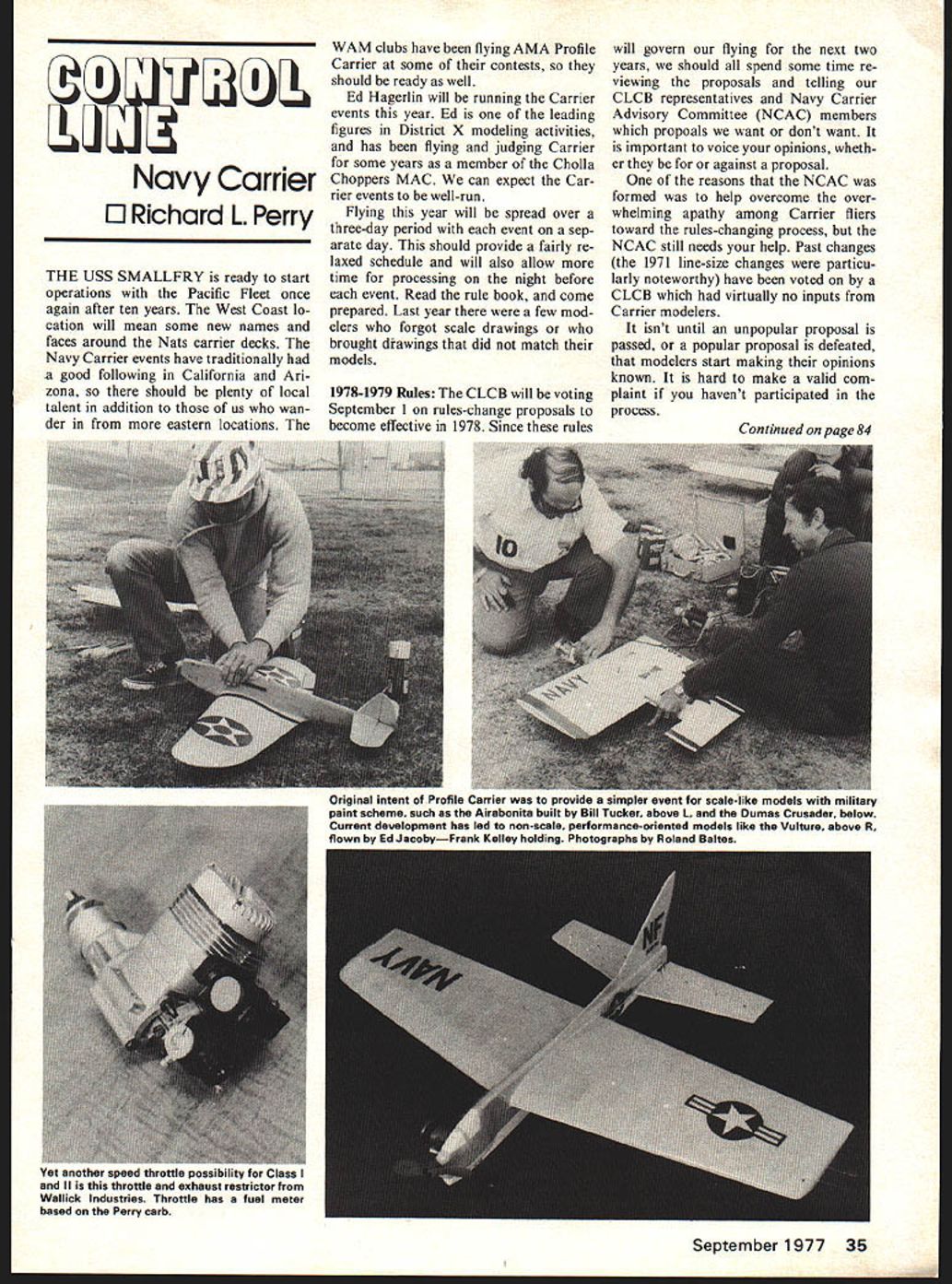
The bonus point proposal would encourage the use of scale-like models in the Profile Carrier event. The bonus would be small (10 points) so that existing models will not be made obsolete, yet it should be enough to encourage the building of some scale-like models. The point award could be changed in the next cycle after we have some more experience with the two types of models in competition. The scale requirements are quite liberal to allow existing scale-like profile kits to be used and to permit simple installation of all of the moveable surfaces commonly used on Profile Carrier models.
The changes to the low-speed portion of our flights would do two things. One would change the penalty for violations during low-speed flight and eliminate the current conflicting rules which say that a flight is official after the low-speed signal but an attempt if there is a violation during low-speed flight. Under the proposed change, low-speed violations would result in loss of low-speed score, not loss of the entire flight.
The second change would delete the current requirement that a model not deviate radically from the flight characteristics of the prototype and substitute a requirement that the model not exceed a 60° nose-high attitude. The latter would provide a uniformly enforceable definition. Enforcement options include loss of the flight (current penalty) or loss of low-speed score for any intentional, prolonged, or repeated deviations. Another option is a five-point penalty each time the 60° limit is exceeded. This would eliminate some judgment calls on intentional or unintentional deviations (failure to correct immediately would still mean loss of flight or low-speed score), but will require officials to count deviations.
Summaries of all proposals and results of CLCB voting are in the "Competition Newsletter" section of past issues.
Richard L. Perry, 5016 Angelita Ave., Dayton, OH 45424.
Transcribed from original scans by AI. Minor OCR errors may remain.

