
CONTROL LINE NAVY CARRIER
Dick Perry
7005 Del Oso Court NE, Albuquerque, NM 87109-2930
This month's column concentrates on relatively new products that are adaptable to Navy Carrier events. Most of these products are intended for radio control (RC), but that never stopped us before.
Northeast Aerodynamics (150 Robinson Rd., Hudson, NH 03051; Tel: (603) 881-5899) manufactures kits in their Profile Warbirds series intended for RC sport flying. They are profile models with landing gear, modeled after World War II aircraft. About half of them are eligible for bonus points in Profile Carrier. Current offerings include an F6F Hellcat, an A6M Zero, a P-51 Mustang, and a Bf-109.
General specifications for these models call for a 50-inch (or slightly greater) wingspan (easily adjusted to the 50-inch upper limit for Profile Carrier) and about 430 square inches of wing area. They are a little larger than traditional Profile Carrier models but are about the size of the Sig Skyray 35, which has its own unofficial Carrier event popular in some areas.
A surprise source for Class I and II models is the relatively new RC World War II Combat event (event number 704, page 160 in the rule book). The event rules require a 5% scale tolerance (as does Navy Carrier) and a 1:12 scale size. The models are designed for a .21 engine if the original was a radial-engine design, and .15 for inline engines.
The only potential hitch is that the chords of the wing and tail surfaces do not have to be scale. Fortunately, most modelers (and commercial kit/plan sources) are sticking to scale. Another minor drawback is that these models have no landing gear; that aspect of the conversion to Carrier use should pose no serious problem.
On the plus side, these models must weigh less than 2.2 pounds including radio, so they tend to be much lighter than alternative conversions of scale RC kits. All of the aircraft of which I am aware fit within our 44-inch wingspan limit, and have about 270–300 square inches of area. At the high end of the scale, the Corsair has 314 square inches, and the F6F Hellcat has 334 if built to exact 1:12 scale. The smallest models would be the Bf-109T at about 190 square inches; other Bf-109 variants were even smaller.
The P-51 Mustang qualifies for Navy Carrier because of its testing near the end of WWII. The Bf-109T was intended for the German aircraft carrier Graf Zeppelin, which was never completed. Tests were also conducted with modified early models of the Bf-109.
Manufacturers and kit sources
- Gus Morfis Plans (4709 Green Meadows Ave., Torrance, CA 90505-5507; Tel: (310) 378-5679) — offers plans for a wide range of models. Example: a Ryan Fireball plan (40-inch span, 275 sq in) with conventional wood construction, sheeted fuselage, and built-up wing.
- Air Kill Products (14 Shady Lake Ct., Sacramento, CA 95834; Tel: (916) 425-9933) — provides short kits for Gus Morfis plans, including cowls and canopies.
- Zigg's Originals (105 Swanton Rd., Madison, WI 53714; Tel: (608) 249-4480) — offers models suitable for Carrier events, including a Zero, a Corsair, and a Hellcat. Wings and fuselages are cut foam, suitable for low-temperature film covering.
- Mey's Hi Tech Hobby (10 Starr Rd., Danbury, CT 06810; Tel: (203) 743-7259) — has a P-51 and a Corsair with fiberglass fuselages and sheeted foam wings with carbon-fiber spars.
- Progressive Miniature Aviation (2467 N. John Young Pkwy, Orlando, FL 32804; Tel: (407) 298-8257) — offers A6M2 Zero, Mustang, Spitfire (Seafire), and Bf-109 models of conventional balsa-and-plywood construction with plastic canopy and cowl.
- Brodak Manufacturing and Distributing Co. (100 Park Ave., Carmichaels, PA 15320; Tel: (412) 966-2726) — producing a model of the Grumman F7F Tigercat for Profile Carrier. The kit is patterned after the Tigercat originally conceived by Bob Smurthwaite and designed in its current configuration by Mike Garmon.
- Golden State Models (RR 6, Box 9, Bloomington, IL 61704; Tel: (309) 827-8765) — manufactures an all-balsa MO-1 for Profile Carrier.
Brodak F7F Tigercat details
- Wingspan: 43 1/3 inches
- Wing area: 354 square inches
- Length: 32 inches
- Wing thickness: constant 1.5 inches (results in about 15% thickness at the root and 21% at the tip due to taper)
- Kit wood and hardware weight: 24 ounces (without engines, tanks, covering, wheels, and bellcrank; includes other hardware)
- Notes: The model should build into a relatively light twin for its size. The 354 sq in wing area is typical of current competition Profile Carrier models. Carrier details are included in the basic design. A line slider is not included but can be installed using common Profile Carrier techniques. A minor modification is required in the engine nacelles: the kit’s cheek cowl is thicker than the 3/4-inch maximum allowable thickness specified in the rules. For those seeking the 20-point bonus for multiengine models, the Brodak F7F is currently the only kit on the market that qualifies.
Rules proposals and contest notes
The deadline for rules change proposals to be effective in 1999 passed just as I was writing this column. I have yet to see the proposals. I am aware of only two Navy Carrier proposals for the current rule cycle:
- Restore the additional starting time for multiengine models, which was inadvertently deleted a few years ago. With the advent of additional bonus points for multiengine models in 1996, a few twins have begun appearing on the Carrier circle. The proposal would grant one minute additional time per added engine. There is also an urgent related proposal that would immediately restore the two-minute allowance from prior rules; I do not know the status of that proposal.
- Allow other than three-line control systems in the Profile Carrier event. This proposal targets electronic throttle controls in Profile Carrier by changing the Profile line requirements to match those for Class I.
Be sure to look in the "Focus on Competition" section of MA for summaries of all the rules proposals. Your Contest Board members need your input when making their voting decisions.
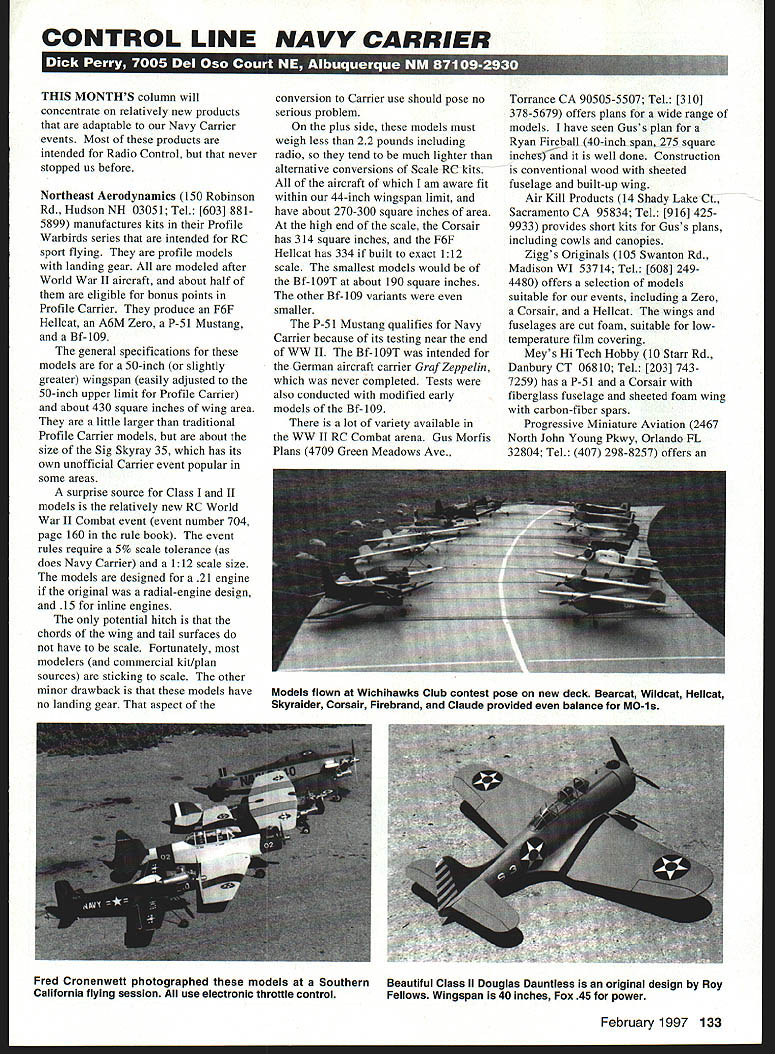
Thanks to Roy Fellows and Fred Cronenwett for contributing this month's photos. All models in Fred's photos use electronic throttle control. The Skyraider was converted from an older Class I model built by Virgil Wilbur, as was the MO-1. The SNJ (AT-6) was built by Grant Hiestand from a House of Balsa kit and fitted with an O.S. .40FP engine. The Sea Fury is Fred's original design with a 41-inch span.
Transcribed from original scans by AI. Minor OCR errors may remain.

