
CONTROL LINE NAVY CARRIER
Dick Perry 7005 Del Oso Court NE, Albuquerque, NM 87109-2930
Correspondence from Lieutenant Mike Danford
I was pleasantly surprised a few months ago when I received Carrier-related e-mail via the Internet. The message was from Lieutenant Mike Danford, who was in the Arabian Gulf on the USS Carl Vinson, flying S-3 Vikings and looking forward to returning to San Diego before the end of 1996.
By the time this issue reaches print, Mike should be in Southern California flying Carrier with the San Diego CL Club. He was planning to build Melvin Schuette's Curtiss XF-13C for the .15 Carrier event.
Mike had interesting thoughts about scoring and where the Carrier emphasis should be to spark event interest. Since his ideas were rather lengthy, I've sent them to the High-Low-Landing newsletter; it provides a better discussion forum than this column. If you'd like to join the discussion and you aren't a member of the Navy Carrier Society yet, you can join by sending $6 to Bill Bischoff, 3734 Truesdell Place, Dallas, TX 75244.
Nats planning and schedule
National Aeromodeling Championships (Nats) planning began in October. The Special Interest Groups had more say in planning the Nats this year; they were invited to participate in a planning meeting at AMA Headquarters, and they will be taking a bigger hand in running events.
- Navy Carrier events will be Thursday, Friday, and Saturday, July 17–19.
- Thursday: Profile Carrier
- Friday: Class I and Class II
- Saturday: unofficial events (traditionally Sportsman Carrier, .15 Carrier, and Sig Skyray Carrier)
Processing for each official event has traditionally been the evening before the event.
Sportsman Carrier
Sportsman Carrier, flown according to AMA Profile Carrier rules, is for modelers who do not fly in official Carrier events during the preceding two days. Sportsman, run by official-event fliers, allows volunteer judges, timers, officials, and helpers to fly at the Nats. It's more relaxed than the official Profile Carrier and is an excellent opportunity for less-experienced Carrier modelers (newcomers) to enjoy competing with and meeting fellow Carrier modelers.
The Navy Carrier Society will sponsor Sportsman Carrier, as it has for many years.
Event sponsorship and volunteers
The Sig Skyray Carrier and .15 Carrier will be flown if they have sponsors. I believe sponsors will be found (Sig has traditionally supported Skyray Carrier), but details were not firm at the time of writing.
Bill Bischoff will be the Navy Carrier Event Director this year; he is looking for volunteers to help run the events. There are plenty of opportunities to help:
- time
- judge
- pull test
- score
- record
- run score sheets from station to station
You may write to Bill at the address listed above or call him at (214) 247-5046.
Rules proposals
All rules change proposals, described briefly in the February column, have been reviewed and approved for consideration for the 1999 flying season. Two proposals specifically affecting Carrier events:
- Allow other three-line control Profile Carrier models using the same-size lines as the Class I line configurations.
- Give multiengine models 1 minute additional starting time per additional engine.
The urgent proposal to reinstate the two-minute starting allowance for extra engines still awaits action. Write to the column and I'll report the result as soon as I can; for the earliest information consult the Focus Competition section.
Seebree Hayes contest — revival of Carrier activity
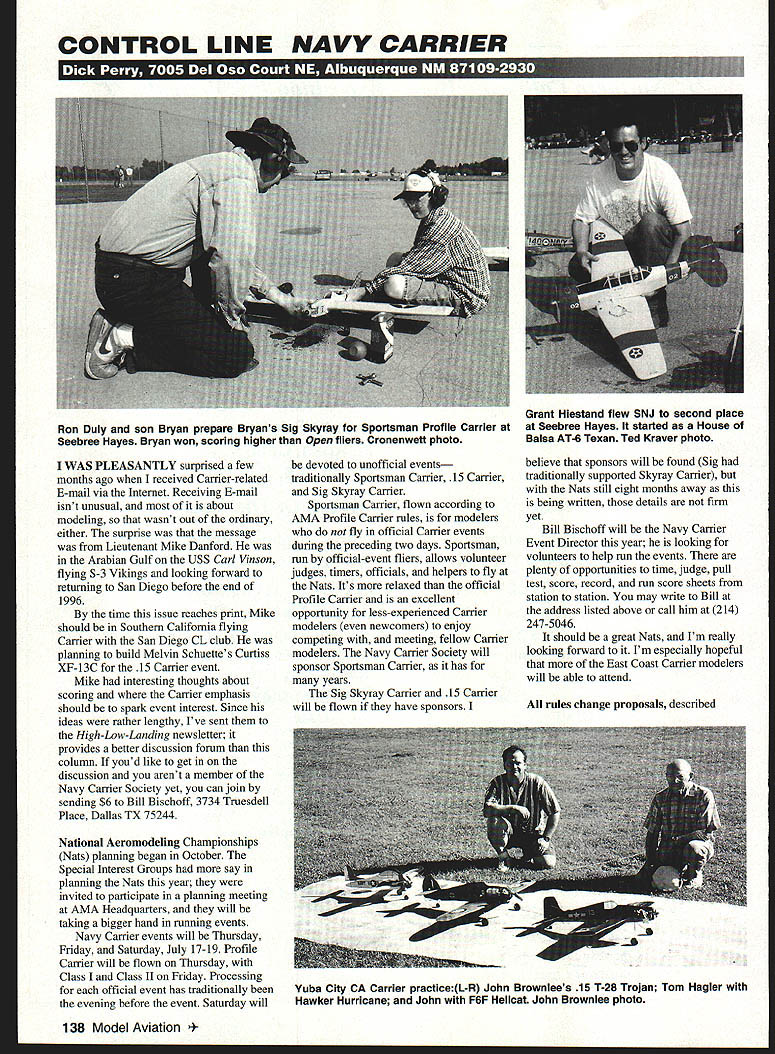
The Seebree Hayes contest this past fall in Los Angeles showed a Carrier activity revival. After an extended vacation, Ron Duly and Keith Trostle returned to the Carrier circle to compete against some of the newer enthusiasts. Welcome back—we missed you! Ron won the first Eugene Ely Award almost 20 years ago at the Riverside, California Nats.
One of the newest additions to our ranks was Bryan Duly, Ron's son. Bryan, a Junior, has obviously been practicing and must have had a good mentor. Flying a Sig Skyway in Class I and Sportsman Profile Carrier, he scored complete flights with full landing points. His Sportsman score was good enough to beat the Open fliers in Profile Carrier. Well done, Bryan!
Las Cruces contest — Mesilla Valley Model Airplane Club
The same weekend as the Seebree Hayes contest, Bill Melton and the members of the Mesilla Valley Model Airplane Club in Las Cruces, New Mexico held their traditional Precision Aerobatics, unofficial racing, and Navy Carrier contest.
This was my first experience at this contest despite being in New Mexico for three years; my international aircraft safety meeting commitments did not interfere with the contest date, so my wife Susan and I took advantage of the opportunity. It was a wonderful weekend with near-perfect weather, good competition, good sportsmanship, and excellent hospitality. I'll definitely be back.
A cookout at Bill and Lois Melton's home and the obligatory tour of Bill's legendary shop started the weekend. Even after selling more than 50 models in the last year, he still has at least 20 airplanes hanging from the walls and ceiling.
One of Bill's latest efforts is a Class II de Havilland Sea Mosquito. It could easily compete in Sport Scale, but it exceeds the maximum weight allowance of four pounds and can't be flown Carrier. Bill plans for his next version to be slightly smaller and within the weight limits.
Engine notes — O.S. VRP-powered MO-1
At the Las Cruces contest I had my first serious flying opportunity with my O.S. VRP-powered MO-1. The model needs more work to coordinate the high- and low-speed mixture settings, but it shows promise. Roy Ward and Bill Calkins have used this engine in Class I. Roy currently flies with a SuperTigre .60 carburetor while Bill uses the standard 4E carburetor and pressure.
My engine is stock, with the 4E carburetor and a K&B exhaust baffle. Notes from my experience:
- Accepts 70% fuel without any change in head spacing.
- Runs best at higher rpm with a low-pitch prop.
- With an APC 9 x 6 there is a significant increase in engine speed as the model accelerates; it takes at least 1-1/2 laps to reach full speed.
- Mixture on the deck must be rich enough to support fuel flow at higher rpm in flight.
- Runs even better with smaller RC Pylon Racing props, but their blade area is inadequate for the acceleration requirement of Carrier (they don't have to get off the ground in 20 feet without a push like we do).
- Highest speed so far: 17.15 seconds (104.9 mph).
Practice deck
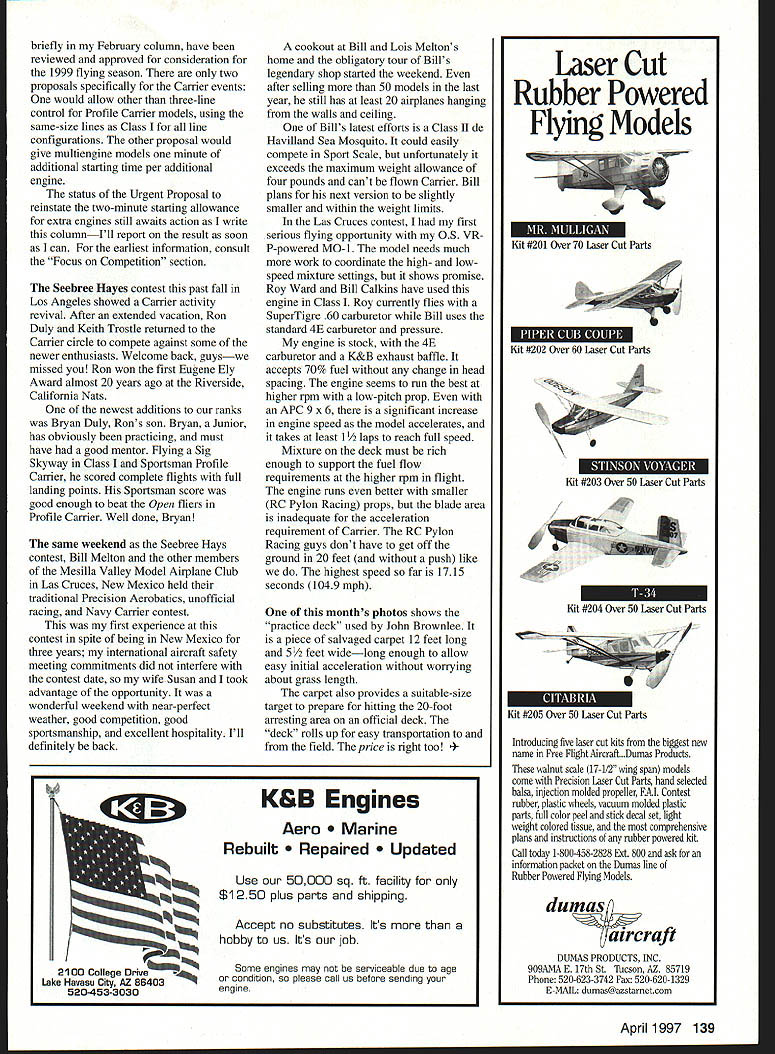
One of this month's photos shows the "practice deck" used by John Brownlee. It is a piece of salvaged carpet 12 feet long and 5 1/2 feet wide—long enough to allow easy initial acceleration without worrying about grass length. The carpet also provides a suitable-size target to prepare for hitting the 20-foot arresting area on an official deck. The "deck" rolls up for easy transportation to and from the field. The price is right too!
Transcribed from original scans by AI. Minor OCR errors may remain.

