
CONTROL LINE NAVY CARRIER
Dick Perry 7005 Del Oso Court NE, Albuquerque, NM 87109-2930
Proposed rule changes
By now you may have read that the two proposed rules changes for Control Line Navy Carrier events passed the initial Control Line Contest Board ballot. As you read this, the cross-proposal deadline of July 15 should be imminent.
I do not expect any cross proposals for the change that would allow an additional minute of starting time for each additional engine. The proposal would shorten the current allowance of two minutes per engine, passed earlier this year as an urgent proposal.
However, the proposal to allow two-line control systems in Profile Carrier probably will see a cross proposal. As originally proposed, the change would mandate Class II line diameters for one- and two-line systems in Profile Carrier. It seems inappropriate to handicap Profile models with such large lines. Because an electronic control system for throttle would have a weight penalty compared to a traditional three-line control system, the smaller line sizes of Class I seem more appropriate.
Lines, weight, and drag
There should be no significant advantage in using a two-line system in Profile Carrier since the intent of the event is to encourage simpler models. Some fliers consider electronic throttle controls an additional complication, although those who use them tend not to agree. The smaller lines do reduce line drag compared to a three-line system. Using Class II line sizes (.024" diameter) would provide a drag disadvantage in addition to the weight required for servo and battery. Using .020" lines (standard cable dimension is .021" diameter) would allow for a line drag reduction to offset the weight of the throttle control system.
If one ignores the differences in line roughness, Reynolds number, and other factors not easily or accurately accommodated for a line with varying airspeed throughout its entire length, the reduction in line drag is roughly proportional to the reduction in line diameter. Using two .020" lines compared to three .015" lines would result in a reduction in line drag of a bit more than 12%, excluding the effect of insulation required for lines carrying an electrical signal.
If we were dealing with small, highly streamlined Speed models, the reduction would be significant. Line drag on a Speed model can contribute more than half of the total drag. On much larger and much "dirtier" Carrier models, line drag is closer to 20–35% of total drag in the standard three-line configuration.
At these lower line-drag contributions, a reduction of 12% produces a reduction in total drag of only 2.5–4.3%. The resulting high-speed advantage for a typical Profile Carrier model would be about 1 mph. Using .021" cable rather than .020" solid lines would cut the advantage almost in half. Adding insulation to the lines and weight to the model most likely puts the electronic throttle control at a disadvantage.
On a heavier and faster Class II model, the advantage of a two-line control system might be worth considering.
Resources and examples
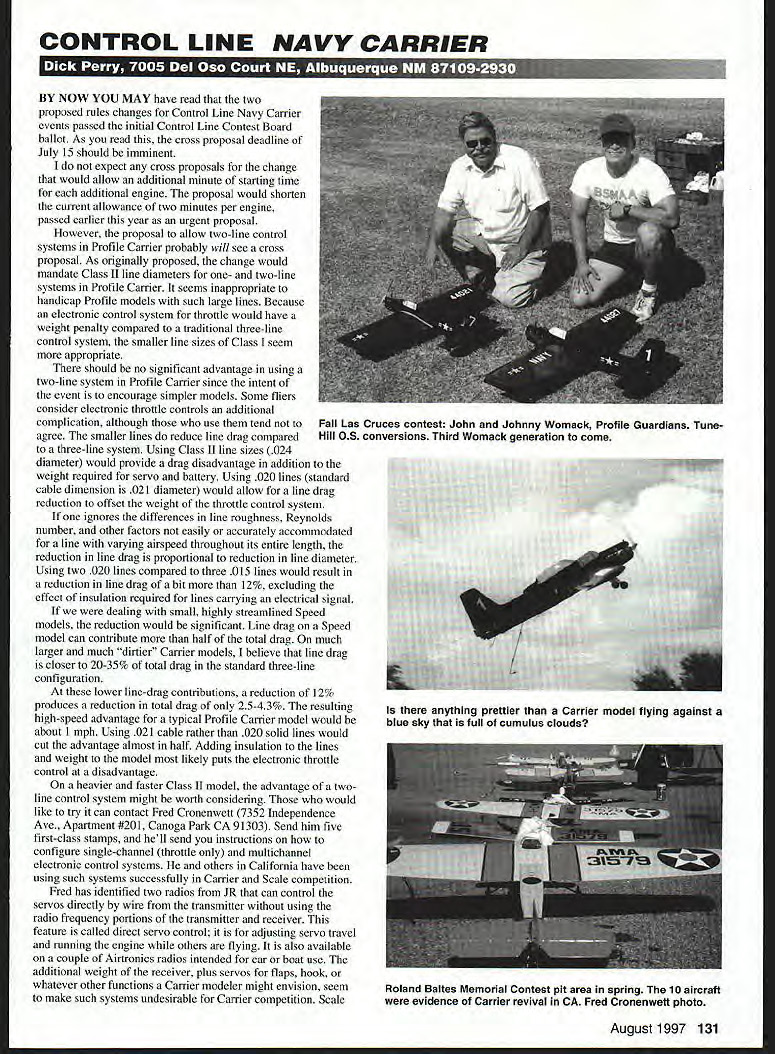
Those who would like to try two-line or electronic systems can contact Fred Cronenwett: 7352 Independence Ave., Apartment #201, Canoga Park, CA 91303. Send him five first-class stamps, and he'll send you instructions on how to configure single-channel (throttle only) and multichannel electronic control systems. He and others in California have been using such systems successfully in Carrier and Scale competition.
Fred has identified two radios from JR that can control the servos directly by wire from the transmitter without using the radio-frequency portions of the transmitter and receiver. This feature is called direct servo control; it is for adjusting servo travel and running the engine while others are flying. It is also available on a couple of Airtronics radios intended for car or boat use. The additional weight of the receiver, plus servos for flaps, hook, or whatever other options a Carrier model might envision, seem to make such systems undesirable for Carrier competition. Fliers, however, could use such a system.
Monoline systems
Getting back to drag, using a monoline system has a potential speed advantage that becomes significant when line drag is reduced as much as 73%. Assuming low-speed capabilities and total weight could be maintained, a monoline system could have as much as a 15- to 18-point advantage compared to a three-line system.
I designed a purely mechanical monoline system for the old rules, but I gave up on it when the scoring changed; it would not have provided adequate throttle control for the current form of flying. The thought of building a universal joint capable of accommodating line sweep and an 80- to 90-pound pull-test definitely put the project into the "too hard" category.
I once saw two monoline units attached to Dale Kim's belt—for controlling elevator and throttle. (I was more interested in the control system than in the event or the airplane, but I think it was on a Scale model.) If variable line sweep was not required (monoline control doesn't need line tension, and a left-hand rotation engine might keep the model out on the lines), maybe it could work. This system is fun to contemplate, but probably way too hard to achieve.
Conclusion
The best routes to success are likely to remain the more traditional ones. Innovation is a great thing, but I suspect that most improvements in Carrier will be relatively straightforward—evolutionary refinements rather than great-leap revolutionary inventions.
Notable past innovations that have had a significant impact on Carrier flying:
- Bob Smurthwaite's three-line control system and exhaust throttle
- Bill Johnson's fuel meter
- Commercial fuel metering carburetors
- Line sliders
What will be next?
Transcribed from original scans by AI. Minor OCR errors may remain.

