
CONTROL LINE: NAVY CARRIER
Dick Perry, 7005 Del Oso Court NE, Albuquerque, NM 87109-2930
Nats Equipment
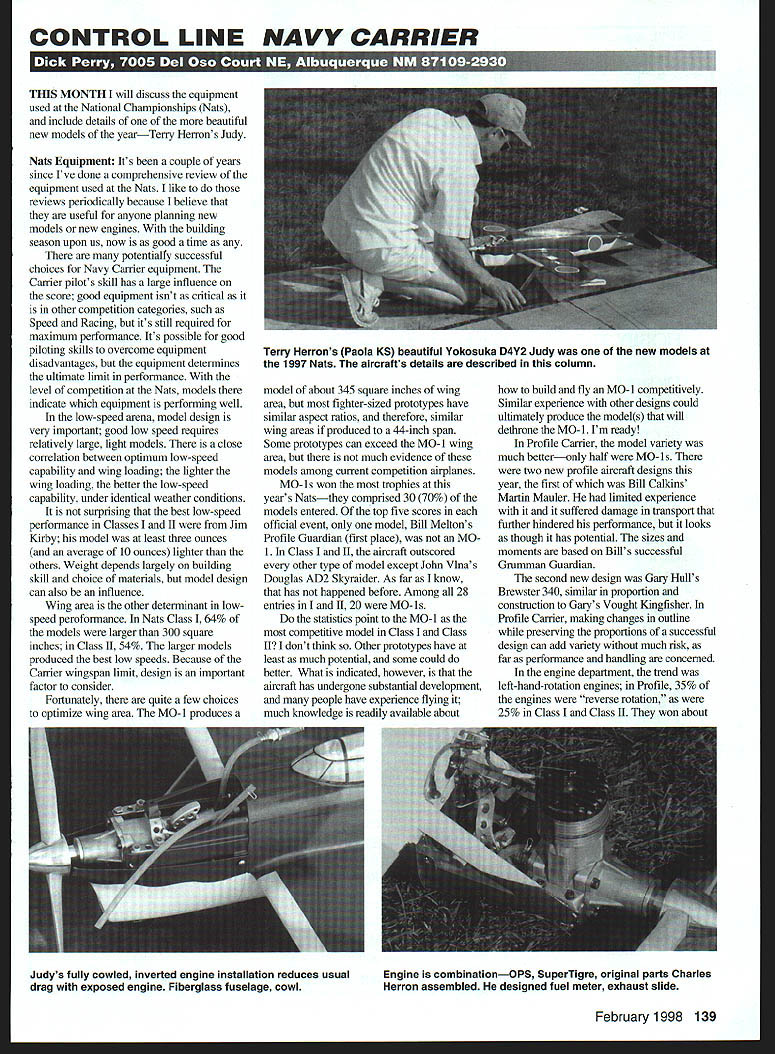
This month I will discuss the equipment used at the National Championships (Nats), and include details of one of the more beautiful new models of the year—Terry Herron's Judy.
It's been a couple of years since I've done a comprehensive review of the equipment used at the Nats. I like to do those reviews periodically because I believe they are useful for anyone planning new models or new engines. With the building season upon us, now is as good a time as any.
There are many potentially successful choices for Navy Carrier equipment. The Carrier pilot's skill has a large influence on the score; good equipment isn't as critical as it is in other competition categories, such as Speed and Racing, but it's still required for maximum performance. It's possible for good piloting skills to overcome equipment disadvantages, but the equipment determines the ultimate limit in performance. With the level of competition at the Nats, models there indicate which equipment is performing well.
In the low-speed arena, model design is very important; good low speed requires relatively large, light models. There is a close correlation between optimum low-speed capability and wing loading: the lighter the wing loading, the better the low-speed capability, under identical weather conditions.
It is not surprising that the best low-speed performance in Classes I and II came from Jim Kirby; his model was at least three ounces (and an average of 10 ounces) lighter than the others. Weight depends largely on building skill and choice of materials, but model design can also be an influence.
Wing area is the other determinant in low-speed performance. In Nats Class I, 64% of the models were larger than 300 square inches; in Class II, 54% were larger. The larger models produced the best low speeds. Because of the Carrier wingspan limit, design is an important factor to consider.
Fortunately, there are quite a few choices to optimize wing area. The MO-1 produces a model of about 345 square inches of wing area, but most fighter-sized prototypes have similar aspect ratios and therefore similar wing areas if produced to a 44-inch span. Some prototypes can exceed the MO-1 wing area, but there is not much evidence of these models among current competition airplanes.
MO-1s won the most trophies at this year's Nats—they comprised 30 (70%) of the models entered. Of the top five scores in each official event, only one model, Bill Melton's Profile Guardian (first place), was not an MO-1. In Class I and II, the MO-1 aircraft outscored every other type of model except John Vlna's Douglas AD2 Skyraider. As far as I know, that has not happened before. Among all 28 entries in I and II, 20 were MO-1s.
Do the statistics point to the MO-1 as the most competitive model in Class I and Class II? I don't think so. Other prototypes have at least as much potential, and some could do better. What is indicated, however, is that the aircraft has undergone substantial development, and many people have experience flying it; much knowledge is readily available about how to build and fly an MO-1 competitively.
Similar experience with other designs could ultimately produce the models that will dethrone the MO-1. In Profile Carrier, the model variety was much better—only half were MO-1s. There were two new profile aircraft designs this year. The first was Bill Calkins' Martin Mauler. He had limited experience with it and it suffered damage in transport that further hindered its performance, but it looks as though it has potential. The sizes and moments are based on Bill's successful Grumman Guardian.
The second new design was Gary Hull's Brewster 340, similar in proportion and construction to Gary's Vought Kingfisher. In Profile Carrier, making changes in outline while preserving the proportions of a successful design can add variety without much risk, as far as performance and handling are concerned.
In the engine department, the trend was toward left-hand-rotation engines; in Profile, 35% of the engines were reverse rotation, as were 25% in Class I and Class II. They won about half of the trophies, and all but one were Wiley or Fox engines.
The engine is the dominant factor in high-speed performance. In Profile, Pete Mazur's Tune-Hill (O.S.) was six mph faster than anything else. In the 20-second range, there were three Wileys, a Nelson, and a Fox, indicating that a variety of properly fitted and adjusted engines can provide top performance. Among the fastest models, the dominant propeller size was 9 x 6, with 80% of those being APC. Pete used a Grish 9 x 7.
As usual, Class I utilized a variety of engines. O.S. was the most-represented manufacturer, with single examples of engines from six other makers. The honors for best high speed, again, went to Pete Mazur. His K&B .40S and Grish 9 x 7 propeller were almost eight mph faster than the closest competitor and about 20 mph faster than most others. That much speed differential is hard to overcome. Pete was 45 points ahead of the second-place score; he remains the one to beat.
Class II fliers also used a variety of engines, although half of them were O.S. manufacture. Bill Melton took top high-speed honors at 117.1 mph. His engine was a Rossi .65 with fuel meter and slide turning a Rev-Up 10 x 8. Terry Herron also topped 110 mph with his hybrid OPS/SuperTiger .64. Big engines prevailed in the speed department, beating every engine of less than .60 cubic inch displacement—I don't think that's a real surprise.
APC propellers were preferred, followed by Grish and Rev-Up. K&B and Fox almost tied for favorite glow plug this year; K&B popularity has greatly increased throughout the past few years. As usual, Bob Smurthwaite's three-line bellcranks were used by many. The current production version by Brodak was the most numerous.
Terry Herron's Judy
In the 1970s, Terry Herron held national records in Senior and Open Class II Carrier with a Japanese Yokosuka D4Y2 Suisei (Comet) that had the Allied codename Judy. Terry's father, Lieutenant Colonel Charles W. Herron, had a significant influence on Terry's success and on the design of the Judy. Charles passed away this year after a prolonged illness, and to honor him Terry built another Judy using the same engine that Charles had built 25 years ago. The Judy did fly before Charles' death.
Terry's new Judy is larger than the original by 11%, but it's three ounces lighter. His high speeds in the 1970s were consistently more than 120 mph, and the new Judy is keeping up. The Judy has achieved 120 mph speeds in competition this year, making it the fastest Carrier model at this time, to my knowledge. The Judy is slightly smaller and heavier than most other Class II models, so low speed may suffer a little. The full low-speed potential will not be reached, however, until a new line slider is designed and installed for next year. Terry is currently scoring about 360 points.
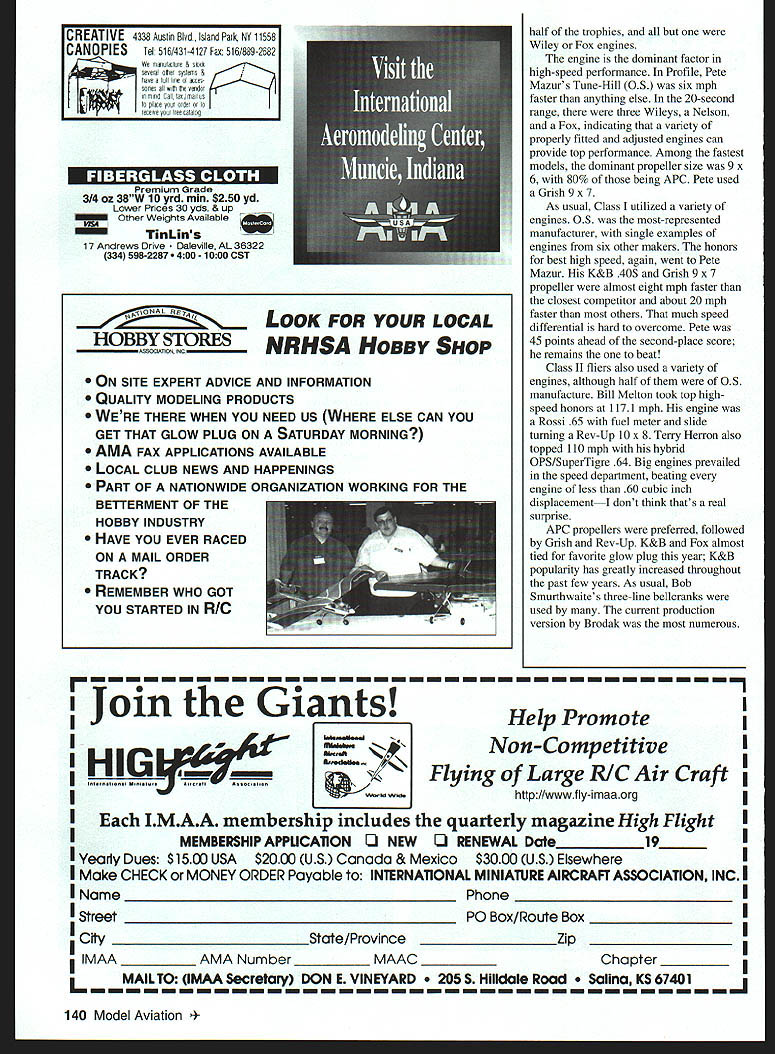
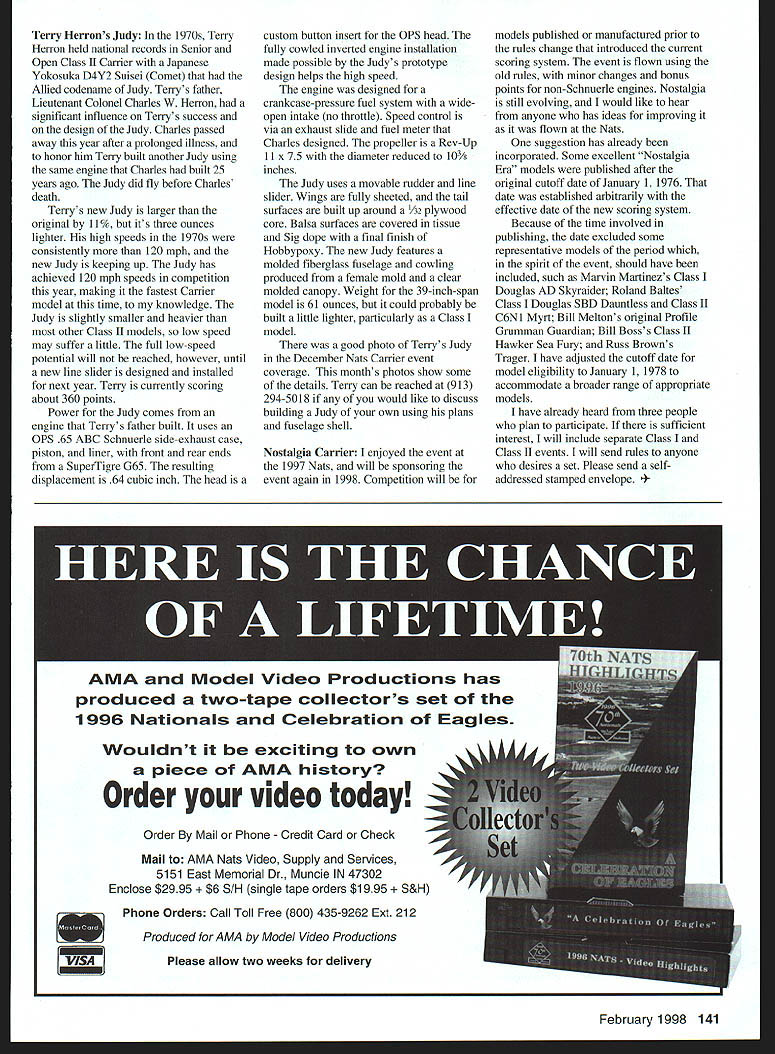
Power for the Judy comes from an engine that Terry's father built. It uses an OPS .65 ABC Schnuerle side-exhaust case, piston and liner, with front and rear ends from a SuperTiger G-65. The resulting displacement is .64 cubic inch. The head is a custom button insert for the OPS head. The fully cowled inverted engine installation made possible by the Judy's prototype design helps the high speed.
The engine was designed for a crankcase-pressure fuel system with a wide-open intake (no throttle). Speed control is via an exhaust slide and fuel meter that Charles designed. The propeller is a Rev-Up 11 x 7.5 with the diameter reduced to 10½ inches.
The Judy uses a movable rudder and line slider. Wings are fully sheeted, and the tail surfaces are built up around a 1/2" plywood core. Balsa surfaces are covered in tissue and Sig dope with a final finish of Hobbypoxy. The new Judy features a molded fiberglass fuselage and cowl produced from a female mold and a clear molded canopy. Weight for the 39-inch-span model is 61 ounces, but it could probably be built a little lighter, particularly as a Class I model.
There was a good photo of Terry's Judy in the December Nats Carrier event coverage. This month's photos show some of the details. Terry can be reached at (913) 294-5018 if any of you would like to discuss building a Judy of your own using his plans and fuselage shell.
Nostalgia Carrier
I enjoyed the event at the 1997 Nats, and will be sponsoring the event again in 1998. Competition will be for models published or manufactured prior to the rules change that introduced the current scoring system. The event is flown using the old rules, with minor changes and bonus points for non-Schumacher engines. Nostalgia is still evolving, and I would like to hear from anyone who has ideas for improving it as it was flown at the Nats.
One suggestion has already been incorporated. Some excellent "Nostalgia Era" models were published after the original cutoff date of January 1, 1976. That date was established arbitrarily with the effective date of the new scoring system. Because of the time involved in publishing, the date excluded some representative models of the period which, in the spirit of the event, should have been included, such as Marvin Martinez's Class I Douglas AD Skyraider; Roland Bates's Class I Douglas SBD Dauntless and Class II C6N1 Myrt; Bill Melton's original Profile Guardian; Bill Boss's Class II Hawker Sea Fury; and Russ Brown's Trager. I have adjusted the cutoff date for models eligible to January 1, 1978 to accommodate a broader range of appropriate models.
I have already heard from three people who plan to participate. If there is sufficient interest, I will schedule separate Class I and Class II events. I will send rules to anyone who desires a set. Please send a self-addressed stamped envelope.
Transcribed from original scans by AI. Minor OCR errors may remain.

