
CONTROL LINE NAVY CARRIER
Dick Perry 7005 Del Oso Court NE, Albuquerque, NM 87109-2930
Wing Loading Revisited
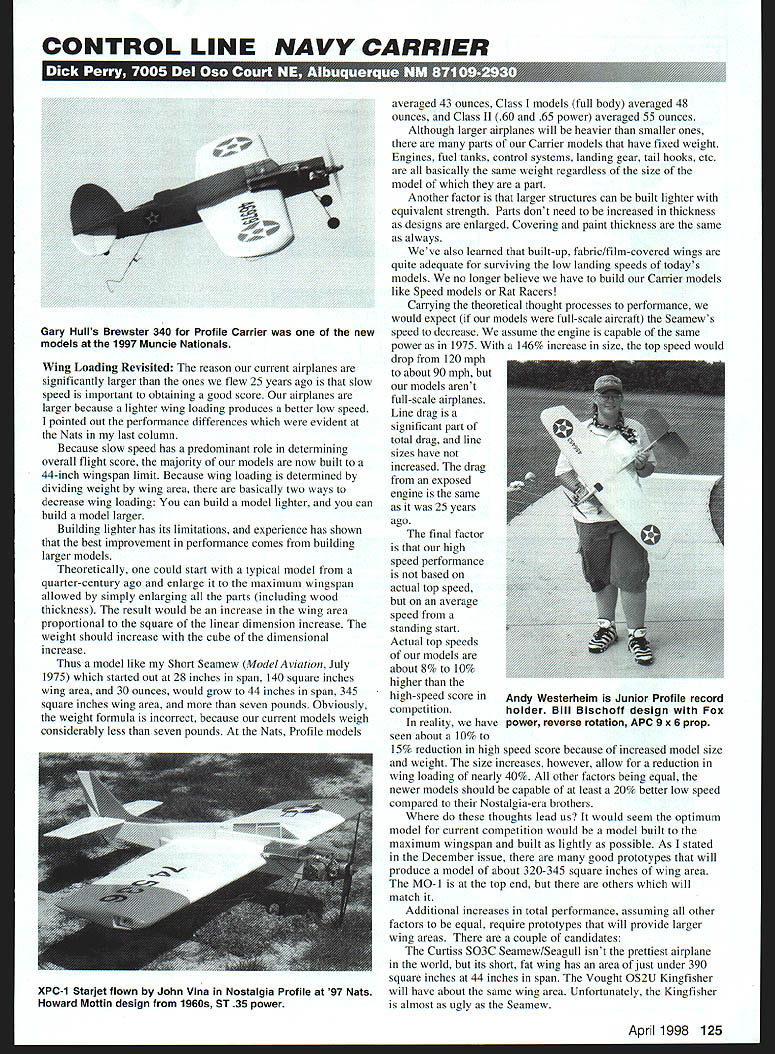
The reason our current airplanes are significantly larger than the ones we flew 25 years ago is that slow speed is important to obtaining a good score. Our airplanes are larger because a lighter wing loading produces better low-speed performance. I pointed out the performance differences that were evident at the Nats in my last column.
Because slow speed has a predominant role in determining overall flight score, the majority of our models are now built to a 44-inch wingspan limit. Wing loading is determined by dividing weight by wing area, so there are basically two ways to decrease wing loading:
- Build the model lighter.
- Build the model larger.
Building lighter has its limitations, and experience has shown that the best improvement in performance comes from building larger models.
Theoretically, one could start with a typical model from a quarter-century ago and enlarge it to the maximum wingspan by simply enlarging all parts (including wood thickness). The wing area would increase proportional to the square of the linear dimension increase, while weight would increase with the cube of the dimensional increase.
For example, my Short Seamew (Model Aviation, July 1975) started at 28 inches span, 140 sq in wing area, and 30 ounces. Enlarged to 44 inches span, the wing area would be about 345 sq in and the naive cube-scaling would predict a weight of more than seven pounds. Obviously, that cube-scaling is not realistic: our current models weigh much less. At the Nats, Profile models averaged 43 ounces; Class I models (full body) averaged 48 ounces; and Class II (.60 and .65 power) averaged 55 ounces.
Several reasons explain why larger models are not as heavy as simple scaling predicts:
- Many components have fixed weight regardless of model size: engines, fuel tanks, control systems, landing gear, tail hooks, etc.
- Larger structures can be built proportionally lighter while maintaining equivalent strength; parts do not need the same relative thickness as designs are enlarged.
- Covering and paint thickness remain constant, so their contribution changes relatively.
- Built-up, fabric/film-covered wings are quite adequate for surviving the low landing speeds of today’s models; we no longer need to build Carrier models like Speed models or Rat Racers.
If we carry the theoretical thought to performance (assuming the engine produces the same power as in 1975), a 146% increase in size would reduce top speed from about 120 mph to roughly 90 mph. But our models are not full-scale aircraft: line drag is a significant part of total drag and line sizes have not increased; the drag from an exposed engine is also unchanged from 25 years ago.
Another point: high-speed performance in competition is based not on actual top speed but on average speed from a standing start. Actual top speeds of our models are about 8%–10% higher than the recorded high-speed score.
In practice, we have seen about a 10%–15% reduction in high-speed score because of increased model size and weight. The size increases, however, allow for a reduction in wing loading of nearly 40%. All other factors being equal, the newer models should be capable of at least a 20% better low-speed performance compared to their Nostalgia-era counterparts.
Where does this lead? The optimum model for current competition appears to be one built to the maximum wingspan and as lightly as possible. As I stated previously, there are many good prototypes that will produce a model of about 320–345 sq in of wing area. The MO-1 is at the top end, but other prototypes will match it.
If additional gains are desired (assuming all else equal), look for prototypes that provide larger wing areas. A couple of candidates:
- Curtiss SO3C Seamew/Seagull: not the prettiest airplane, but its short, fat wing yields just under 390 sq in at 44 inches span.
- Vought OS2U Kingfisher: similar wing area to the Seamew (about 390 sq in), though also not especially attractive.
- Supermarine Seafire: a prettier alternative. The Seafire is the naval version of the Spitfire. Common clipped-wing versions build to about 350 sq in, only slightly better than other fighters of the era. However, a low-altitude variant with a shorter, low-mounted wing clipped at each tip produces a model of about 430 sq in.
If you are thinking of a new model and a new prototype (anything but an MO-1), consider the Seamew, Kingfisher, and Seafire before you stop looking.
Nostalgia Carrier
There is still plenty of time to prepare for the Nostalgia Carrier event at the Nationals. Profile and combined Class I/II will be offered. If you plan to compete, please let me know:
- E-mail: 71370,1477@compuserve.com
- Tel.: (505) 884-7405
If there is sufficient interest, I will separate Class I and Class II. I will send rules to those who ask.
Model magazines still offer many older designs that are eligible for Nostalgia Carrier, and many out-of-print plans can be ordered from Gleason Enterprises:
- Gleason Enterprises, 1106 10th Dr. SE, Austin, MN 55912
Opportunity for Nationals Attendees
We are always looking for qualified and willing volunteers to assist in running the Carrier events at the Nationals. If you are willing to work the events and want to earn the sincere appreciation of your fellow Carrier modelers, please consider volunteering for at least one day.
You can sign up by contacting:
- Bill Calkins, 317 Snow Street, Sugar Grove, IL 60554
- Tel.: (630) 466-1531
Brett Smith
Navy Carrier flying lost one of its own on November 18 when Brett Smith succumbed to cancer at the age of 38. Brett was the event director for Carrier events at many recent Sig contests and was a contestant at Fargo. His loss will be felt by all of us.
Transcribed from original scans by AI. Minor OCR errors may remain.

