

Control Line: Navy Carrier
Richard L. Perry
National Carrier Organization: During the Nats, the initial steps were taken to form a national organization of Navy Carrier modelers. This organization will serve as a means of promoting the Navy Carrier events, encouraging participation in the events, and sharing ideas among Carrier enthusiasts. It will also represent Navy Carrier fliers with AMA and will allow inputs from a large number of Carrier modelers to be used to guide the Navy Carrier Advisory Committee in making its recommendations to the Control Line Contest Board.
The newsletter for the organization is Hi, Low, Landing, with Ted Kraver serving as editor. Five dollars annual dues include the newsletter subscription. You can join by sending $5.00 to Ted at 1212 E. Manhattan Dr., Tempe, AZ 85282.
Harry Higley and I will be handling the initial organizational matters. We hope to have a constitution ready for approval and hold an election of officers by January. We need nominations and volunteers for officers, ideas for the constitution, and suggestions on a name for the organization. Send your inputs to me or to Harry at 433 Arquilla Dr., Glenwood, IL 60425.
This organization has the potential to really improve our event, but to be successful, we need you!
Which Guardian?
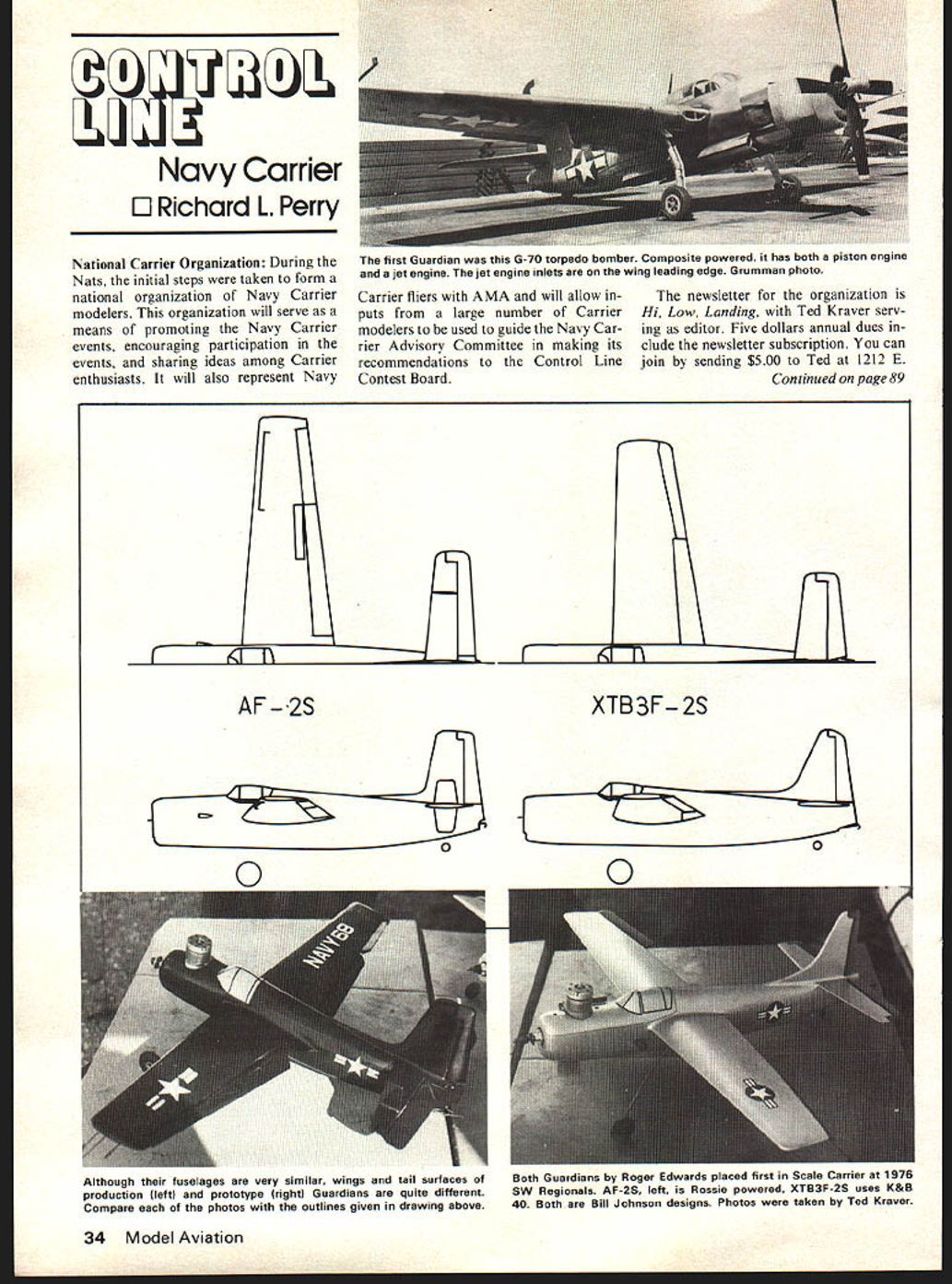
When the Grumman designers started work on their G-70 design in 1944, they didn't have our event in mind, yet the AF-2S Guardian which developed from the G-70 has become one of the most popular Navy Carrier models of all time. The aircraft is well suited to the event because of its large tail area and fuselage proportions which produce a well-balanced model using normal building techniques.
Another Guardian is becoming more popular among Carrier modelers — the prototype Guardian. There were really three different Guardian prototypes. The first, which carried the Navy designator XTB3F-1, had a composite propulsion system with a piston engine in the nose and a jet in the tail. The intakes for the jet engine were in the wing root and are clearly visible in the photograph.
The XTB3F-1 started life as a torpedo bomber, but problems with the jet engine and a re-evaluation of the torpedo bomber role by the Navy caused Grumman to revise the design. The XTB3F-2S was born as a piston-engine antisubmarine aircraft and became the forerunner of the AF-2S production Guardian with which we are so familiar. It is these XTB3F-2S and AF-2S Guardians that are modeled for the Carrier events.
Transcribed from original scans by AI. Minor OCR errors may remain.

