
CONTROL LINE NAVY CARRIER
Dick Perry, 7005 Del Oso Court NE, Albuquerque, NM 87109-2930
Mystery Airplane
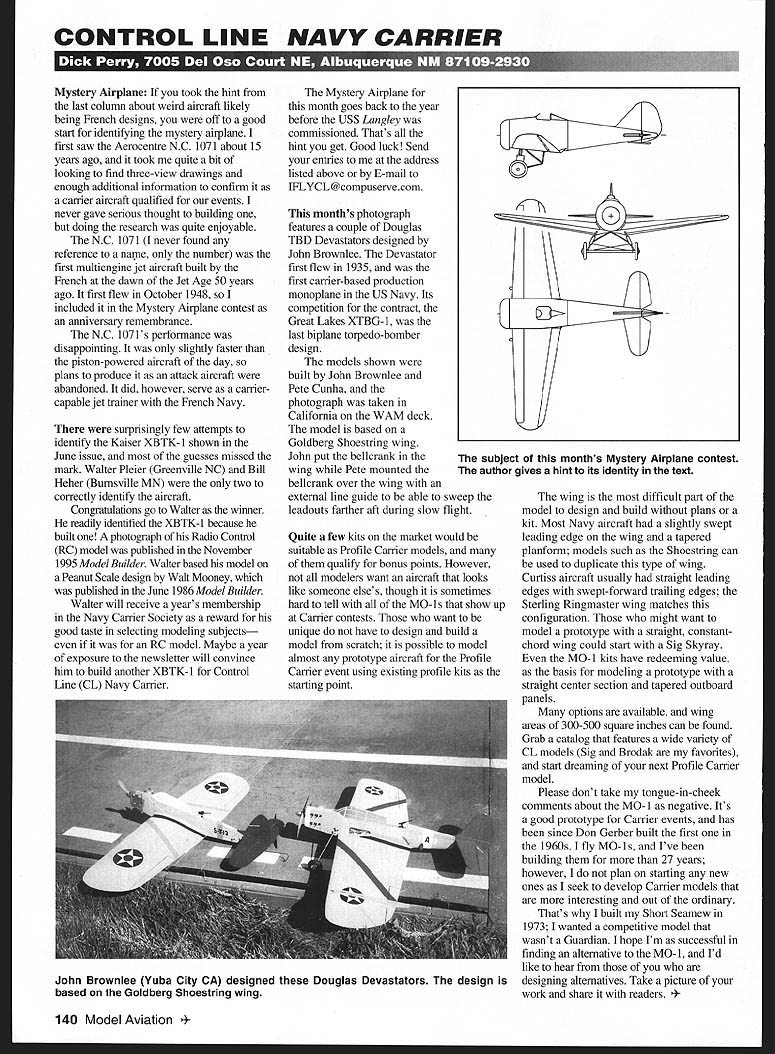
If you took the hint from the last column about weird aircraft likely being French designs, you were off to a good start for identifying the mystery airplane. I first saw the Aerocentre N.C. 1071 about 15 years ago, and it took me quite a bit of looking to find three-view drawings and enough additional information to confirm it as a carrier aircraft qualified for our events. I never gave serious thought to building one, but doing the research was quite enjoyable.
The N.C. 1071 (I never found any reference to a name, only the number) was the first multiengine jet aircraft built by the French at the dawn of the Jet Age 50 years ago. It first flew in October 1948, so I included it in the Mystery Airplane contest as an anniversary remembrance.
The N.C. 1071's performance was disappointing. It was only slightly faster than the piston-powered aircraft of the day, so plans to produce it as an attack aircraft were abandoned. It did, however, serve as a carrier-capable jet trainer with the French Navy.
There were surprisingly few attempts to identify the Kaiser XBTK-1 shown in the June issue, and most of the guesses missed the mark. Walter Pleier (Greenville, NC) and Bill Heher (Burnsville, MN) were the only two to correctly identify the aircraft.
Congratulations go to Walter as the winner. He readily identified the XBTK-1 because he built one! A photograph of his radio-controlled model was published in the November 1995 Model Builder. Walter based his model on a Peanut Scale design by Walt Mooney, which was published in the June 1986 Model Builder.
Walter will receive a year's membership in the Navy Carrier Society as a reward for his good taste in selecting modeling subjects—even if it was for an RC model. Maybe a year of exposure to the newsletter will convince him to build another XBTK-1 for control line (CL) Navy Carrier.
The Mystery Airplane for this month goes back to the year before the USS Langley was commissioned. That's all the hint you get. Good luck! Send your entries to me at the address listed above or by e-mail to IFLYCL@compuserve.com.
This month's photograph features a couple of Douglas TBD Devastators designed by John Brownlee. The Devastator first flew in 1935, and was the first carrier-based production monoplane in the U.S. Navy. Its competition for the contract, the Great Lakes XTBG-1, was the last biplane torpedo-bomber design.
The models shown were built by John Brownlee and Pete Cunha, and the photograph was taken in California on the WAM deck. The model is based on a Goldberg Shoestring wing. John put the bellcrank in the wing while Pete mounted the bellcrank over the wing with an external line guide to be able to sweep the leadouts farther aft during slow flight.
Quite a few kits on the market would be suitable as Profile Carrier models, and many of them qualify for bonus points. However, not all modelers want an aircraft that looks like someone else's; though it is sometimes hard to tell with all of the MO-1s that show up at Carrier contests. Those who want to be unique do not have to design and build a model from scratch; it is possible to model almost any prototype aircraft for the Profile Carrier event using existing profile kits as the starting point.
The wing is the most difficult part of the model to design and build without plans or a kit. Most Navy aircraft had a slightly swept leading edge on the wing and a tapered planform; models such as the Shoestring can be used to duplicate this type of wing. Curtiss aircraft usually had straight leading edges with swept-forward trailing edges; the Sterling Ringmaster wing matches this configuration. Those who might want to model a prototype with a straight, constant-chord wing could start with a Sig Skyray. Even the MO-1 kits have redeeming value as the basis for modeling a prototype with a straight center section and tapered outboard panels.
Many options are available, and wing areas of 300–500 square inches can be found. Grab a catalog that features a wide variety of CL models (Sig and Brodak are my favorites), and start dreaming of your next Profile Carrier model.
Please don't take my tongue-in-cheek comments about the MO-1 as negative. It's a good prototype for Carrier events, and has been since Don Gerber built the first one in the 1960s. I fly MO-1s, and I've been building them for more than 27 years; however, I do not plan on starting any new ones as I seek to develop Carrier models that are more interesting and out of the ordinary.
That's why I built my Short Seamew in 1973; I wanted a competitive model that wasn't a Guardian. I hope I'm successful in finding an alternative to the MO-1, and I'd like to hear from those of you who are designing alternatives. Take a picture of your work and share it with readers.
Transcribed from original scans by AI. Minor OCR errors may remain.

