
CONTROL LINE NAVY CARRIER
Dick Perry
427 Live Oak Lane NE, Albuquerque NM 87122
New address and contact
I'm still in Albuquerque but have moved to a different house with a garage large enough for a workshop and our cars. At the moment the garage is serving as a storeroom; it will likely be a couple more months before the shelves are in and the moving boxes are unpacked enough to make the garage usable. You may call me at (505) 856-7008.
Mystery Airplane
The Mystery Airplane contests resumed after a break for Nationals coverage in the December issue.
- August contest: The winner was William Dahlgren, who correctly identified the Aerocentre N.C.1071. Many other readers also identified this rather obscure aircraft. Bill provided additional information (new to me) about the airplane's predecessor: it originally used reciprocating engines with propellers. If you want to try one of these unusual twins at the field, I will work on a three-view as soon as I find the right box. I can send an 8 x 10 print on request. If you build one, I won't be responsible for any adverse comments from your friends at the flying field.
- October contest: The Mystery Airplane was a small monoplane designed by Handley Page in 1921 and first flown in 1923. Intended as a fighter/scout for the U.S. Navy, the monoplane configuration was expected to offer a significant speed advantage over contemporary biplanes. To reduce landing speed to that of a biplane, the design used full-span leading-edge slots and slotted trailing-edge flaps that also served as ailerons; the slots and flaps deployed together.
To save cost the aircraft was powered by a surplus Bentley B.R. two-rotary engine. Even so, it managed a top speed of about 145 mph with a stall speed near 45 mph. Poor handling qualities led the U.S. Navy to cancel the project. Other versions with larger, more modern engines were proposed, but the monoplane lost out to biplanes in initial design competitions. The factory designation was H.P.21 and the U.S. Navy designation H.P.S.1.
The winner of the October Mystery Airplane contest was Windsor Whittle of Memphis, Tennessee. Windsor will receive a one-year membership in the Navy Carrier Society.
Rules
By now you should have had a chance to review the rules results from the last cycle. Two Carrier proposals were under consideration, and both passed:
- Profile Carrier three-line requirement removed
- Profile Carrier will now allow the same line sizes and combinations as Class I: one-, two-, or three-line setups using .029, .020, or .015 line sizes.
- This change allows electronic throttle-control systems to use two lines rather than the three lines previously required. Electronic control functions other than elevator generally require insulated lines and have limited application in Carrier except among a few devotees. The change reduces the handicap for models using electronic throttle control.
- Engine starting time allowance
- Models with more than one engine will be allowed one minute per additional engine after the first, instead of the prior two minutes per additional engine.
Nationals — Terry Herron's Judy
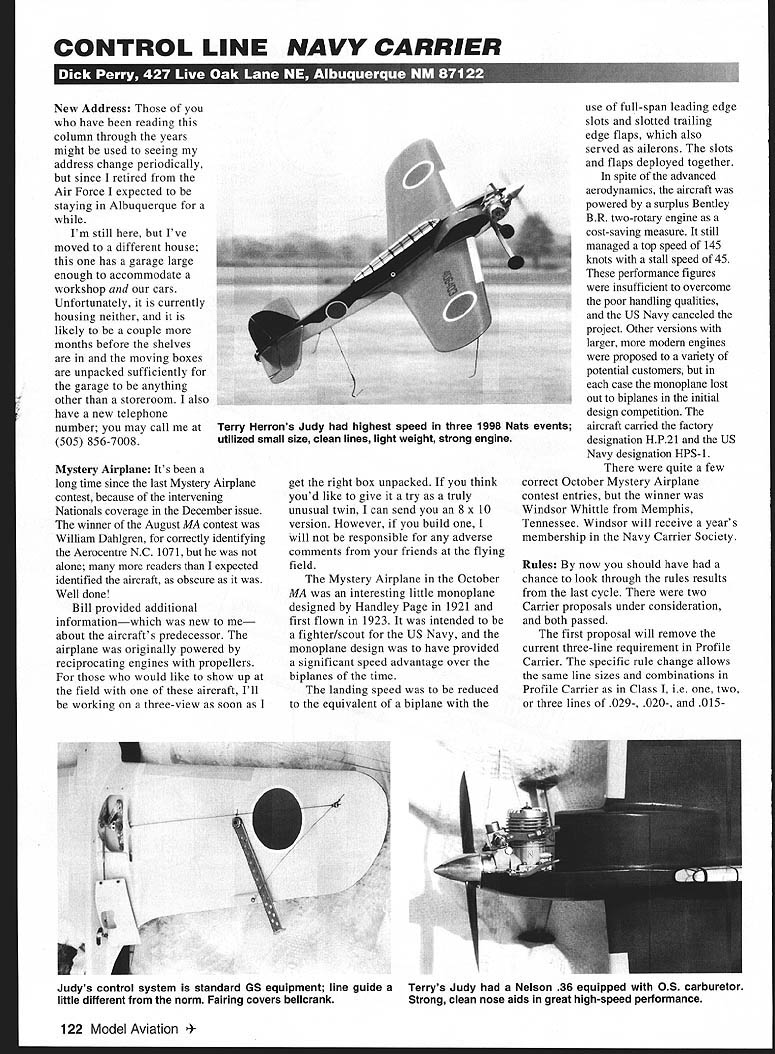
Terry Herron brought another Judy to the Nationals this year and created quite a bit of excitement. Terry consistently competes near the top in the high-speed portion of flights, and his new Profile Judy was the fastest Profile Carrier model this year — the fastest model across the three classes — at 113 mph.
Key features and performance:
- Weight and dimensions: 41 ounces (lightest Profile model this year); wingspan 40-1/2 inches; wing area slightly over the 300 square-inch minimum.
- Airframe: The wing airfoil is relatively thin. The nose is cleanly faired with a small spinner. Additional fairings and internal controls reduced drag and helped achieve excellent high-speed performance.
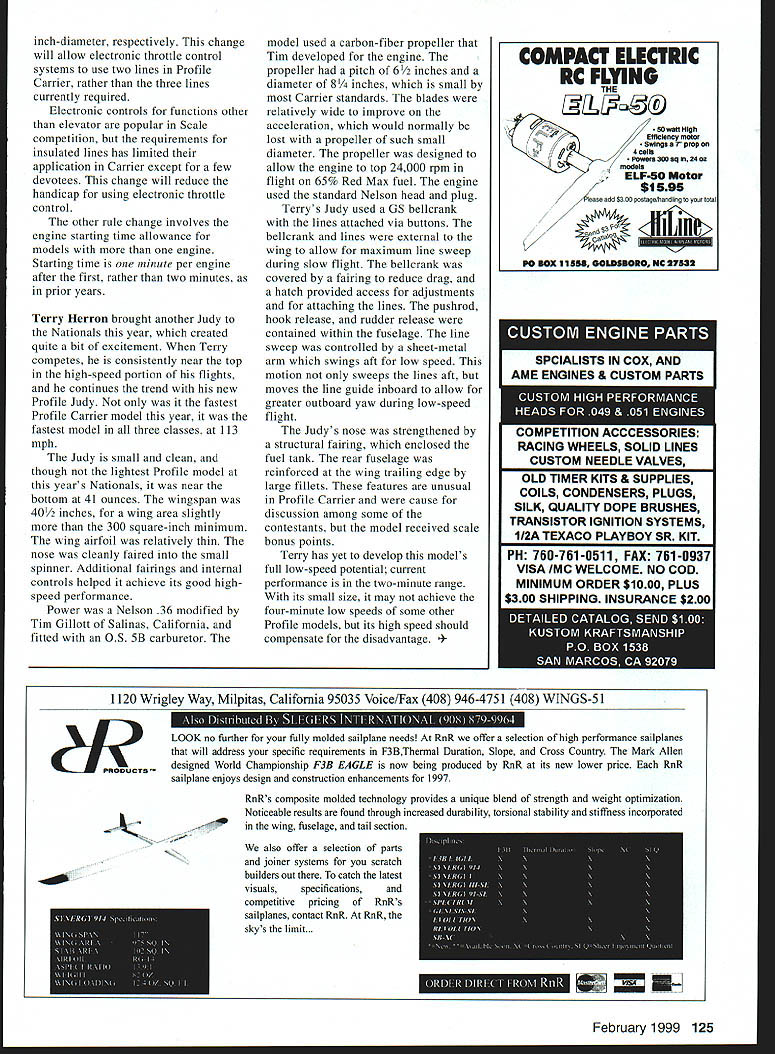
- Powerplant: A Nelson .36 modified by Tim Gillott (Salinas, California), who fitted an O.S. 5B carburetor and used the standard Nelson head and plug.
- Propeller: A carbon-fiber propeller developed by Tim, diameter 8-1/4 inches, pitch 6-1/2 inches. For small-Carrier standards the blades are relatively wide to improve acceleration that would otherwise be lost with such a small diameter. The propeller was designed to allow the engine to reach 24,000 rpm full-on using 65% Red Max fuel.
- Controls and line system: Terry used a GS bellcrank with the lines attached via buttons. The bellcrank and lines are external to the wing to allow maximum line sweep during slow flight; the bellcrank is covered by a fairing and a hatch provides access for adjustments and line attachment. The pushrod, hook release, and rudder release are contained within the fuselage. Line sweep is controlled by a sheet-metal arm that swings aft for low-speed flight; this both sweeps the lines aft and moves the line guide inboard to permit greater outboard yaw during slow flight.
- Structure and scale: The Judy's nose is strengthened by a structural fairing that also encloses the fuel tank. The rear fuselage is reinforced at the wing trailing edge with large fillets. These features are unusual in Profile Carrier and prompted discussion among contestants, but the model received scale bonus points.
Terry has not yet developed the model's full low-speed potential; current low-speed performance is in the two-minute range. Given its small size, it may not achieve the four-minute low speeds of some other Profile models, but its outstanding high speed should compensate for that disadvantage.
Transcribed from original scans by AI. Minor OCR errors may remain.

