
CONTROL LINE NAVY CARRIER
Dick Perry 427 Live Oak Lane NE, Albuquerque NM 87122 E-mail: IFLYCL@compuserve.com
Phoenix Carrier Contest
I had a wonderful time in November in Phoenix, Arizona, at the Arizona Control Line Club Carrier contest. It was the first Carrier event in the state in quite a few years to feature the full set of Carrier events. The Southwest Regionals drew considerable Carrier participation in the early 1970s, but now the Regionals feature only Profile Carrier.
It was great to renew old friendships. Some pilots and aircraft showed the effects of a long layoff, but everyone had a good time. Thanks to Ted Kraver for sponsoring the event and serving as Contest Director.
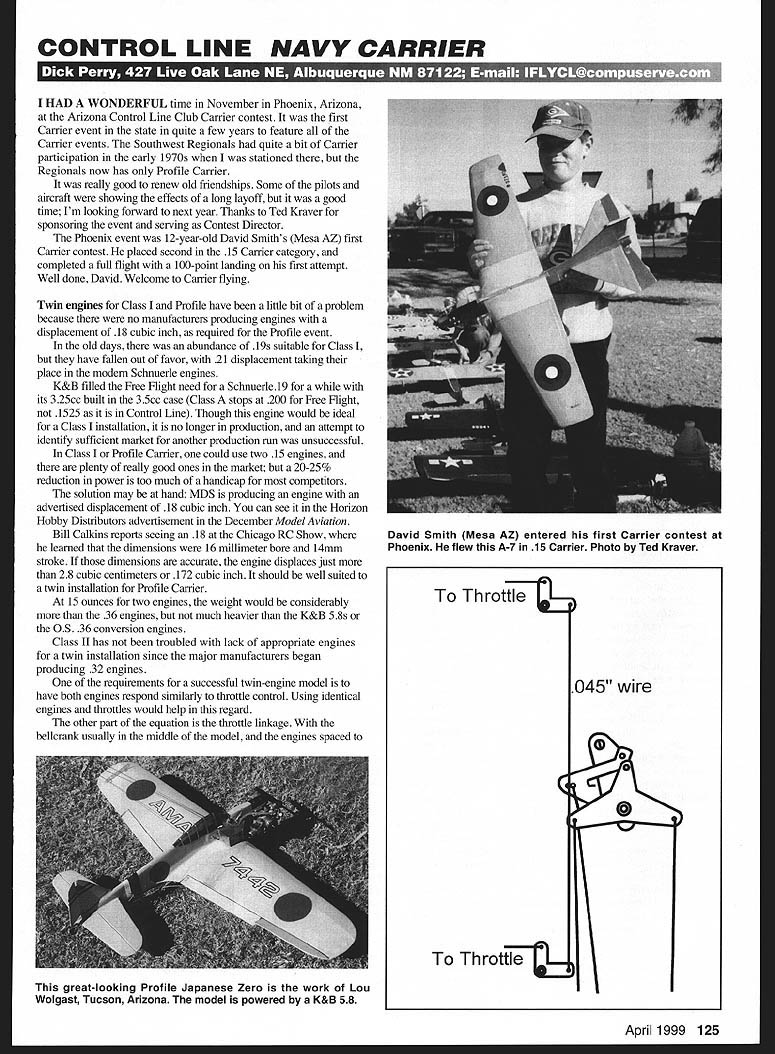
Twelve-year-old David Smith (Mesa, AZ) entered his first Carrier contest at Phoenix. He placed second in .15 Carrier and completed a full flight with a 100-point landing on his first attempt. Well done, David — welcome to Carrier flying.
ENGINES AND TWIN INSTALLATIONS
Engine availability for Profile and Class I
Twin engines for Class I and Profile have been problematic because manufacturers have not produced engines of the .18 cu in displacement required for Profile. In earlier days there were many .19s suitable for Class I, but they have fallen out of favor as .21-displacement Schnuerle engines became common.
K&B briefly filled a Free Flight need for a Schnuerle .19 with its 3.25 cc unit built in a 3.5 cc case (Class A stops at .200 cu in for Free Flight, not .1525 as it is in Control Line). That engine would be ideal for a Class I installation, but it is no longer in production and an attempt to justify another production run was unsuccessful.
Using two .15 engines in Class I or Profile is possible and there are many good .15s available, but the typical 20–25% reduction in power compared with larger engines is a significant handicap for most competitors.
A possible solution: MDS is producing an engine advertised as .18 cu in. Bill Calkins reported seeing an .18 at the Chicago R/C Show with a 16 mm bore and 14 mm stroke. If those dimensions are accurate the displacement is just over 2.8 cc (≈0.172 cu in), which should be well suited to a twin installation for Profile Carrier. Two of these .18s will weigh more than two .15s, but should still be lighter than typical .36-class installations such as K&B .58s or O.S. .36 conversion engines.
Class II has not had the same problem since major manufacturers began producing .32 engines suitable for twin installations.
Throttle control and linkage for twins
A successful twin installation requires both engines to respond similarly to throttle control. Using identical engines and identical throttles helps achieve that.
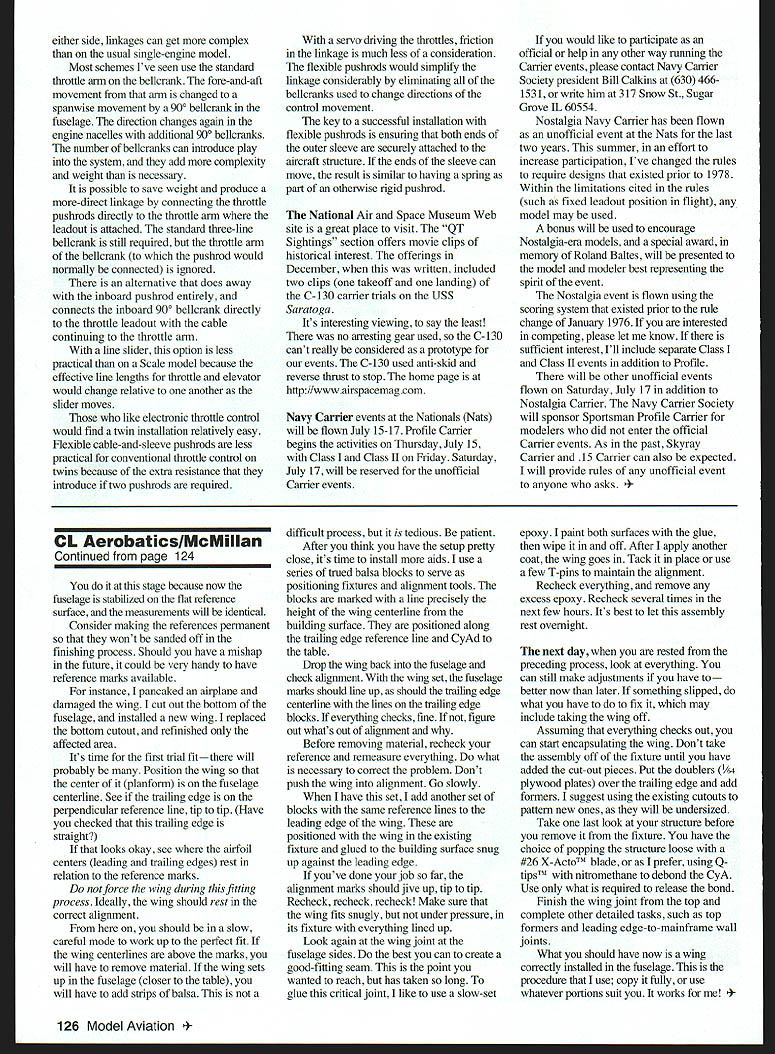
The throttle linkage can become complex. Typical layouts place the bellcrank in the middle of the fuselage while the engines sit to either side, requiring linkages and multiple 90° bellcranks to change the direction of motion. Each additional bellcrank can introduce play, complexity, weight and the need for adjustments.
Possible simplifications:
- Use a more direct linkage connecting the throttle pushrods directly to the throttle arm where practical.
- Retain the leadout attached to the standard three-line bellcrank; normally the throttle arm/bellcrank pushrod connects to the inboard 90° bellcrank.
- An alternative is to eliminate the inboard pushrod and connect the inboard 90° bellcrank directly to the throttle leadout cable, continuing to the throttle arm.
- A line-slider is less practical on a scale model because slider movement changes effective line lengths and the relationship between throttle and elevator.
Flexible cable-and-sleeve pushrods can simplify linkage by eliminating some bellcranks, but they introduce extra resistance and typically require stronger springs. The sleeve must be securely attached at both ends; otherwise sleeve movement can mimic a springy pushrod and produce unwanted throttle behavior.
MISCELLANY
National Air and Space Museum / C-130 carrier trials
The National Air and Space Museum (Air & Space) web site is worth visiting. The Sightings section offers movie clips and historical items; in December it included two clips of the C-130 carrier trials on USS Saratoga. The C-130 used anti-skid and reverse thrust to stop and no arresting gear was used, so it is not really a prototype for our Carrier events. The home page: http://www.airspacemag.com
NATIONALS (NATS) SCHEDULE AND CONTACT
Navy Carrier events at the Nationals will be flown July 15–17.
- Thursday, July 15: Profile Carrier
- Friday, July 16: Class I and Class II
- Saturday, July 17: Unofficial Carrier events (see below)
If you would like to participate as an official or help run the Carrier events, contact Navy Carrier Society event director Bill Callais:
- Phone: (630) 446-1531
- Mail: 317 Snow St., Sugar Grove IL 60554
NOSTALGIA NAVY CARRIER AND UNOFFICIAL EVENTS
Nostalgia Navy Carrier has been flown as an unofficial event at the Nats for the past two years. To increase participation, the rules have been changed to require designs that existed prior to 1978. Within the rule limitations (such as fixed leadout position in flight), any model that meets the era requirement may be used.
- A trophy will encourage Nostalgia-era models.
- A special award in memory of Ronald Bales will go to the model and modeler best representing the spirit of the event.
- The Nostalgia event is flown using the scoring system that existed prior to the rule change of January 1976.
- If there is sufficient interest, separate Class I and Class II Nostalgia events will be included.
Other unofficial events planned for Saturday, July 17:
- Spartan Profile Carrier (for models not entered in official Carrier events)
- Skyraider
- .15 Carrier
Rules for any unofficial event are available on request. If you are interested in competing or want copies of the rules, let me know.
Transcribed from original scans by AI. Minor OCR errors may remain.

