
CONTROL LINE: NAVY CARRIER
Dick Perry 427 Live Oak Lane NE, Albuquerque NM 87122 E-mail: IFLYCLC@compuserve.com
Opening notes
As I write this, the groundhog has just predicted an early spring. I hope it brings good flying weather and warm temperatures so we can all get out and test-fly before the contest season gets into full swing.
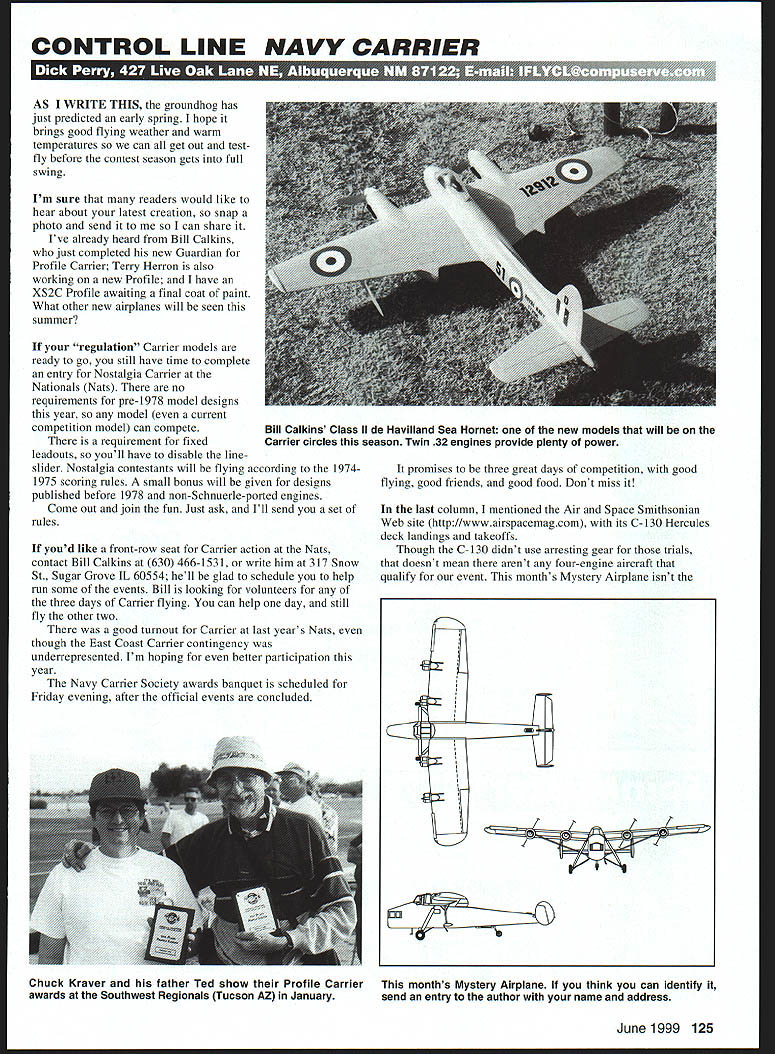
If you have a new creation, snap a photo and send it to me so I can share it. I've already heard from Bill Calkins, who just completed his new Guardian for Profile Carrier; Terry Herron is working on a new Profile; and I have an XS2C Profile awaiting a final coat of paint. What other new airplanes will we see this summer?
Nostalgia Carrier at the Nationals
If your "regulation" Carrier models are ready, you still have time to enter Nostalgia Carrier at the Nationals (Nats).
- Any model may compete this year (there are no strict pre-1978 design requirements).
- Fixed leadouts are required — you must disable the line-slider.
- Nostalgia contestants will fly according to the 1974–1975 scoring rules.
- A small bonus will be awarded for designs published before 1978 and for non–Schnuerle-ported engines.
Come out and join the fun. Ask me and I'll send you a set of rules.
Volunteers and schedule
If you'd like a front-row seat for Carrier action at the Nats, contact Bill Calkins:
- Phone: (630) 466-1531
- Mail: 317 Snow St., Sugar Grove, IL 60554
He can schedule you to help run events and is looking for volunteers for any of the three days of Carrier flying. You can help one day and still fly the other two.
There was a good turnout for Carrier last year, though the East Coast contingent was underrepresented. I'm hoping for even better participation this year. The Navy Carrier Society awards banquet is scheduled for Friday evening, after the official events conclude. It promises to be three great days of competition, with good flying, good friends, and good food. Don't miss it!
Mystery Airplane
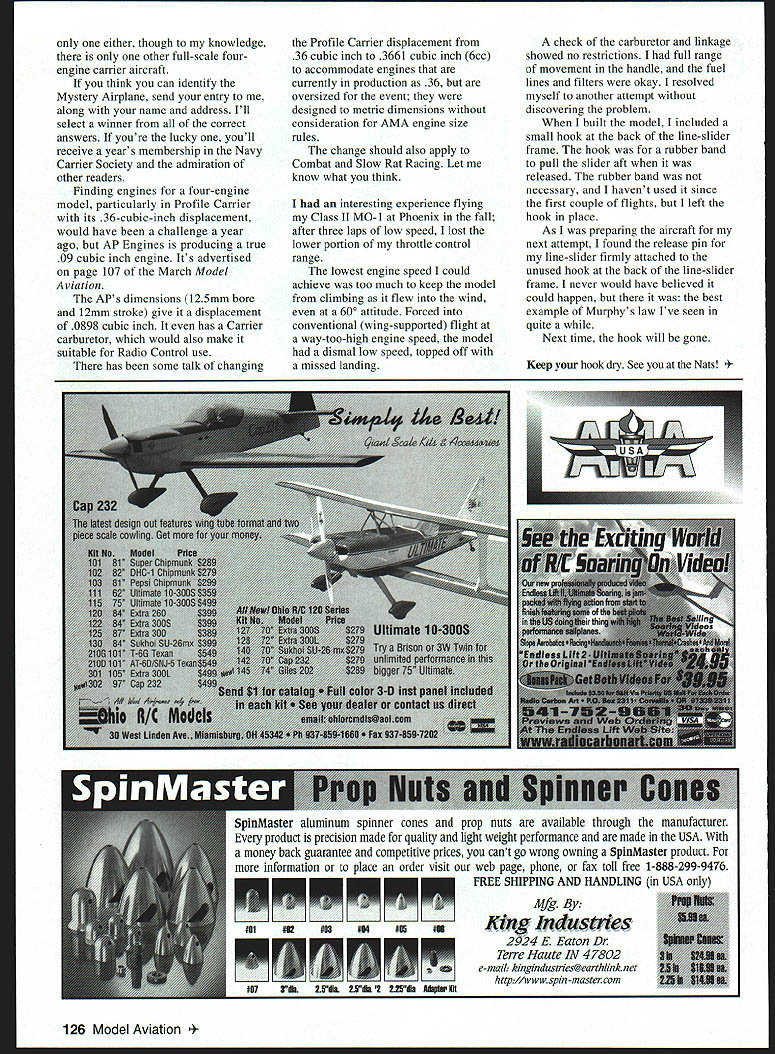
In the last column I mentioned the Air & Space Smithsonian web site (http://www.airspacemag.com) with its C-130 Hercules deck landings and takeoffs. Although the C-130 didn't use arresting gear for those trials, that doesn't mean there aren't any four-engine aircraft that qualify for our event.
This month's Mystery Airplane is not the C-130. If you think you can identify it, send your entry to the author with your name and address. I'll select a winner from all correct answers. The winner will receive a one-year membership in the Navy Carrier Society and the admiration of other readers.
Engines and displacement considerations
Finding engines for a four-engine model, particularly a Profile Carrier with its .36-cubic-inch displacement, would have been a challenge a year ago. AP Engines is now producing a true .09 cubic-inch engine, advertised in the March Model Aviation (page 107).
- AP dimensions: 12.5 mm bore × 12 mm stroke
- Displacement: 0.0898 cubic inch (approx .09 cu in)
- It is fitted with a Carrier carburetor, which would also make it suitable for radio control use.
There has been discussion about changing the Profile Carrier displacement from .36 cubic inch to .3661 cubic inch (6 cc) to accommodate engines currently produced as .36 but that are slightly oversized for the event. The event was designed using metric dimensions; any change should also apply to Combat and Slow Rat Racing. Let me know what you think.
Personal flying note — lesson learned
At Phoenix last fall I flew a Class II MO-1 and after three laps at low speed I lost the lowest throttle setting — the engine would not reduce enough to keep the model from climbing. I flew into the wind at a 60° attitude and forced it into a conventional wing-supported flight at way-too-high engine speed; the model handled poorly at low speed and topped off, and I missed the landing.
I checked the carburetor linkage and found no restrictions; fuel lines and filters were fine. On preparing the aircraft for the next attempt I discovered the cause: I had left a small hook on the back of the line-slider frame (used only for an initial rubber-band adjustment) and the release pin of the line-slider had become firmly attached to that unused hook. It was a classic Murphy's-law problem. Lesson learned — remove unnecessary hooks.
Transcribed from original scans by AI. Minor OCR errors may remain.

