
CONTROL LINE NAVY CARRIER
Dick Perry 427 Live Oak Lane NE, Albuquerque, NM 87122 E-mail: iflycl@compuserve.com
This month's column has a distinctly English tone to it, with the photos, mystery airplane, Web site, and model descriptions—but don't be misled into thinking that everything will be British.
A good number of models at the 1998 Nationals were patterned after British Royal Navy prototypes. Among them were:
- Fairey Barracuda by Garry Andrews
- Brewster 340 by Gary Hull
- Grumman Wildcats by Terry Kirby and Dave Rolley, Jr., which the Royal Navy flew during World War II
Leon Ryktarsyk brought out his Barracuda and Sea Hornet but did not enter them in the competition. I hope we'll see them fly this year.
This month's photos are of two other models based on British designs.
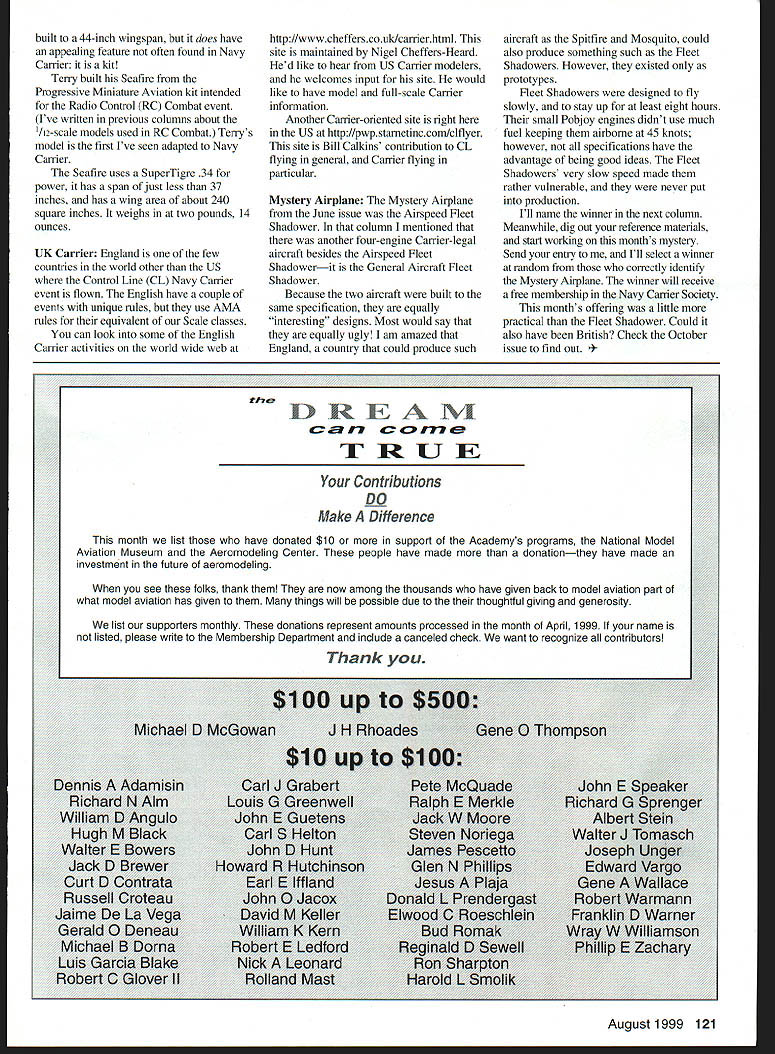
Bill Calkins' Class I Hawker Sea Fury is an original design. Bill's model spans somewhat less than the 44-inch limit and weighs in at two pounds, 14 ounces, powered by a K&B .40S engine.
The Sea Fury was the last piston-engined fighter in the Fleet Air Arm's first-line units. It first flew as a prototype at the end of World War II, and its performance was excellent. The Bristol Centaurus engine, which produced just under 2,500 horsepower, was a large factor in that. The Sea Fury still does rather well on the air-racing circuit.
With its broad, clipped-ellipse wings, it is among the lower-aspect-ratio propeller fighters, which means it can have a relatively large wing area as a model built for the Navy Carrier event. If built to exact scale, with a span of 44 inches, it will have a wing area of 368 square inches. The MO-1 built to scale has a wing area of 345 square inches. The larger wing area is an advantage in slow flight, as long as weight can be kept under control.
The Sea Fury's engine makes for a rather large fuselage cross-section. With a large spinner and sleek lines, this size factor need not be a detriment to high speed. The cowl would be large enough (approximately 5 3/4 inches in diameter) to nearly conceal a .60 or .65 engine. Bill's smaller model does a good job of hiding the K&B.
Larger fuselages don't necessarily mean heavier fuselages, as long as appropriate construction methods are used. Because a larger cross-section can carry the same load with much thinner materials, it is possible to keep weight under control with judicious design. Curved surfaces are particularly well-suited to thin materials because the arched surface is much less prone to deformation than the flat surfaces on a model such as the MO-1.
I've built a six-inch-diameter fuselage using four 1/8- by 1/2-inch balsa longerons, and very narrow ring formers of lightweight plywood. The main loads are carried by a 1/4-inch fuselage skin, with a covering of 1/2-ounce glass cloth. It is one of the most rigid fuselages I've built—much stiffer than any of my MO-1 models.
The Seafire is the naval version of the venerable Spitfire. In its clipped-wing variants, which were designed for operations at lower altitudes, the Seafire is one of the lowest-aspect-ratio aircraft eligible for bonus points in Navy Carrier. It will produce a model of more than 420 square inches if built to a full 44-inch span.
The other model shown is a Supermarine Seafire Mk XV, built by Terry Kirby for Class I. It isn't the clipped-wing variant, and it isn't built to a 44-inch wingspan, but it does have an appealing feature often not found in Navy Carrier: it is a kit!
Terry built his Seafire from the Progressive Miniature Aviation kit intended for the Radio Control (RC) Combat event. (I've written in previous columns about the 1/12-scale models used in RC Combat.) Terry's model is the first I've seen adapted to Navy Carrier.
The Seafire uses a SuperTigre .34 for power, has a span of just less than 37 inches, a wing area of about 240 square inches, and weighs in at two pounds, 14 ounces.
UK Carrier
England is one of the few countries in the world other than the U.S. where the Control Line (CL) Navy Carrier event is flown. The English have a couple of events with unique rules, but they use AMA rules for their equivalent of our Scale classes.
You can look into some of the English Carrier activities on the World Wide Web at http://www.cheffers.co.uk/carrier.html. This site is maintained by Nigel Cheffers-Heard. He'd like to hear from U.S. Carrier modelers, and he welcomes input for his site. He would like to have model and full-scale Carrier information.
Another Carrier-oriented site is right here in the U.S. at http://pwp.starnetinc.com/clflyer. This site is Bill Calkins' contribution to CL flying in general, and Carrier flying in particular.
Mystery Airplane
The Mystery Airplane from the June issue was the Airspeed Fleet Shadower. In that column I mentioned that there was another four-engine Carrier-legal aircraft besides the Airspeed Fleet Shadower — it is the General Aircraft Fleet Shadower. Because the two aircraft were built to the same specification, they are equally interesting designs. Most would say that they are equally ugly! I am amazed that England, a country that could produce such aircraft as the Spitfire and Mosquito, could also produce something such as the Fleet Shadowers. However, they existed only as prototypes.
Fleet Shadowers were designed to fly slowly and to stay up for at least eight hours. Their small Mercury engines didn't use much fuel keeping them airborne at 45 knots; however, not all specifications have the advantage of the best good ideas. The Fleet Shadowers' very slow speed made them rather vulnerable, and they were never put into production.
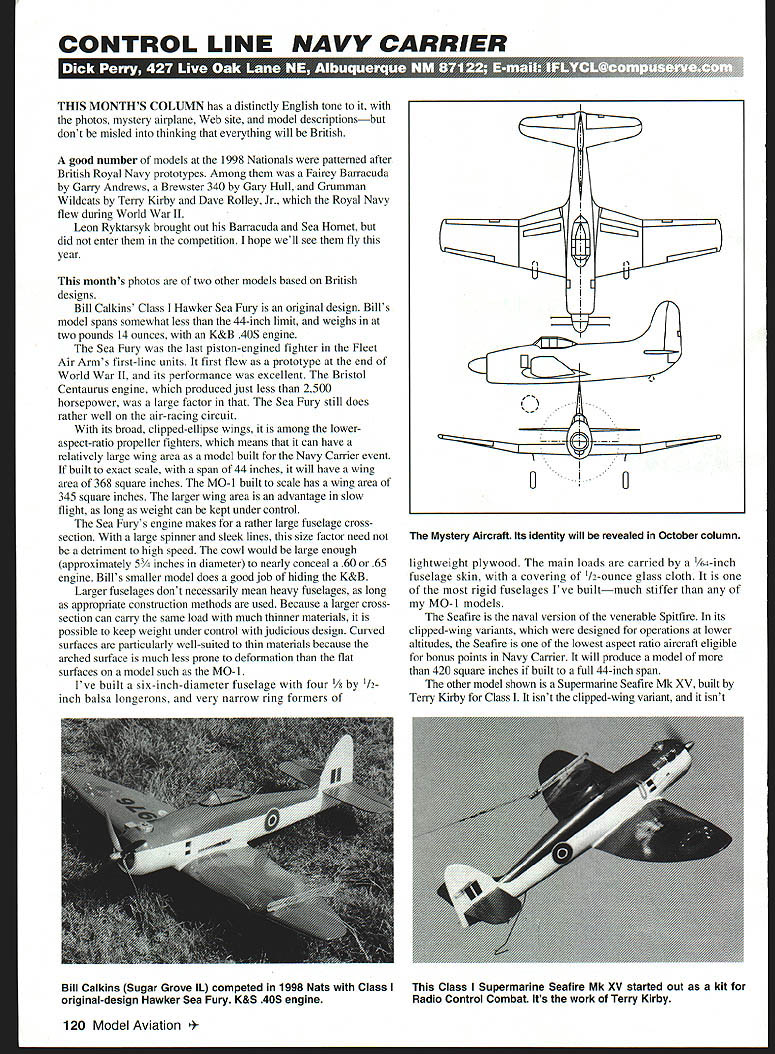
I'll name the winner in the next column. Meanwhile, dig out your reference materials and start working on this month's mystery. Send your entry to me, and I'll select a winner at random from those who correctly identify the Mystery Airplane. The winner will receive a free membership in the Navy Carrier Society.
This month's offering was a little more practical than the Fleet Shadower. Could it also have been British? Check the October issue to find out.
Transcribed from original scans by AI. Minor OCR errors may remain.

