

CONTROL LINE NAVY CARRIER
Dick Perry 427 Live Oak Lane NE, Albuquerque, NM 87122 E-mail: IFLYCL@compuserve.com
OOPS! I gave incorrect credit for the beautiful de Havilland Sea Hornet shown in the June issue. It doesn't belong to Bill Calkins at all; the Sea Hornet is the handiwork of Bill Melton of Las Cruces, New Mexico.
I received notice from Bill Calkins just after the photo was published, and I was able to trace down the rightful owner through the AMA number on the wing. I'll bet the authors of the original rule requiring models to display owners' AMA numbers didn't envision that benefit.
Bill's Sea Hornet is the second version of that particular prototype he has produced. The first was built to the maximum-allowable 44-inch wingspan (345 square inches), and it ended up weighing more than the four-pound limit at that size.
The current version of the Sea Hornet in the June issue is smaller. Its 40-inch span allows for a lighter model, and attention to weight produced a model that tips the scales at 57 ounces. That's only slightly more than what a 205-square-inch Class II Guardian used to weigh, and the Sea Hornet has 285 square inches of wing area and two engines.
The Sea Hornet is a Class II model that uses two O.S. .32 SX engines, which run on suction. Bill has been having some trouble with the outboard engine, which likes to quit on takeoff. He has tried all of the known tricks — including replacing the fuel tank — without results so far, but he hopes to identify the problem and get the airplane flying reliably.
Bill reports that the Sea Hornet flies very nicely when both engines are running and has excellent slow-speed characteristics. As are the rest of Bill's models, the Sea Hornet is an outstanding example of the modeler's art.
I received photos of two new twin-engine models from Terry Kirby.
Terry's Profile F7F Tigercat is based on the Flying Models plans, but with a foam wing substituted for the built-up wing on the plans. Terry has installed two MDS .18 engines. Control is through a conventional three-line bellcrank. The F7F flies well and has potential, although Terry only has a few flights on it so far.
Terry's North American PBJ-1H was scaled down from Ziroli plans. It also uses MDS .18s for power. Terry used a two-line bellcrank and an electronic throttle control system by J&R. The PBJ is his first attempt at electronic controls, and it was a real learning experience. The finished model weighed in at two ounces more than the four-pound limit. Terry has yet to fly the model.
It's nice to see a few twin-engine aircraft at the flying fields, but the 20-point bonus for multiengine models has yet to produce a rush of new models. The additional cost and complexity, for no proven performance advantage, has many modelers waiting to see if others are successful with multiengine models before they take the plunge.
I have a multiengine model on the drawing board, and I hope to have it flying for the next competition season. I don't believe there will be a performance penalty — certainly no more than will be compensated by the bonus points.
My main reason for changing from the MO-1 designs that I've used for the last 15 years is variety. I'm growing tired of the MO-1, no matter how well it flies. I firmly believe that, with a little development work, other prototypes will produce models equal in performance. The reason for the MO-1's success is that so many modelers have worked on them for so long, and shared their work with the rest of us.
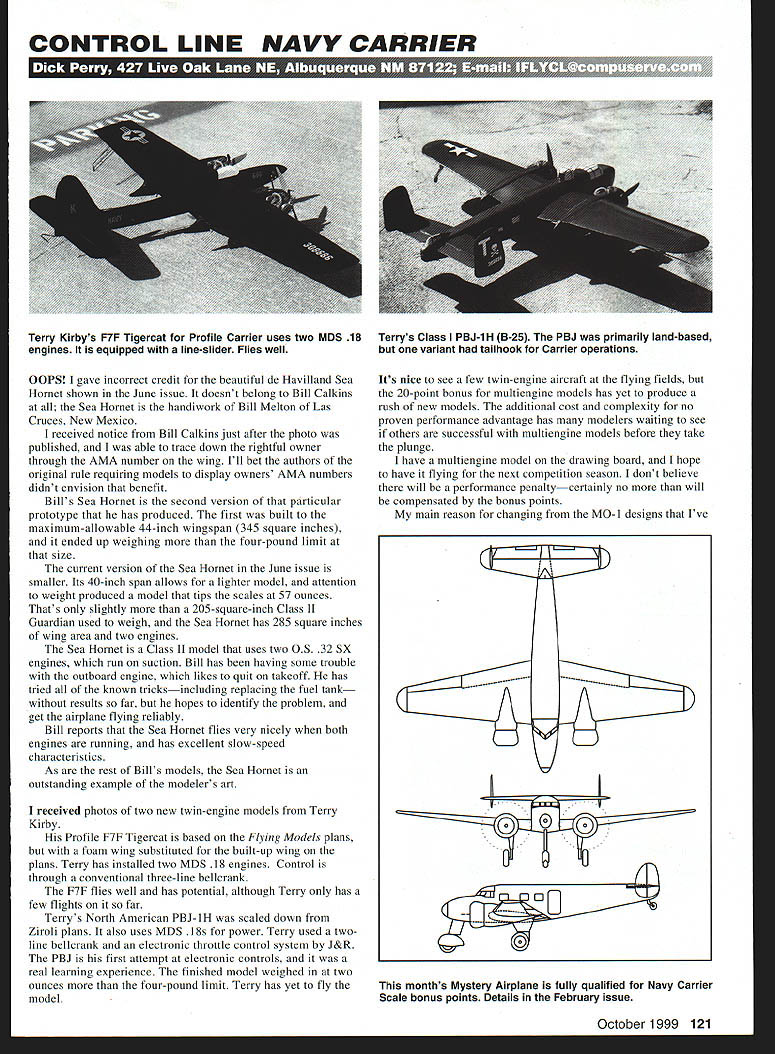
Mystery Airplane
The last Mystery Airplane has yet to be published as I write this column, so I haven't heard from an anticipated horde of readers pointing out the error in the drawing of the Curtiss XBTC-2. I suspect I will not be disappointed; you all did a pretty good job of keeping me in line.
The side-view drawing of the wing doesn't match the top view in the drawing that I submitted. When I noticed the discrepancy, I started making comparisons to my photo records and checking other parts of the drawing. I found a couple of other inconsistencies in the drawing as well. I've corrected the drawing and will provide a copy to anyone who would like one.
This error shows the problems with relying on a single source for information! I try to provide accurate drawings when they might be used for Scale documentation, but I rushed the Curtiss drawing to make publication deadlines and I didn't do enough verification.
The XBTC-2 was produced in 1943 as a single-seat torpedo bomber, but the specification was superseded by the need for a second crew member as airborne radar began to see more widespread use. As a result, the aircraft never went into production. The XBTC-2 was powered by the Pratt & Whitney R-4360, driving twin contra-rotating three-bladed propellers.
I'll announce the winner of the June Mystery Airplane contest in the February issue. December will be devoted to the Nationals coverage.
The April Mystery Airplane was the General Aircraft Fleet Shadower. Congratulations to Bennett Randman of Jackson, Mississippi, who was selected from among the correct entries. He will receive a free year's membership in the Navy Carrier Society.
The Mystery Airplane for this month is much more practical than the Fleet Shadower as a multiengine model for Navy Carrier. Though it doesn't look the part, it is fully qualified for Scale bonus points. I'll tell you more about it in the February issue, lest I give you too much of a hint this time.
Identifying the aircraft that it was based on shouldn't be much of a problem, but you'll have to provide the correct Navy designation for this particular aircraft to be a winner in February.
If you know the identity of this month's Mystery Airplane, you may write or E-mail me at the addresses shown at the heading of this column.
Transcribed from original scans by AI. Minor OCR errors may remain.

