
Control Line: Navy Carrier
Richard L. Perry
THE BALLOTS have been counted in the CLCB voting for the 1978-1979 rules. Since the rule book is likely to be late again (not all contest boards were as timely as the CLCB), I'll summarize the changes so that you will have an idea of what to expect next year. If you are building a new model this winter, you will probably want to include the new rules in your plans.
Aircraft requirements have changed slightly, mostly in the paint department. Acceptable paint schemes have expanded a little. Any military paint scheme is acceptable. Profile models must carry national markings (the old "Navy markings" requirement was rather ill-defined). The paint and marking requirements are now the same for all Carrier classes. A canopy or designated cockpit area is required on Profile Carrier models.
The engine rules for Profile Carrier are the same as they have been for the last two years. Although a definite majority of modelers questioned wanted a change, the desired change (requiring mass-produced plain-bearing engines) was not an option the way the CLCB was voting. The only way we could get mass-produced engines was to allow ball bearings as well. My feelings are that a change to ball-bearing engines in Profile is about ten years overdue, but a lot of people still want plain bearings, and the CLCB apparently felt that keeping plain bearings was more important than doing away with the machine-shop engines.
All flights are now official when the contestant signals for low speed. Infractions during low speed now result only in loss of low-speed points—the flight will still be official. The flight will continue, and the contestant can still earn landing points. As in the past, touching the "water" at any time will immediately end the flight.
The "radical deviation" rule has been dropped in Class I and Class II. In its place is a 60° nose-high limit during low speed flight which applies to all classes of Carrier. It is recognized that momentary loss of control could cause violations of this rule. Because of this, momentary, inadvertent deviations will be allowed. Because the 60° limit is subject to an official's judgment, a contestant must be notified when he exceeds the 60° limit, and be allowed to correct without penalty. Failure to correct immediately will cause loss of low-speed score. Any intentional deviation, such as repeated oscillations above 60° in an attempt to slow the model, will also cause the loss of low-speed score.
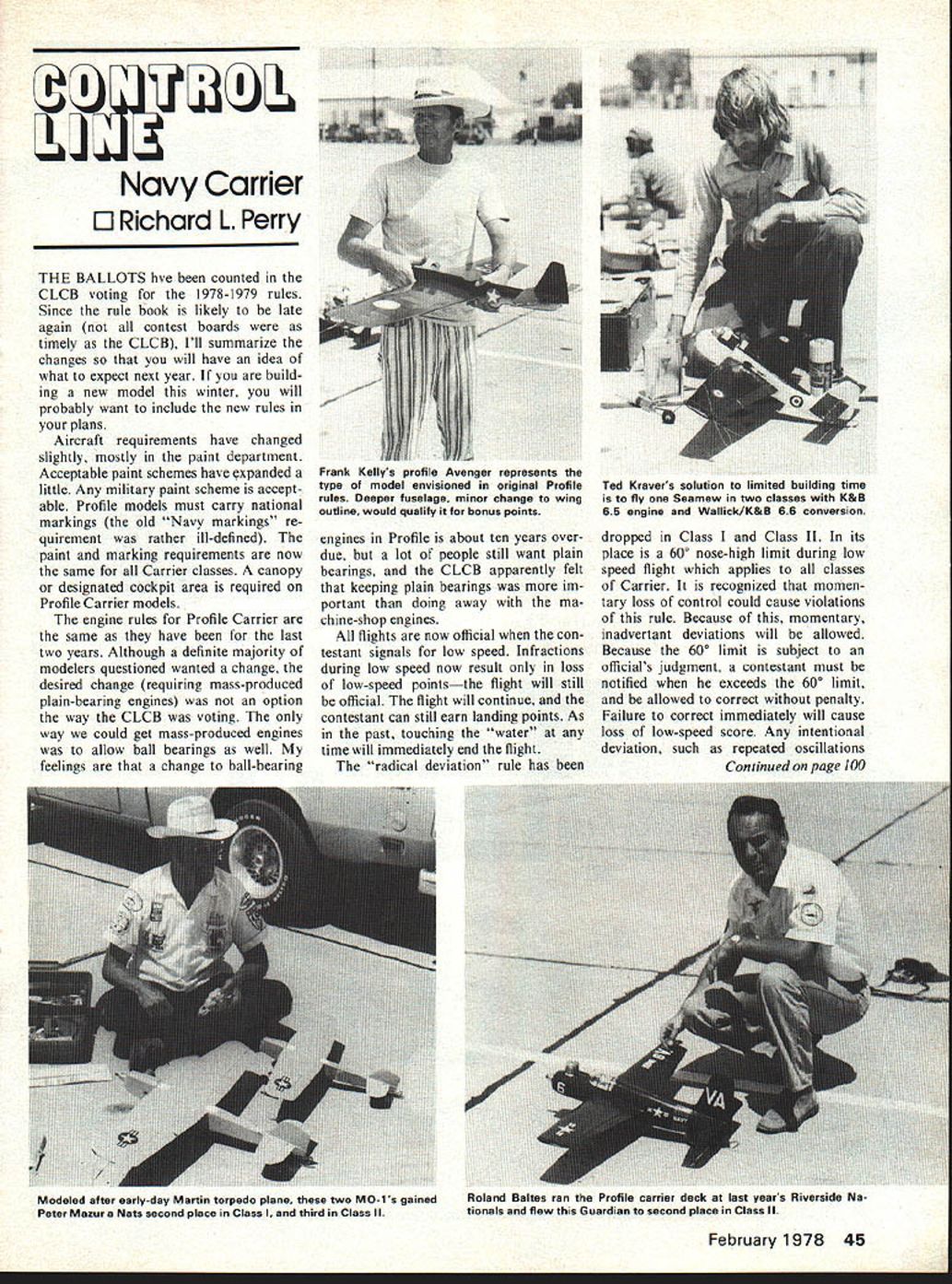
A scale bonus of 10 points now will be awarded in the profile class. The rules are rather liberal. Acceptable designs are defined just as for Class I and Class II, but the judging is less restrictive. Three-view drawings must be presented, but there is no maximum allowable deviation as in the scale classes. The judge must be able to see clearly that the model is a close representation of the original airplane. There are no restrictions to moveable surfaces as long as overall outlines of wing and tail surfaces are preserved, and there is no requirement for scale-like dihedral or landing gear location.
Those are the rules. There are no changes that will make existing models or engines obsolete. The only possible change required on a few profile class models will be the addition of some type of cockpit and appropriate national markings. Anyone planning to build a new Profile Carrier model should at least consider building a model that will qualify for the scale bonus points.
There are a number of kits that are easily adopted to the new bonus point rule. The G-S Products Bearcat, Corsair, and Skyraider are excellent kits designed from the beginning for the Profile Carrier event. The old Sterling Mustang is a good candidate since the P-51 (A and D models) was used for Navy takeoff and landing trials in 1944.
Most full-scale carrier airplanes had tapered wings, and scratch-building a tapered wing requires cutting out a lot of different size ribs. There are, however, numerous kits which can be used as the basis for a tapered-wing profile scale model. The Goldberg Shoestring (swept leading edge) and Cosmic Wind (straight leading edge) yield about 360 square inches of wing area. The Sterling Ringmaster is in the same size category. For airplanes with only a mild trailing edge taper, the construction method used in the Top Flite Flight Streak is appropriate. The Flight Streak uses a rectangular wing section with a tapered trailing edge flap. The Sterling Yak-8 is smaller. It may be hard to find, but it should make a good Airabonta with minor changes to wing and tail outlines.
There were quite a few straight-wing biplanes around in the earlier days of naval aviation. The Sig Fokker D-VII and Spad kits would be a good place to start, or a biplane could be built around Harry Higley's Mo-Bipe design.
As new scale-like profile models are developed, I would like to include photos of them in this column. Send black and white glossy prints of your favorite model to me, and I will try to have the photos published. All I ask is your participation and patience; we are limited on the number of photos we can print each month.
Richard L. Perry, 5016 Angelita Ave., Dayton, OH 45424.
Transcribed from original scans by AI. Minor OCR errors may remain.

