
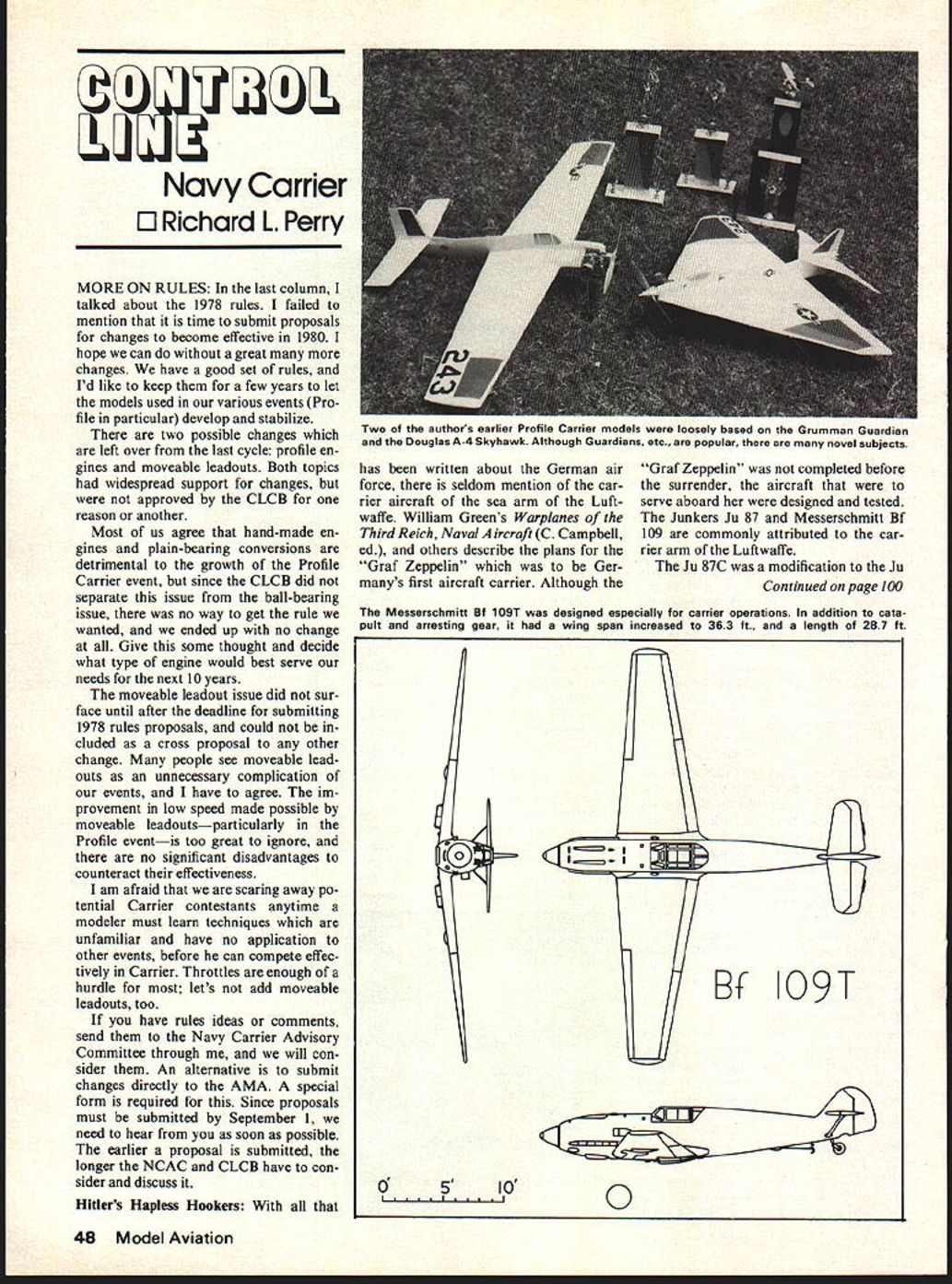
Control Line: Navy Carrier
Richard L. Perry
MORE ON RULES: In the last column, I talked about the 1978 rules. I failed to mention that it is time to submit proposals for changes to become effective in 1980. I hope we can do without a great many more changes. We have a good set of rules, and I'd like to keep them for a few years to let the models used in our various events (Profile in particular) develop and stabilize.
There are two possible changes which are left over from the last cycle: profile engines and moveable leadouts. Both topics had widespread support for changes, but were not approved by the CLCB for one reason or another.
Most of us agree that hand-made engines and plain-bearing conversions are detrimental to the growth of the Profile Carrier event, but since the CLCB did not separate this issue from the ball-bearing issue, there was no way to get the rule we wanted, and we ended up with no change at all. Give this some thought and decide what type of engine would best serve our needs for the next 10 years.
The moveable leadout issue did not surface until after the deadline for submitting 1978 rules proposals, and could not be included as a cross proposal to any other change. Many people see moveable leadouts as an unnecessary complication of our events, and I have to agree. The improvement in low speed made possible by moveable leadouts—particularly in the Profile event—is too great to ignore, and there are no significant disadvantages to counteract their effectiveness.
I am afraid that we are scaring away potential Carrier contestants anytime a modeler must learn techniques which are unfamiliar and have no application to other events before he can compete effectively in Carrier. Throttles are enough of a hurdle for most; let's not add moveable leadouts, too.
If you have rules ideas or comments, send them to the Navy Carrier Advisory Committee through me, and we will consider them. An alternative is to submit changes directly to the AMA. A special form is required for this. Since proposals must be submitted by September 1, we need to hear from you as soon as possible. The earlier a proposal is submitted, the longer the NCAC and CLCB have to consider and discuss it. Ju 87B design which added folding wings and a tail hook. A Ju 87T torpedo plane was also tested.
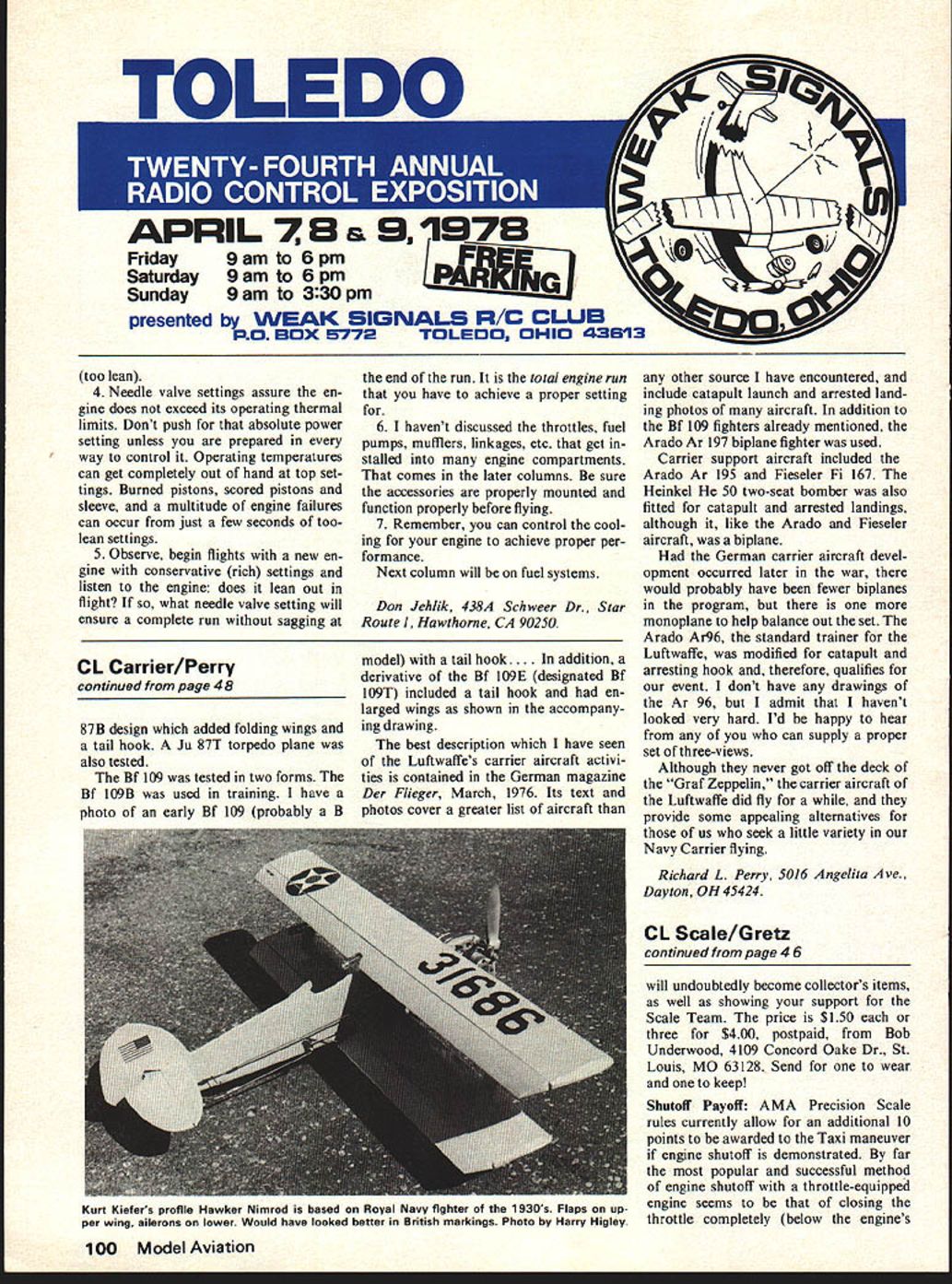
The Bf 109 was tested in two forms. The Bf 109B was used in training. I have a photo of an early Bf 109 (probably a B model) with a tail hook. In addition, a derivative of the Bf 109E (designated Bf 109T) included a tail hook and had enlarged wings as shown in the accompanying drawing.
The best description which I have seen of the Luftwaffe's carrier aircraft activities is contained in the German magazine Der Flieger, March, 1976. Its text and photos cover a greater list of aircraft than any other source I have encountered, and include catapult launch and arrested landing photos of many aircraft. In addition to the Bf 109 fighters already mentioned, the Arado Ar 197 biplane fighter was used.
Carrier support aircraft included the Arado Ar 195 and Fieseler Fi 167. The Heinkel He 50 two-seat bomber was also fitted for catapult and arrested landings, although it, like the Arado and Fieseler aircraft, was a biplane.
Had the German carrier aircraft development occurred later in the war, there would probably have been fewer biplanes in the program, but there is one more monoplane to help balance out the set. The Arado Ar 96, the standard trainer for the Luftwaffe, was modified for catapult and arresting hook and, therefore, qualifies for our event. I don't have any drawings of the Ar 96, but I admit that I haven't looked very hard. I'd be happy to hear from any of you who can supply a proper set of three-views.
Although they never got off the deck of the "Graf Zeppelin," the carrier aircraft of the Luftwaffe did fly for a while, and they provide some appealing alternatives for those of us who seek a little variety in our Navy Carrier flying.
Richard L. Perry, 5016 Angelina Ave., Dayton, OH 45424.
Transcribed from original scans by AI. Minor OCR errors may remain.

