
ControlLine.. Navy Carrier.. Richard Perry
WITH A FOOT and a half of snow on the carrier deck and frost on my workshop windows, the spring contest season seems a long way off. By the time you read this, it will be time to get out to the practice circles again. I envy those of you in warmer climates who can fly all year.
It will be good to get out and fly again, and I am looking forward to making a lot of contests this year. I hope to catch up with some old friends whom I didn't see very much last year and to meet some of you who have been writing to me.
I was reviewing some contest results from last year, and was pleased to see Terry Herron listed among the winners again. Terry took a few years off to go to school, and we missed him. His 370+ scores in Class II indicate that he hasn't lost any of the skills that made him so competitive in the past.
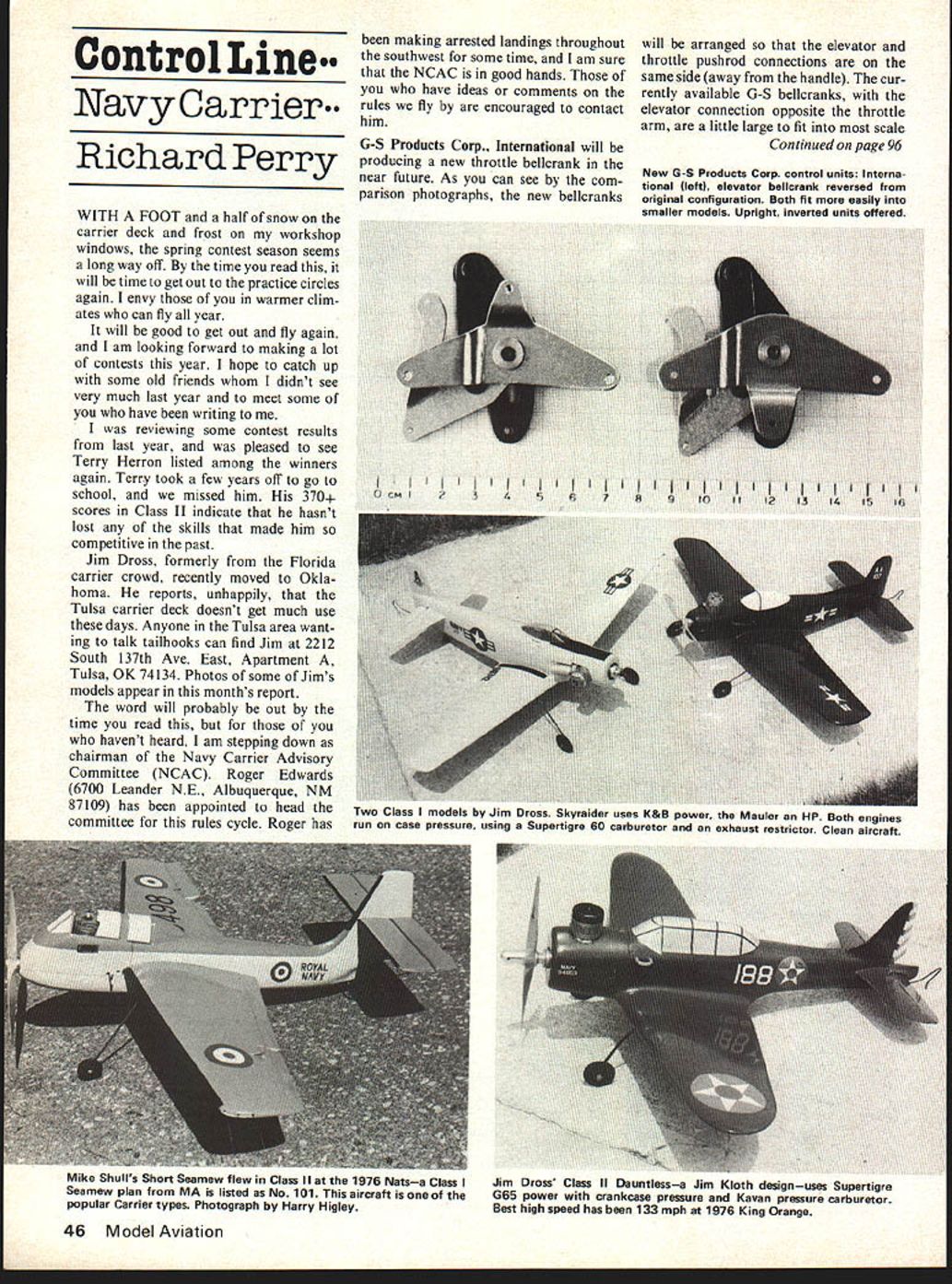
Jim Dross, formerly from the Florida carrier crowd, recently moved to Oklahoma. He reports, unhappily, that the Tulsa carrier deck doesn't get much use these days. Anyone in the Tulsa area wanting to talk tailhooks can find Jim at 2212 South 137th Ave. East, Apartment A, Tulsa, OK 74134. Photos of some of Jim's models appear in this month's report.
The word will probably be out by the time you read this, but for those of you who haven't heard, I am stepping down as chairman of the Navy Carrier Advisory Committee (NCAC). Roger Edwards (6700 Leander N.E., Albuquerque, NM 87109) has been appointed to head the committee for this rules cycle. Roger has been making arrested landings throughout the southwest for some time, and I am sure that the NCAC is in good hands. Those of you who have ideas or comments on the rules we fly by are encouraged to contact him.
G-S Products Corp. International will be producing a new throttle bellcrank in the near future. As you can see by the comparison photographs, the new bellcranks will be arranged so that the elevator and throttle pushrod connections are on the same side (away from the handle). The currently available G-S bellcranks, with the elevator connection opposite the throttle arm, are a little large to fit into most scale models. class Carrier ships. The new bellcranks are more compact, and still provide the strength, smoothness, and throttle arm movement which are characteristic of the original G-S bellcranks. The G-S control units are the best available, in my opinion, and that includes the home-built units I have seen.
We Carrier fliers are fortunate that our models usually last a long time. I've flown the same models for five or six seasons. This can be a mixed blessing, however, since the control system is usually concealed and cannot be inspected for damage. The single components most susceptible to the ravages of time are the leadouts. Corrosion and wear are the primary problems.
Solid and cable leadouts are both popular. Solid leadouts withstand corrosion and wear better if you can keep them straight. I prefer cable leadouts. I won't argue for or against either type, but I do want to mention some procedures which could reduce the potential problems.
Solid leadouts can be soldered fairly well. Cable leadouts are a little different. The small-diameter wire is more prone to damage from overheating, and excess flux can be carried inside the cable for quite a distance from the solder joint. If not properly neutralized (a baking soda solution is good), this flux can cause corrosion. I recommend the wire-wound line terminations shown in the rule book for cable leadouts to avoid the potential problems of soldering cable. Epoxy can be used to coat lightly the wire bindings to prevent them from coming loose.
Leadouts should always be larger diameter wire than that required for control lines to avoid excessive weakening due to wear. At the bellcrank, where wear is greatest, leadouts can be placed inside small-diameter brass tubing.
With proper precautions to combat wear and corrosion, the control system can remain safe and functional for the life of the model.
Richard L. Perry, 5016 Angelita Ave., Dayton, OH 45424.
Transcribed from original scans by AI. Minor OCR errors may remain.

