
Control Line: Navy Carrier
Richard Perry
I promised that I would write about throttles this month. I have had quite a few ideas to try out, but haven't yet had a chance to test them all. My goal has been to find a variety of throttle schemes that are simple to operate and readily available through hobby shops.
The simplest throttle is the suction system using a standard RC carburetor. There is a wide variety of RC .40 and .60 engines available, and the latter designs are quite powerful. The only disadvantage to using a suction system is that engine power will be somewhat lower than that of a pressurized system with a wide-open intake. The greatest power difference is seen when using a suction carburetor that was designed for the size engine you are using. This is because most carburetors are designed to provide consistent performance over a wide range of conditions. These carbs have small throat areas so that fuel draw will be relatively high. Most engines can run quite successfully on much larger carburetors.
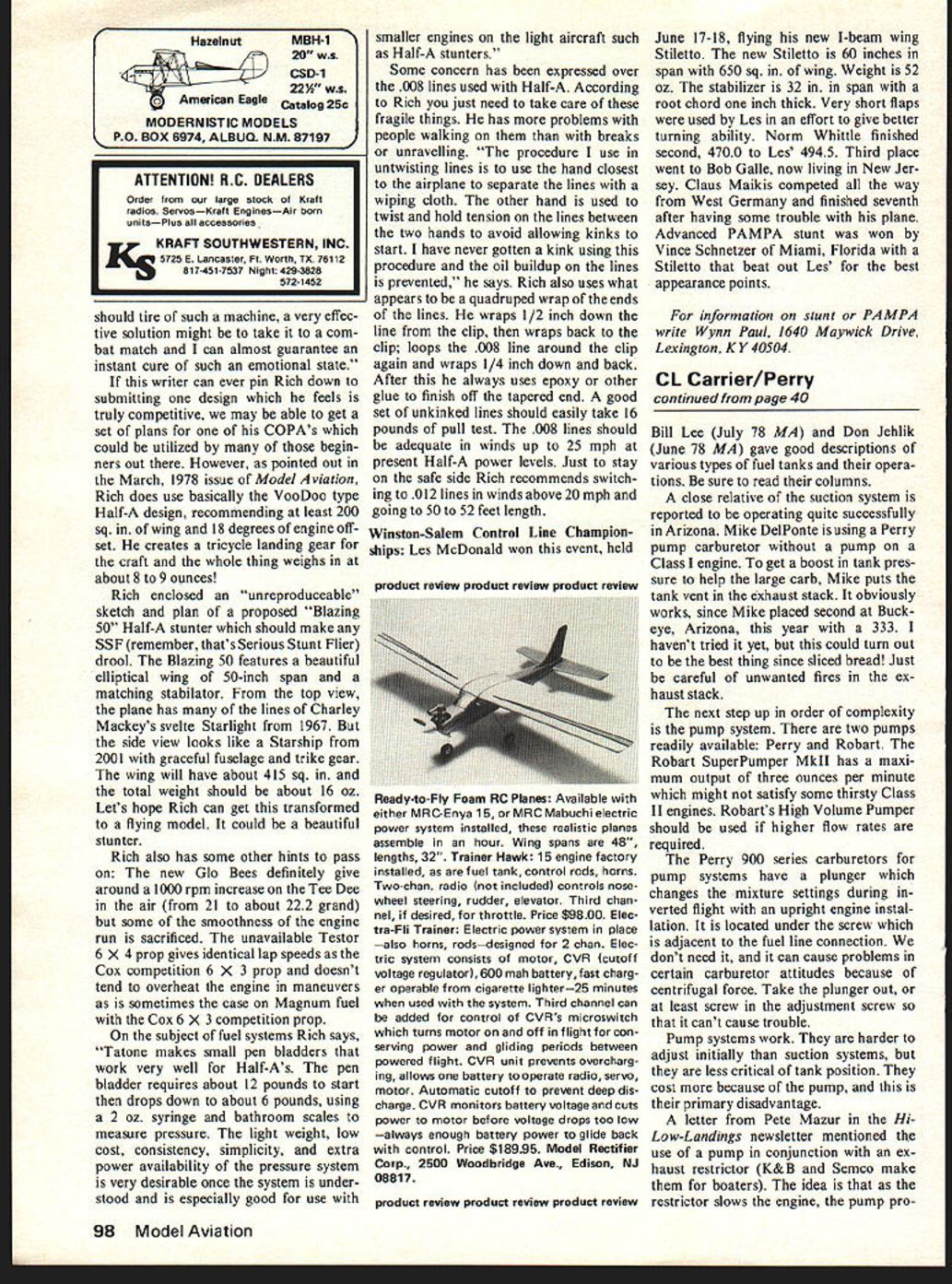
I've talked before about carburetor throat area for Profile Carrier engines. A 35–40 size engine can function quite well on a carb with a throat area of 30 mm². This is about 50–80% larger than the carburetors supplied with this size engine. It is, in fact, about the size carburetor usually found on a .60. The large Perry carbs, for example, have throat areas of 29 mm² (except for the Kraft 61 and OPS 60; these are about 37 mm²). I have used a large Perry carb on a Fox .36 with no problems at all. A rear-intake engine should be able to use even larger carbs because the fuel tank can be closer to the carb.
I haven't yet run tests on the .60-size Class II engines, but they should be able to handle a 55 mm² carb without trouble. Perhaps a carb as large as 62 mm² would work. I hope so because that is the size of the Perry 900-series carburetors which are designed for use with a pump.
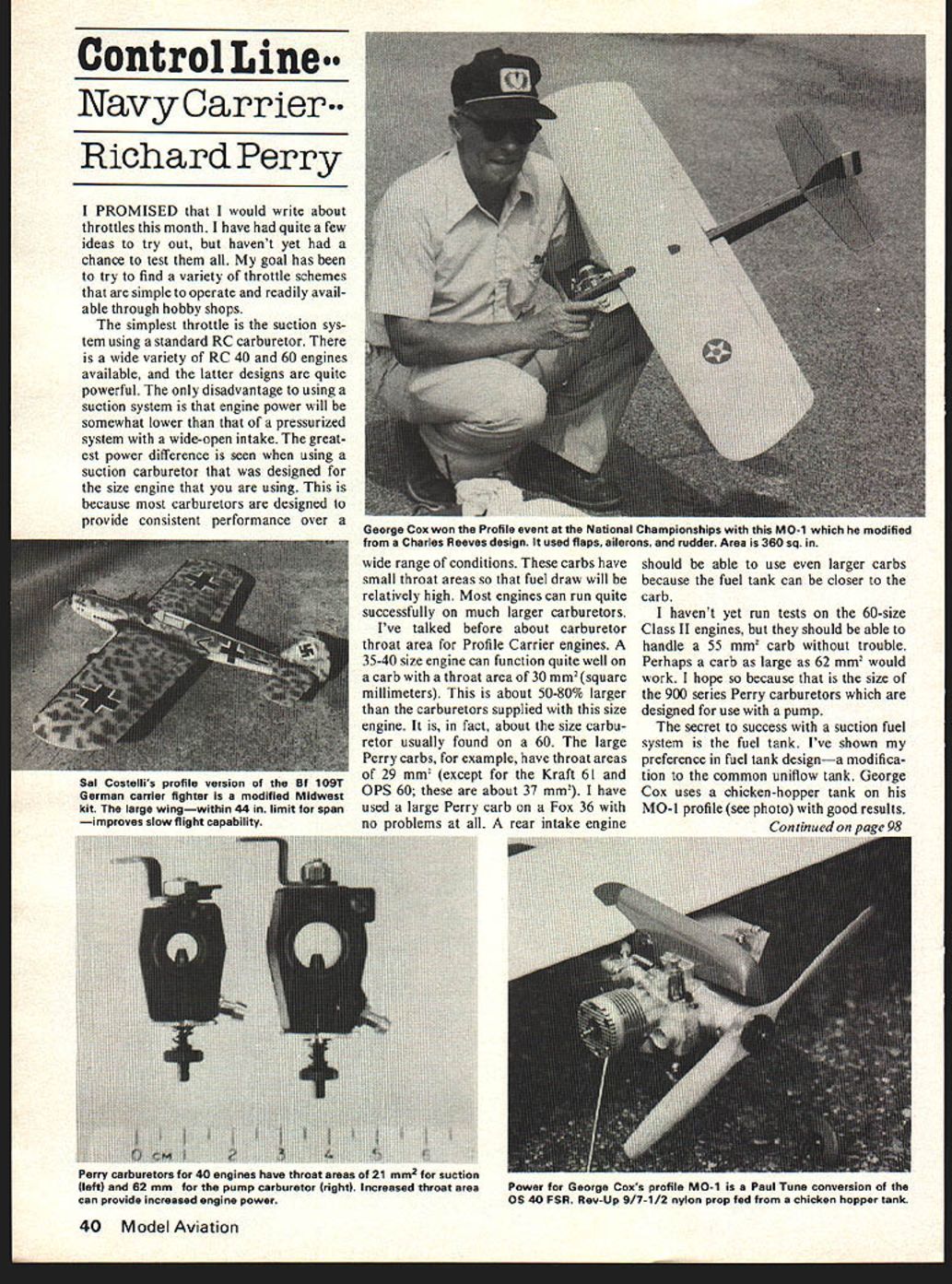
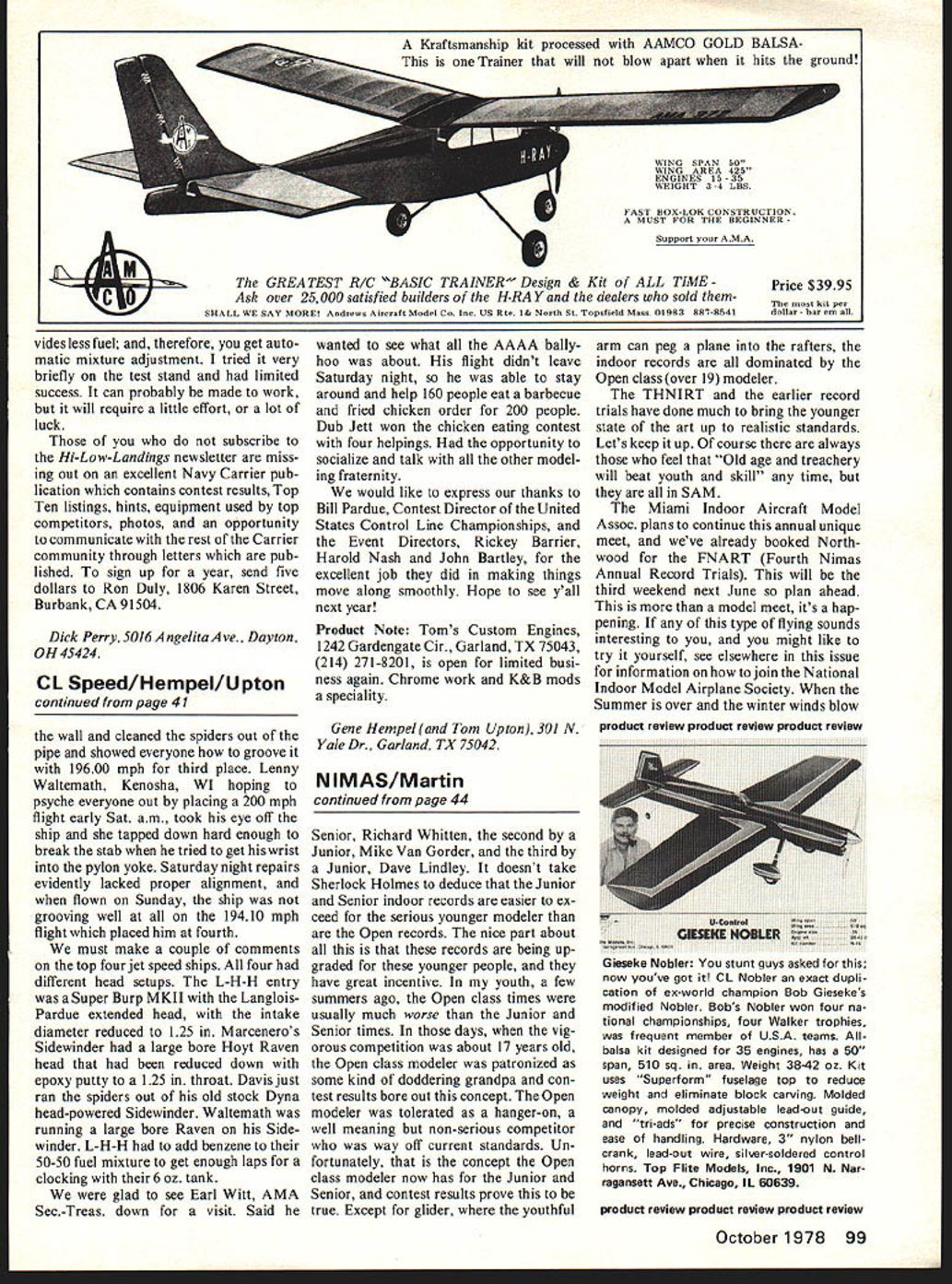
The secret to success with a suction fuel system is the fuel tank. I've shown my preference in fuel tank design—a modification to the common uniflow tank. George Cox uses a chicken-hopper tank on his MO-1 profile with good results.
CL Carrier / Perry
Bill Lee (July '78 MA) and Don Jehlick (June '78 MA) gave good descriptions of various types of fuel tanks and their operations. Be sure to read their columns.
A close relative of the suction system is reported to be operating quite successfully in Arizona. Mike DelPonte is using a Perry pump carburetor without a pump on a Class I engine. To get a boost in tank pressure to help the large carb, Mike puts the tank vent in the exhaust stack. It obviously works, since Mike placed second at Buckeye, Arizona, this year with a 0.333. I haven't tried it yet, but this could turn out to be the best thing since sliced bread! Just be careful of unwanted fires in the exhaust stack.
The next step up in order of complexity is the pump system. There are two pumps readily available:
- Perry
- Robart
The Robart SuperPumper Mk II has a maximum output of three ounces per minute which might not satisfy some thirsty Class II engines. Robart's High Volume Pumper should be used if higher flow rates are required.
The Perry 900-series carburetors for pump systems have a plunger which changes the mixture settings during inverted flight with an upright engine installation. It is located under the screw adjacent to the fuel line connection. We don't need it, and it can cause problems at certain carburetor attitudes because of centrifugal force. Remove the plunger, or at least screw in the adjustment screw so that it can't cause trouble.
Pump systems work. They are harder to adjust initially than suction systems, but they are less critical of tank position. They cost more because of the pump, and this is their primary disadvantage.
A letter from Pete Mazur in the Hi-Low-Landings newsletter mentioned the use of a pump in conjunction with an exhaust restrictor (K & B and Semco make them for boaters). The idea is that as the restrictor slows the engine, the pump provides less fuel; therefore, you get automatic mixture adjustment. I tried it very briefly on the test stand and had limited success. It can probably be made to work, but it will require a little effort—or a lot of luck.
Those of you who do not subscribe to the Hi-Low-Landings newsletter are missing out on an excellent Navy Carrier publication which contains contest results, Top Ten listings, hints, equipment used by top competitors, photos, and an opportunity to communicate with the rest of the Carrier community through published letters. To sign up for a year, send five dollars to Ron Duly, 1806 Karen Street, Burbank, CA 91504.
Dick Perry 5016 Angelita Ave. Dayton, OH 45424
Transcribed from original scans by AI. Minor OCR errors may remain.

