
Control Line: Navy Carrier
By Richard L. Perry
The last few months have been rather enjoyable for me. Traveling to the NATS and attending contests in DeKalb, Illinois, and Dayton, Ohio, gave me a chance to renew some old friendships and start new ones. There never seems to be as much time as we'd like, however, to sit around and talk Carrier. There was some discussion around DeKalb about a wintertime gathering of Carrier fliers to talk about last summer's flying and next year's models, and to keep warm thoughts of Carrier flying while the cold winter winds blow. I hope it works out — it sounds like a good time; I wish I were going to be around to enjoy it.
I'll be back in the Southwest this winter after being away for over five years. I'll be moving around a lot, but will still receive my mail at my Dayton, Ohio, address, so you'll have no trouble sending me photos of your latest project or a description of your newest idea.
The NATS report covered the who, what, and when, but it left out much of the how. I'd like to fill in some of that data.
NATS highlights
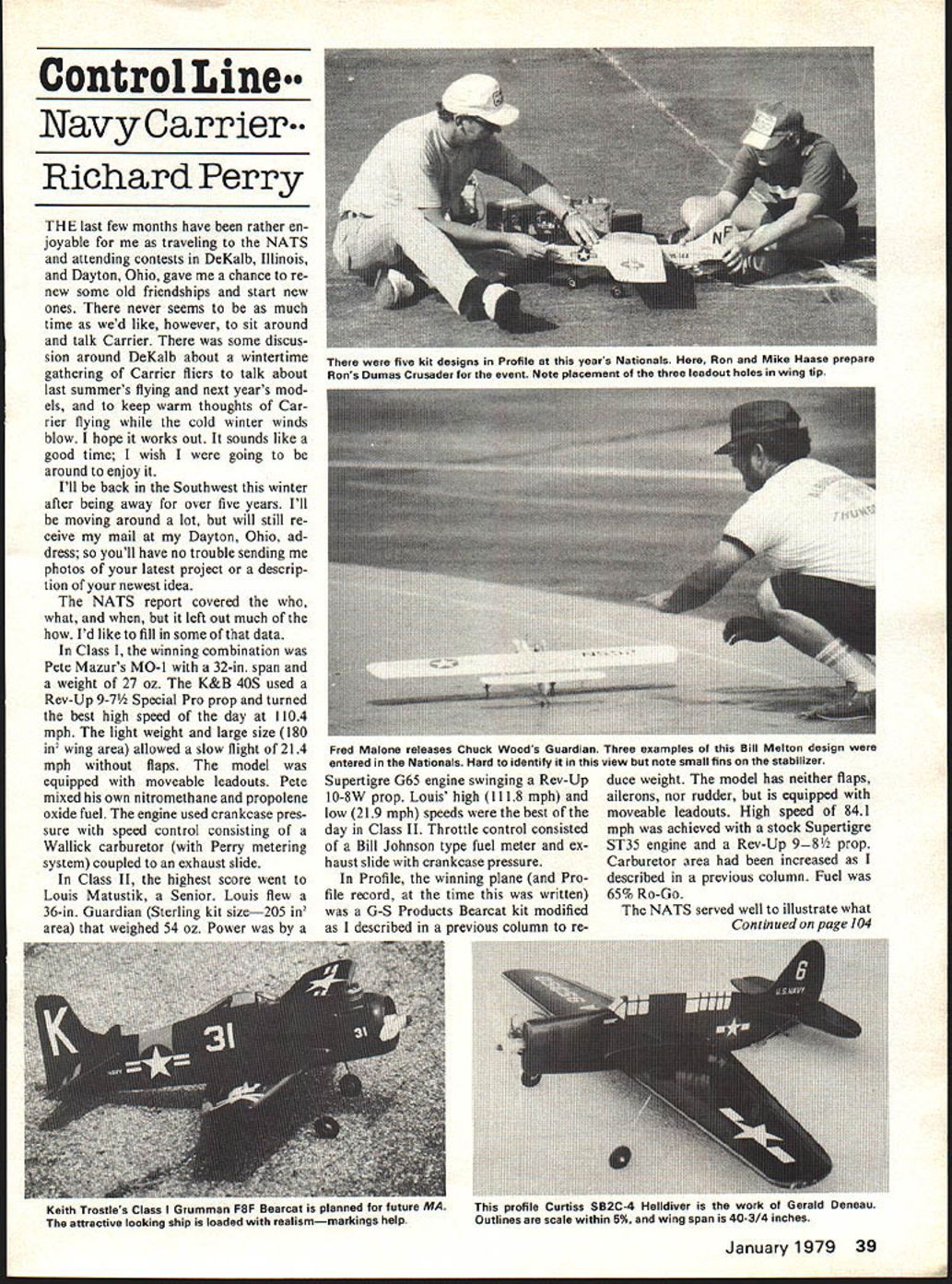
#### Class I The winning combination was Pete Mazur's MO-1 with a 32‑in. span and a weight of 27 oz. The K&B 40S used a Rev‑Up 9-7½ Special Pro prop and turned the best high speed of the day at 110.4 mph. The light weight and large size (180 in² wing area) allowed a slow flight of 21.4 mph without flaps. The model was equipped with movable leadouts. Pete mixed his own nitromethane and propylene oxide fuel. The engine used crankcase pressure with speed control consisting of a Wallick carburetor (with Perry metering system) coupled to an exhaust slide.
There were almost as many different engines as there were entries in Class I. The other 40‑size events have encouraged engine manufacturers to produce a wide variety of good 40 engines, and the technology is spreading into the RC 40s as well. Most good hobby shops should have a selection of engines that would be suitable for Class I, not to mention the Pylon and Rat engines that are often cast aside because they no longer restart well enough.
#### Class II The highest score went to Louis Matustik, a Senior. Louis flew a 36‑in. Guardian (Sterling kit size — 205 in² area) that weighed 54 oz. Power was provided by a Supertigre G65 engine swinging a Rev‑Up 10-8W prop. Louis' high (111.8 mph) and low (21.9 mph) speeds were the best of the day in Class II. Throttle control consisted of a Bill Johnson–type fuel meter and an exhaust slide with crankcase pressure.
In Class II there were fewer engine types (Webra, Supertigre, and Rossi) but no single dominant engine. Many manufacturers are building new 60s for RC Pattern that should be really great for Class II. They even come with throttles. And don't put down suction fuel systems, either: the second highest Class II flight score at the NATS (157.6) went to an MO-1 with nothing movable but the elevator. The top speed was only 2 mph behind the leader, and the engine used a stock Supertigre carburetor and a suction fuel system.
#### Profile The winning plane (and Profile record, at the time this was written) was a G-S Products Bearcat kit modified as I described in a previous column to reduce weight. The model has neither flaps, ailerons, nor rudder, but is equipped with movable leadouts. A high speed of 84.1 mph was achieved with a stock Supertigre ST35 engine and a Rev‑Up 9-8½ prop. Carburetor area had been increased as I described earlier. Fuel was 65% Ro‑Go.
In Profile, 73% of the engines were Supertigre ST35s. There were three Fox Profile Carrier Specials and one TWA, which did not fly because of damage to the model. The Supertigres took all the trophies.
Observations and advice
The NATS served well to illustrate what I've been trying to get across for years — it doesn't take a machine shop, a trick airplane, and a large bankroll to enjoy Carrier flying and do well at it. Profile was won using commercially available equipment with minor modifications which were discussed at length in this magazine — no secrets! Even the fuel was right off the dealer's shelf.
So pass the word and get your friends out to fly Carrier. Take your Profile ships to the field on the weekends, and pass the handle around. Once someone has flown with a throttle, it's hard to go back to just two lines.
Rules and CLCB
The last few issues have listed the new rules proposals for the current cycle. If you haven't read them, by all means do so. Some of the proposals may sound good to you; others may turn your stomach, but whatever your opinion, you owe it to yourself to make your thoughts known to your CLCB representative. Hurry, if you want to be heard. Their addresses are in the "Competition Newsletter" section. The CLCB members don't have crystal balls to tell them what you want; they have to hear from you. Invest a few minutes in the future of your event.
Contact
Richard L. Perry 5016 Angelita Ave. Dayton, OH 45424
Transcribed from original scans by AI. Minor OCR errors may remain.

