
Navy Carrier
Richard L. Perry
THE NATS is behind us for another year, the flying season in the northern states is drawing to a close, and it is time to start thinking about building new ships for next year. Before you start, however, take time to ensure that your engines will be ready to go next spring when you are. With castor oil rather expensive and mixing rather poorly with larger amounts of nitromethane, many commercial fuels use synthetic oil. While the synthetics do quite well at their assigned job, lubrication, some of them are very poor at a second function which we all expect from oil—rust prevention. Many of the synthetics lose any rust-preventive qualities they might have had when exposed to the air for a week or two. To be safe, put a good rust-inhibiting oil in your engines before wrapping them up for the winter.
Many people use WD-40 or one of the other multi-purpose household oils. I have used Marvel Mystery Oil for over a year and am quite pleased with it. It was recommended to me by Tom Upton who uses it because it can take higher temperatures than most other oils without decomposing. Look for it in auto supply stores; it is sold as a top oil in a Tatone priming bottle with a 1/16 in. OD brass tube stuck in the spout. The tube makes a good oil "can."
Senior Profile Carrier at this year's NATS was won by Carlos Aloise using a new engine from Fox. It is a rear-exhaust engine with Schnuerle-type porting and no exhaust restrictor. By NATS time, only 16 had been produced, and there were enough parts for 100. If the engine is successful, I expect there will be more. Carlos' Fox was at least as good as the Super Tigres, and as experience is gained with the engine, it may well end up being the best unmodified engine for the event. Its announced price of $80 is more than double the cost of the other Profile engines on the market.
While the new Fox is a little removed from the inexpensive engines originally envisioned for Profile Carrier, I certainly can't blame Duke Fox for trying to produce a better product. Progress is the name of the game in competition. The new engine is a good argument for allowing engine modifications, and is one more reason why CDs should consider having Expert/Novice divisions for Profile Carrier at their contests.
Expert/Novice classes have been tried in some areas already, and these should serve as a good basis for submitting rules proposals for such a division. Members of the CL Contest Board with whom I have spoken favor some means of establishing experience or skill levels in Carrier as well as other events. If you have any ideas, submit a rules change proposal (ask AMA HQ for the necessary form) or send it to me and I will see that the Navy Carrier Advisory Committee looks at it.
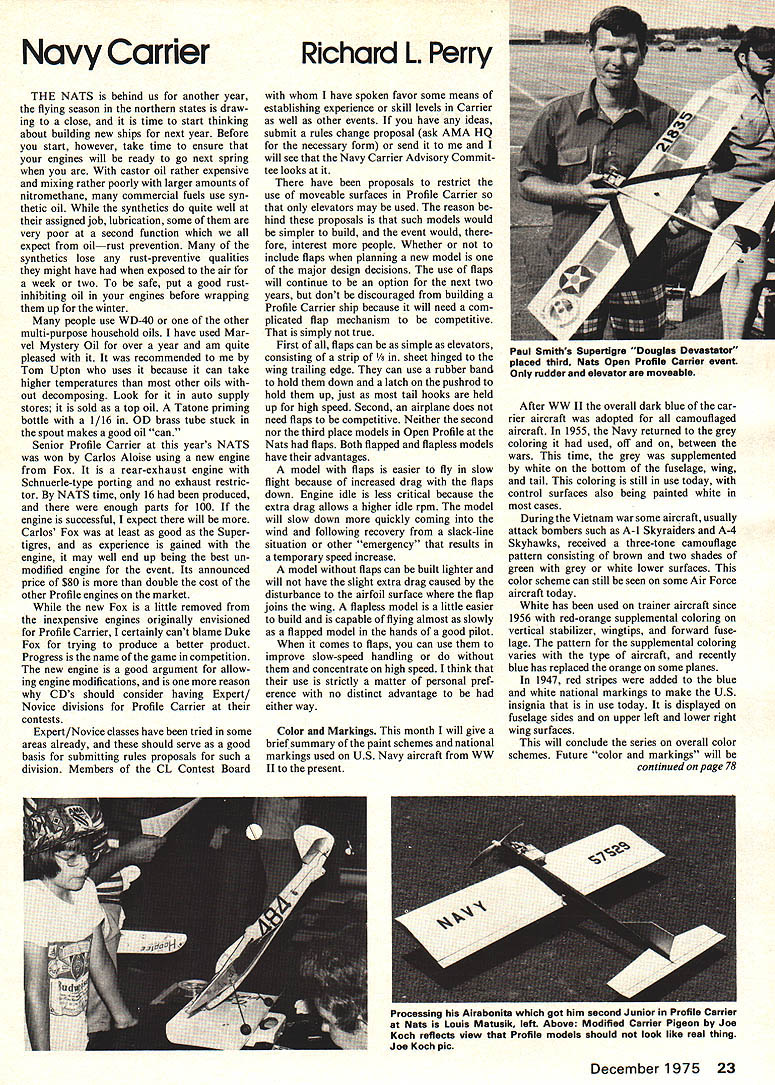
There have been proposals to restrict the use of moveable surfaces in Profile Carrier so that only elevators may be used. The reason behind these proposals is that such models would be simpler to build, and the event would, therefore, interest more people. Whether or not to include flaps when planning a new model is one of the major design decisions. The use of flaps will continue to be an option for the next two years, but don't be discouraged from building a Profile Carrier ship because it will need a complicated flap mechanism to be competitive. That is simply not true.
First of all, flaps can be as simple as elevators, consisting of a strip of 1/32 in. sheet hinged to the wing trailing edge. They can use a rubber band to hold them down and a latch on the pushrod to hold them up, just as most tail hooks are held up for high speed. Second, an airplane does not need flaps to be competitive. Neither the second nor the third place models in Open Profile at the Nats had flaps. Both flapped and flapless models have their advantages.
A model with flaps is easier to fly in slow flight because of increased drag with the flaps down. Engine idle is less critical because the extra drag allows a higher idle rpm. The model will slow down more quickly in the wind and following recovery from a slack-line situation or other "emergency" that results in a temporary speed increase.
A model without flaps can be built lighter and will not have the slight extra drag caused by the disturbance to the airfoil surface where the flap joins the wing. A flapless model is a little easier to build and is capable of flying almost as slowly as a flapped model in the hands of a good pilot. When it comes to flaps, you can use them to improve slow-speed handling or do without them and compete on high speed. I think that their use is strictly a matter of personal preference with no distinct advantage to be had either way.
Color and Markings
This month I will give a brief summary of the paint schemes and national markings used on U.S. Navy aircraft from WW II to the present.
After WW II the overall dark blue of the carrier aircraft was adopted for all camouflaged aircraft. In 1955, the Navy returned to the gray coloring it had used on and off between wars. This gray was supplemented by white on the bottom of the fuselage, wing and tail. This coloring is still in use today, with control surfaces also being painted white in most cases.
During the Vietnam War some aircraft, usually attack bombers such as A-1 Skyraiders and A-4 Skyhawks, received a three-tone camouflage pattern consisting of brown and two shades of green with gray lower surfaces. This color scheme can still be seen on some Air Force aircraft today.
White has been used on trainer aircraft since 1956 with red-orange supplemental coloring on the vertical stabilizer, wingtips, and forward fuselage. The pattern for the supplemental coloring varies with the type of aircraft, and recently blue has replaced the orange on some planes.
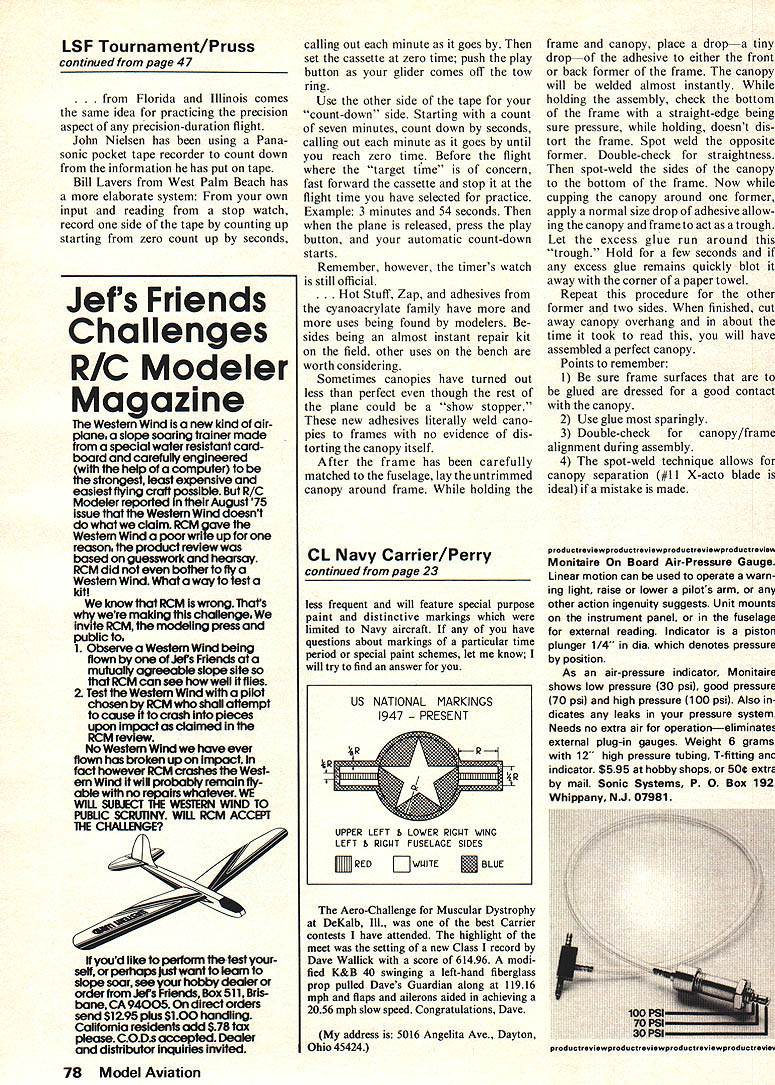
In 1947, red stripes were added to the blue and white national markings to make the U.S. insignia that is in use today. It is displayed on fuselage sides and on upper left and lower right wing surfaces.
This will conclude the series on overall color schemes. Future "Color and Markings" will be continued on page 78.
Control Line: Navy Carrier
less frequent and will feature special purpose paint and distinctive markings which were limited to Navy aircraft. If any of you have questions about markings of a particular time period or special paint schemes, let me know; I will try to find an answer for you.
US NATIONAL MARKINGS 1947 - PRESENT
UPPER LEFT & LOWER RIGHT WING LEFT & RIGHT FUSELAGE SIDES
RED WHITE BLUE
The Aero-Challenge for Muscular Dystrophy at DeKalb, Ill., was one of the best Carrier contests I have attended. The highlight of the meet was the setting of a new Class I record by Dave Wallick with a score of 614.96. A modified Keil K&B 40 swinging a left-hand fiberglass prop pulled Dave's Guardian along at 119.16 mph and flaps and ailerons aided in achieving a 20.56 mph slow speed. Congratulations, Dave.
(My address is: 5016 Angelita Ave., Dayton, Ohio 45424.)
Transcribed from original scans by AI. Minor OCR errors may remain.

