


Control Line: Navy Carrier
Richard Perry
Overview
This month's topics include Ron Duly's record-setting Class II model and related thoughts on trimming Carrier models, plus some discussion of flaps — both simple and complex.
Class II record and Ron Duly's model
The Class II record (at the time this was written) belongs to Ron Duly of Burbank, California. The model is a prototype XTB3F-2S Grumman Guardian with a 36-inch wingspan. It is basically a Sterling kit fuselage with new wing and tail surfaces to match the prototype outlines. The wing is carved from a solid piece of 3/4-inch balsa with 1/64-inch plywood inserts in the leading and trailing edges. Flaps and ailerons are used; the rudder is fixed.
Ron uses a stock Rossi ABC 60 with the piped-timed liner (non-Schnuerle). His normal fuel and feed system:
- Fuel: 70% nitromethane, 10% propylene oxide, 20% oil.
- Feed: metal fuel tank and crankcase pressure.
- Throttle: Bill Johnson type fuel meter and exhaust slide.
Ron has done well with this combination for some time, including a first at the 1977 NATS. The record performance resulted from improvements in the propeller and in low-speed handling.
Propeller changes
Ron used a Rev-up 10-8W prop which had been pitched up to a true 8-inch pitch. This prop was the latest and best in a series of props which were changed in increments of 1/4 inch pitch from the stock 10-8W prop (approximately 7-inch pitch based on the back of the blade).
Center of gravity and low-speed handling
Low-speed handling was improved by shifting the center of gravity (CG) aft slightly. Ron gave no exact balance point, but it was likely about:
- 15% to 20% of the mean aerodynamic chord (MAC)
- roughly 20% to 25% of the root chord on a Guardian wing
A CG located at 15% to 20% MAC with a large tail volume ratio, as on most high-powered, propeller-driven prototypes, should provide plenty of elevator effectiveness to hold the nose attitude when the wing is stalled. From there, practice is required to learn the characteristics of the model and engine and to perfect a smooth throttle technique.
Balance, practice, and good throttle technique are the important factors in good low-speed performance. Neither Ron nor I use moveable leadouts, and 20-mph flights pose no problems. Ron uses ailerons, as do about half of Class I and Class II fliers; I side with the other half and don't use ailerons — it's simpler. I think wing-tip weight is more effective than ailerons in maintaining line tension under all flight conditions. It is a matter of personal preference.
One further problem often encountered in low-speed flight is oscillation in roll near the stall. Rog Edwards of Albuquerque, New Mexico, and I have both found that washing out the wingtips (twisting the tips so that the leading edge is down) by two to three degrees can help solve the oscillation problem. Smooth throttle technique also seems to help.
A technique which I have found to work very well on Class I and Class II models is to set the engine thrust line and the horizontal stabilizer level (zero incidence). I set the wing root at two degrees positive incidence measured from the leading edge to the trailing edge (not along the bottom of the airfoil). A two-degree washout puts the wingtips at zero incidence. This results in very light loading of the tips during high-speed flight and seems to improve elevator effectiveness during slow flight.
Youngman flaps — Bob Reynolds' system
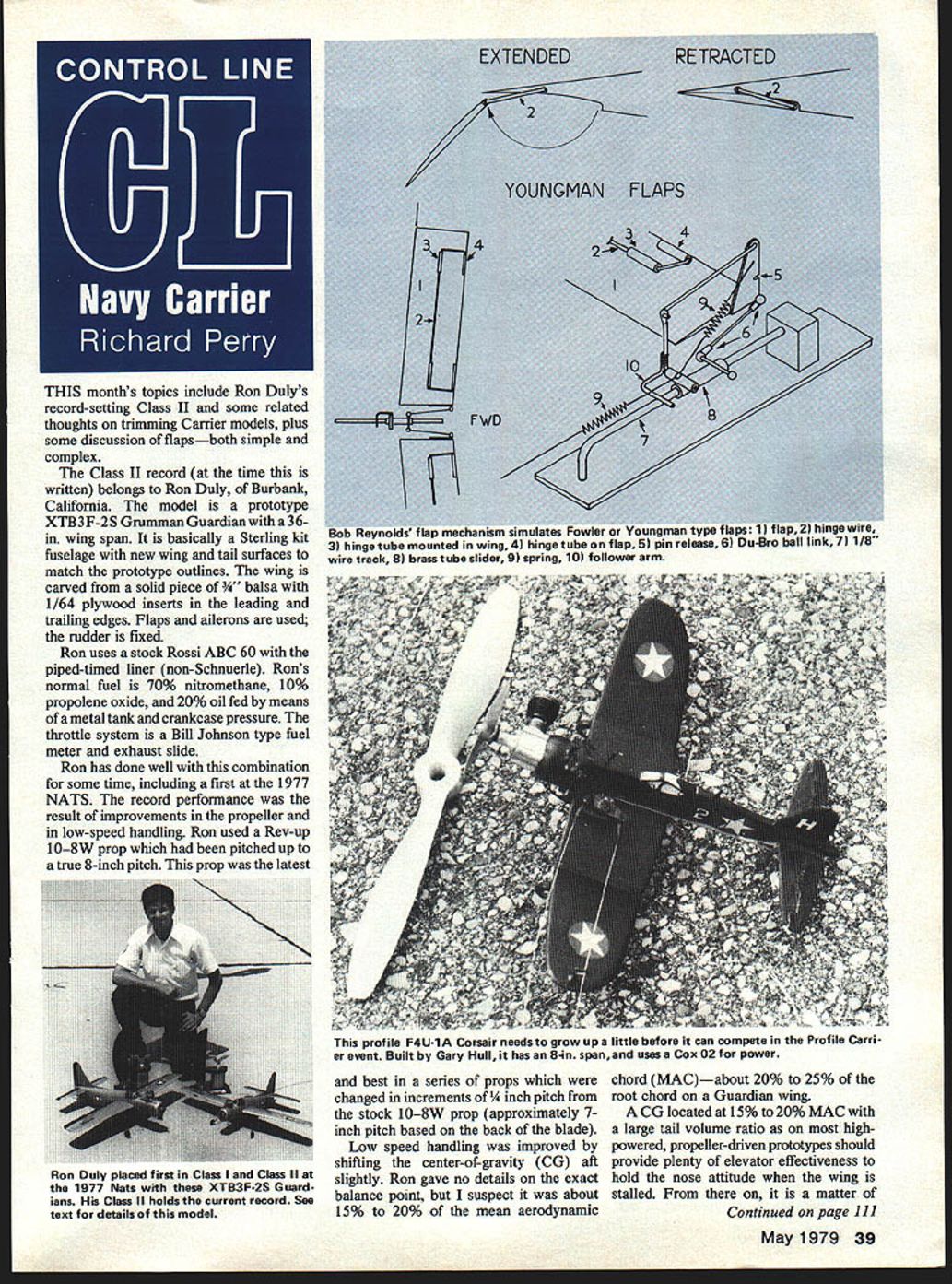
Bob Reynolds of Tucson, Arizona, has developed a system for operating the Youngman flaps on his Fairey Firefly. Key features of the system:
- A pin holds the flaps in the retracted position.
- When released, the flaps move down out of the wing and swing back toward the trailing edge as a spring pulls the slide assembly aft.
- As the slide reaches the end of the 1/8-inch wire, the follower arm moves over the curved end of the wire, allowing a second spring to deflect the flaps.
- The system closely duplicates the operation of the prototype flaps and results in an effective increase in wing area when the flaps are deployed.
- The design allows the flaps to blow up to a streamlined position if they should deploy during high-speed flight.
Although flap systems like Bob's are a joy to behold, they are not necessary for good low-speed performance. In fact, many people prefer to use no flaps at all. I think flaps do offer a slight advantage in low-speed performance, particularly if a model is flown without stalling or prop-hanging.
Flaps in profile Carrier models
In profile Carrier, two-minute low speeds (around 15 mph) are quite possible using flaps, and the model can be in a near-level attitude. The simplest flap, and the type used almost universally in Carrier, is the plain flap. The plain flap is the type used on Stunt ships in which the flap is simply hinged to the rear of the airfoil section. The Top Flite Streak and Sterling Mustang kits have fixed sheet-balsa flaps which can easily be hinged to form plain flaps.
The most common method of operating flaps is to use a conventional horn and a pushrod attached to another horn on the tailhook. When the tailhook deploys, the flaps are deployed also. The use of a spring clevis at one end of the pushrod allows adjustment of the amount of flap deflection, so flap travel can be adjusted to suit existing wind conditions.
Flap dimensions and effectiveness
- Flaps are most effective if their chord is at least 10% of the wing chord, but not more than 20%.
- Flaps work best on thicker wings (at least 15% thickness ratio), but they are effective on thinner wings as well.
- The key to effective flap operation is a blunt, well-rounded leading edge.
Richard L. Perry 5016 Angelita Ave. Dayton, OH 45424
Transcribed from original scans by AI. Minor OCR errors may remain.

