
Control Line: Navy Carrier
I'm back at the typewriter again after a short break for the Nats coverage, which Frank Kelly handled for me this year (thanks, Frank). I'm getting settled into a new job and hope to be back at the Nats again next year. I'll be flying out of North Carolina for the next few years and hope to take in a few East Coast contests that I haven't attended yet.
This month I am continuing the discussion on engine speed control with systems that use the exhaust slide, which I covered in my last column. Since writing that piece I've talked to Kris Jones (6125 Tujunga Ave., North Hollywood, CA 91606) and seen some of the exhaust slides he has installed. If you want a slide but don't want to do the work yourself, contact Kris for prices.
The exhaust-slide type of speed control was originally used on suction engines and was a significant improvement over intake clappers and other crude (by today's standards) intake throttles. As engine speed was reduced by exhaust back pressure, the airflow through the intake decreased, resulting in automatic mixture compensation.
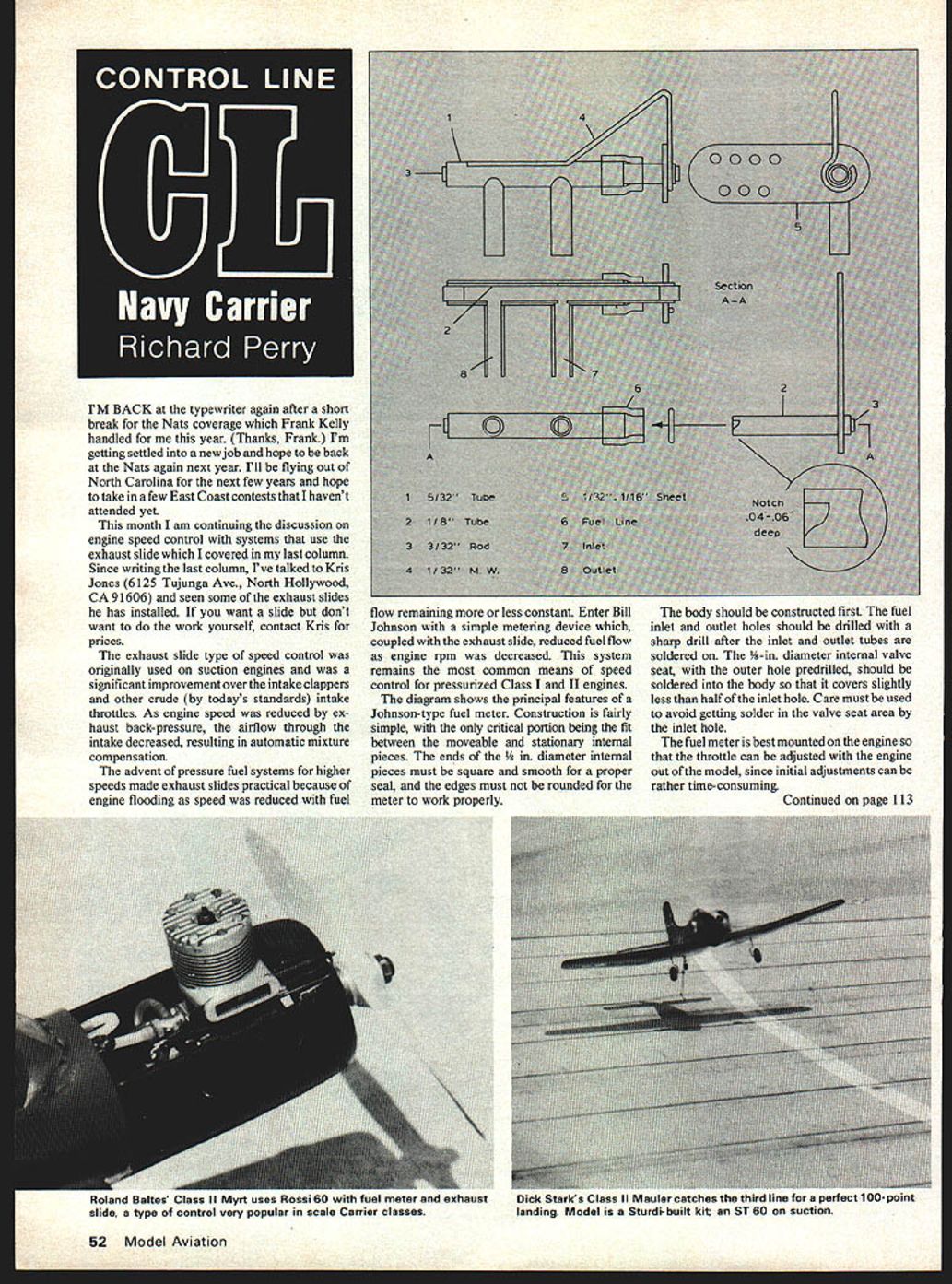
The advent of pressure-fuel systems for higher speeds created a new problem: engines tended to flood as speed was reduced because fuel flow remained more or less constant. Bill Johnson developed a simple metering device which, coupled with the exhaust slide, reduced fuel flow as engine rpm decreased. This Johnson-type fuel meter remains the most common means of speed control for pressurized Class I and II engines. The diagram in the original article shows the principal features of a Johnson meter.
Construction is fairly simple, with the only critical portion being the fit between the movable and stationary internal pieces. The ends of the 1/8-inch-diameter internal pieces must be square and smooth for a proper seal, and the edges must not be rounded for the meter to work properly.
The body should be constructed first. The fuel inlet and outlet holes should be drilled with a sharp drill after the inlet and outlet tubes are soldered on. The 5/32-inch-diameter internal valve seat, with the outer hole predrilled, should be soldered into the body so that it covers slightly less than half of the inlet hole. Care must be used to avoid getting solder in the valve-seat area around the inlet hole.
The fuel meter is best mounted on the engine so that the throttle can be adjusted with the engine out of the model, since initial adjustments can be rather time-consuming.
CL Navy Carrier / Perry
continued from page 52
Initial adjustments are made by setting the meter so that it is just starting to open and adjusting the exhaust slide so that it is about 1/16 inch open from the fully closed position. Check to see that the meter is fully open when the exhaust slide is open, and adjust the meter-arm length if necessary, being careful that the closed positions are not affected. The engine is now ready to run.
Adjust the needle valve for the proper high-speed mixture first, then close the throttle gradually. An excessively rich engine as speed is reduced means that the exhaust slide is closing ahead of the fuel meter. If the mixture goes lean at low speed, the meter-and-slide relationship must be adjusted so that the slide closes earlier for a given meter position.
If the idle mixture is good but the engine quits in the middle range, the rate of fuel-meter opening can be adjusted by using a longer meter arm to provide a leaner mid-range mixture or a shorter meter arm to provide a richer mid-range mixture. If adjustments here disrupt the high-speed setting, the notch in the meter will have to be modified and the process begun again.
The most trouble-free and reliable throttle system I have ever used consisted of an old Kavan pressure carburetor and an exhaust slide. The Kavan carb had a cam-actuated valve which released tank pressure when the throttle was closed. I set the carb so that it closed to the point that the engine ran at about 12,000 rpm and remained in that position (with the pressure-relief valve open). Speed control between 12,000 rpm and full idle was accomplished with the exhaust slide alone.
The Kavan pressure carb has been out of production for some time, but a similar system using a large intake throttle and a separate pressure-relief valve could be very rewarding for someone willing to spend a little time developing the setup.
Richard L. Perry 416 Woodhill Drive, Goldsboro, NC 27530.
Transcribed from original scans by AI. Minor OCR errors may remain.

