
NAVY CARRIER
By Richard Perry
This month I'll cover some less-well-known carrier subjects by Lockheed and Boeing, and an over-center bellcrank, spring-loaded for full deflection in both directions.
Lockheed carrier-related jets
Lockheed was not well known for building carrier-based aircraft, though they provided numerous land-based aircraft to the Navy. There are, however, two Lockheed jets qualifying for our event:
- P-80A Shooting Star: The Navy acquired three P-80A fighters from the Air Force for evaluation. One was fitted with arresting and catapult gear and tested aboard the USS Franklin D. Roosevelt.
- T2V-1 Seastar: In 1952 Lockheed began development of a trainer for use aboard aircraft carriers. The resulting T2V-1 Seastar showed its P-80/T-33 heritage. The Navy purchased a total of 149.
Three-view drawings of the Seastar can be found in Swanborough and Bowers' United States Navy Aircraft Since 1911.
Both Lockheed aircraft have straight-tapered wings and small stabilizers. They should provide interesting Profile Carrier subjects, where scale requirements would allow some dimensional changes to improve flight characteristics.
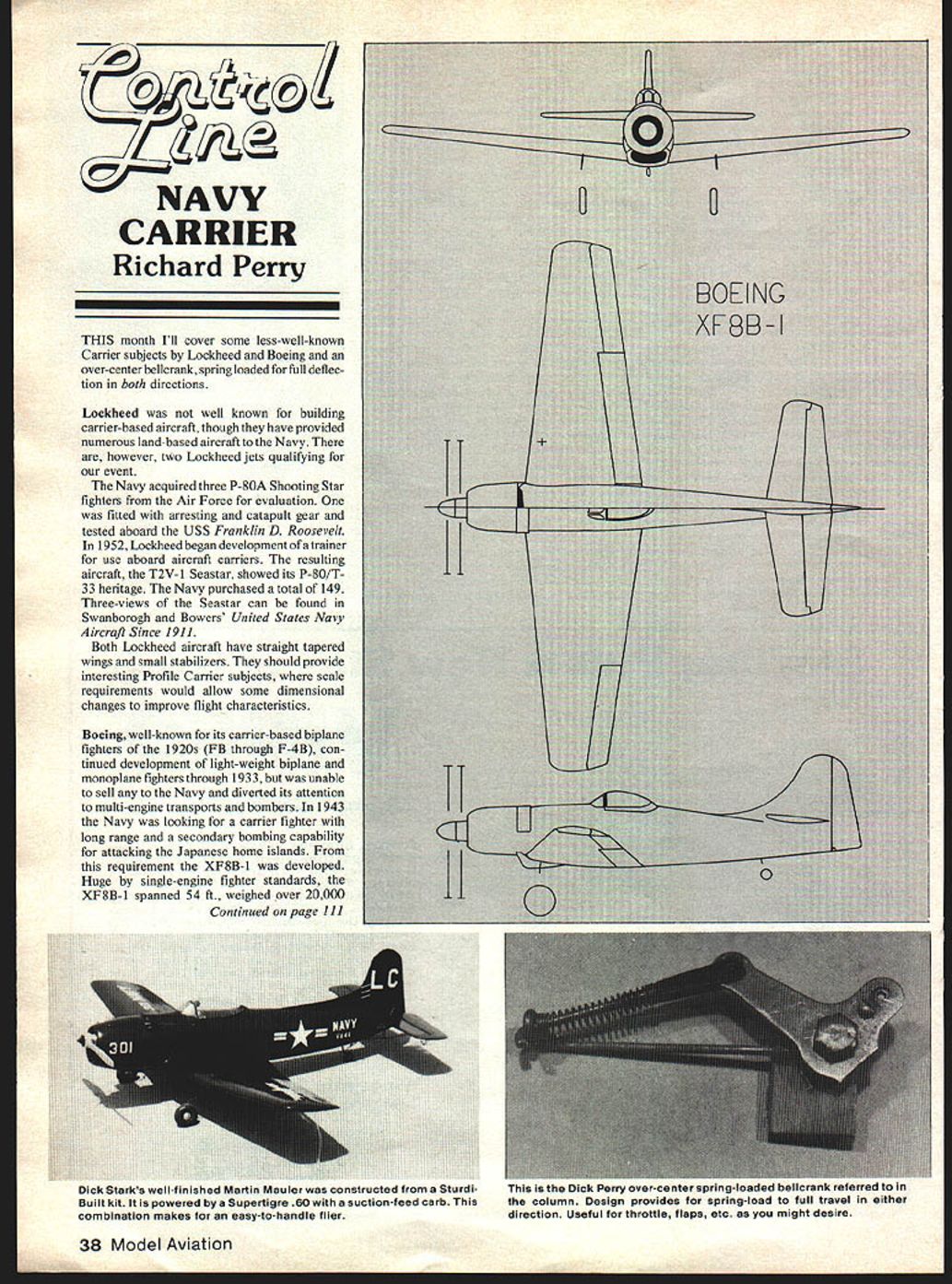
Boeing XF8B-1
Boeing, well known for its carrier-based biplane fighters of the 1920s (FB through F-4B), continued development of lightweight biplane and monoplane fighters through 1933 but was unable to sell any to the Navy and shifted attention to multi-engine transports and bombers.
In 1943 the Navy was looking for a carrier fighter with long range and a secondary bombing capability for attacking the Japanese home islands. From this requirement the XF8B-1 was developed. By single-engine fighter standards it was huge:
- Span: 54 ft
- Loaded weight: over 20,000 lbs
- Power: about 3,000 hp driving contra-rotating props
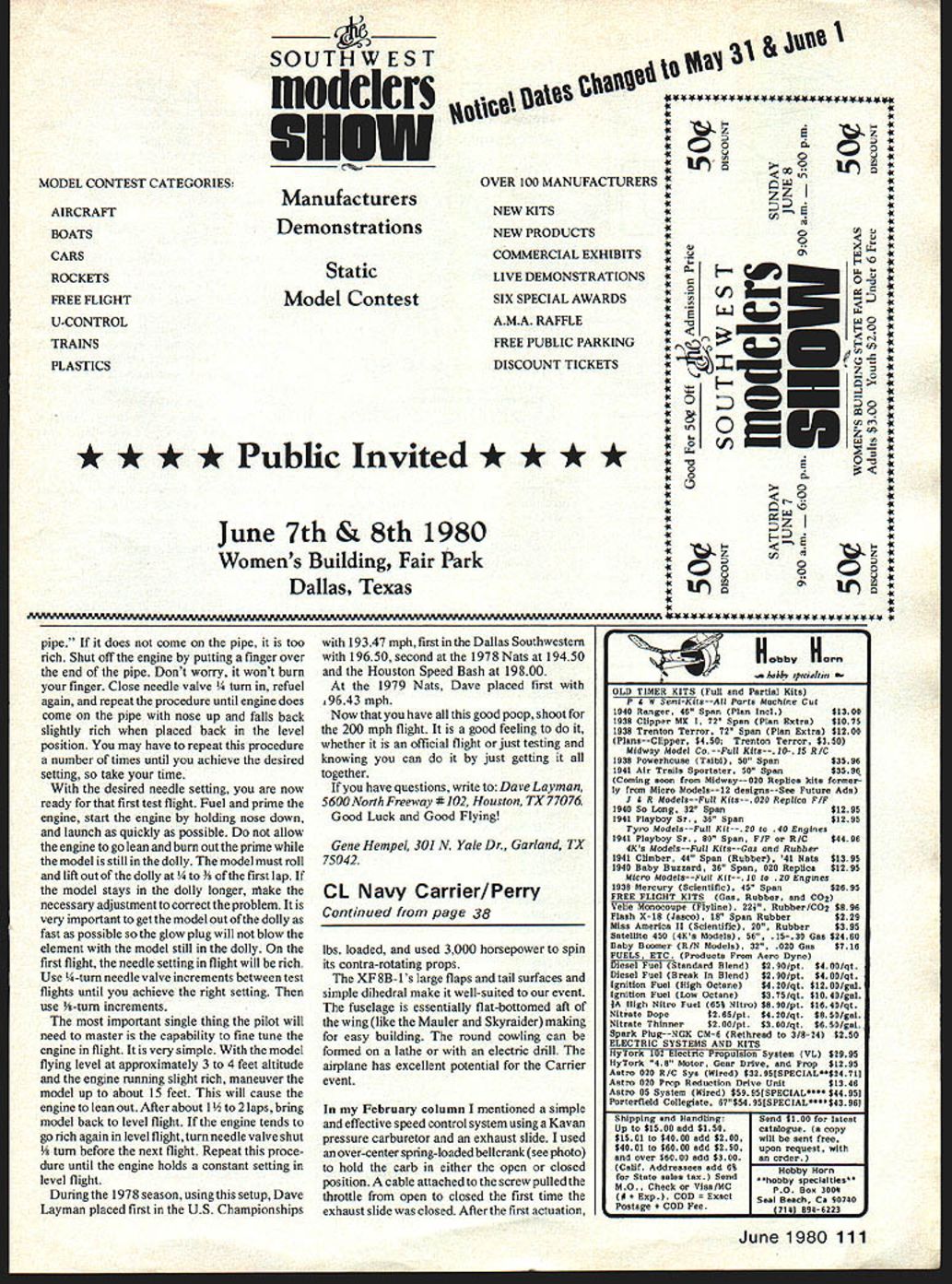
The XF8B-1's large flaps, large tail surfaces, and simple dihedral make it well-suited to our event. The fuselage is essentially flat-bottomed aft of the wing (like the Mauler and Skyraider), making for easy building. The round cowling can be formed on a lathe or with an electric drill. The airplane has excellent potential for the Carrier event.
Over-center bellcrank and throttle/flap control
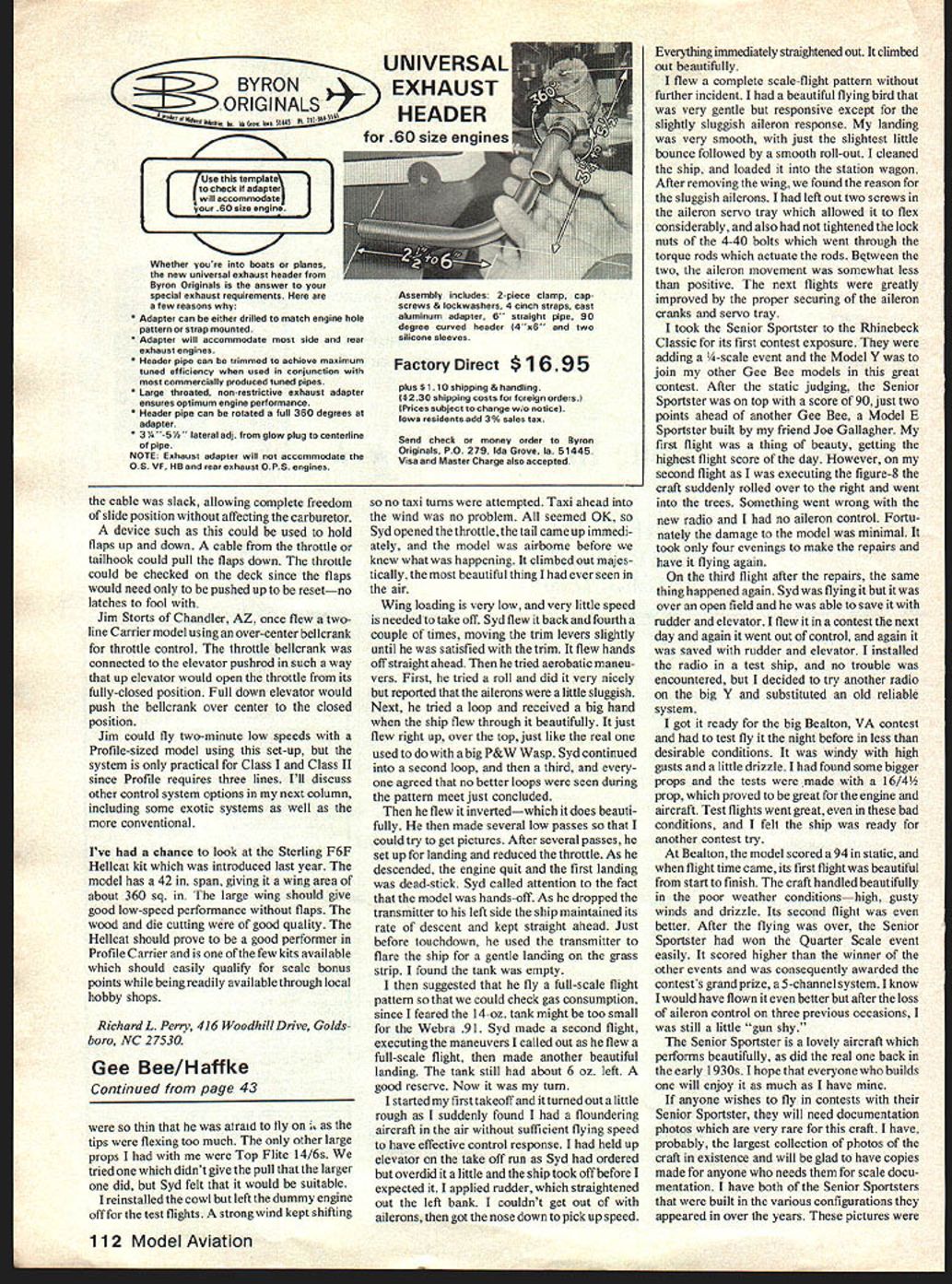
In my February column I mentioned a simple and effective speed-control system using a Kavan pressure carburetor and an exhaust slide. I used an over-center, spring-loaded bellcrank to hold the carb in either the open or closed position.
- Operation: A cable attached to the screw pulled the throttle from open to closed the first time the exhaust slide was closed. After the first actuation, the cable held the carb closed. The system can be reset by manually opening the carb.
- Features: The over-center bellcrank design provides spring-loaded full travel in either direction. The cable was left slack, allowing complete freedom of slide position without affecting the carburetor.
A device such as this could be used to hold flaps up or down. A cable from the throttle or tailhook could pull the flaps down. The throttle could be checked on the deck since the flaps would need only to be pushed up to be reset—no latches to fool with.
Jim Storts of Chandler, AZ, once flew a two-line Carrier model using an over-center bellcrank for throttle control. The throttle bellcrank was connected to the elevator pushrod so that up elevator opened the throttle from its fully closed position. Full down elevator pushed the bellcrank over center to the closed position.
Jim could fly two-minute low speeds with a Profile-sized model using this setup, but the system is only practical for Class I and Class II since Profile requires three lines. I'll discuss other control systems in my next column, including some exotic systems as well as the more conventional.
Sterling F6F Hellcat kit
I've had a chance to look at the Sterling F6F Hellcat kit introduced last year. The model has a 42 in span, giving it a wing area of about 360 sq in. The large wing should give good low-speed performance without flaps. The wood and die cutting were of good quality.
The Hellcat should prove to be a good performer in Profile Carrier and is one of the few kits available that should easily qualify for scale bonus points while being readily available through local hobby shops.
Richard L. Perry 416 Woodhill Drive Goldsboro, NC 27530
Transcribed from original scans by AI. Minor OCR errors may remain.

