
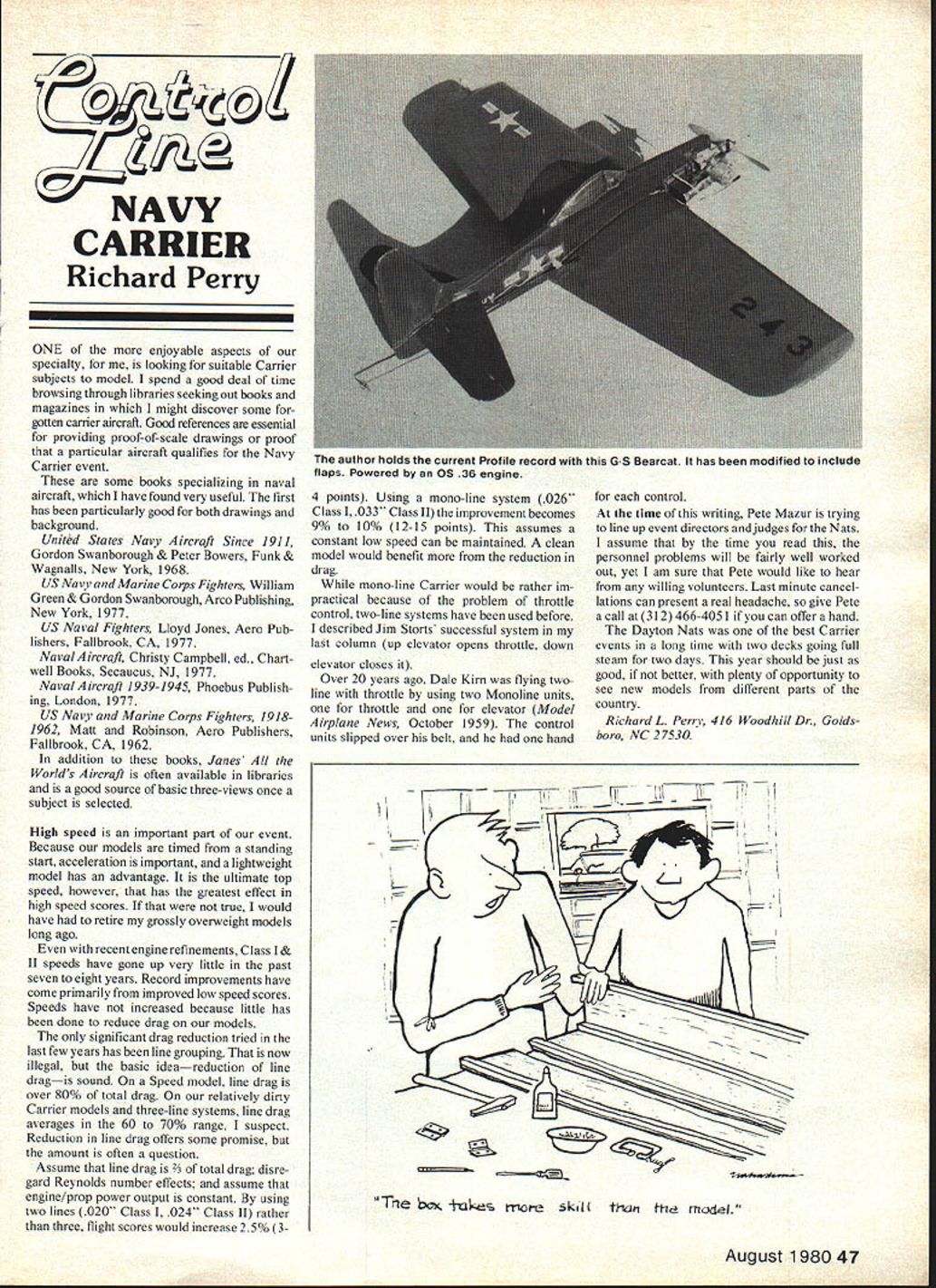
Control Line: Navy Carrier
By Richard L. Perry
One of the more enjoyable aspects of our specialty, for me, is looking for suitable carrier subjects to model. I spend a good deal of time browsing libraries, seeking out books and magazines in which I might discover some forgotten carrier aircraft. Good references are essential for providing proof-of-scale drawings or proof that a particular aircraft qualifies for the Navy Carrier event.
Recommended references
- United States Navy Aircraft Since 1911, Gordon Swanborough & Peter Bowers, Funk & Wagnalls, New York, 1968.
- US Navy and Marine Corps Fighters, William Green & Gordon Swanborough, Arco Publishing, New York, 1977.
- US Naval Fighters, Lloyd Jones, Aero Publishers, Fallbrook, CA, 1977.
- Naval Aircraft, Christy Campbell, ed., Chartwell Books, Secaucus, NJ, 1977.
- Naval Aircraft 1939–1945, Phoebus Publishing, London, 1977.
- US Navy and Marine Corps Fighters, 1918–1962, Matt Robinson, Aero Publishers, Fallbrook, CA, 1962.
In addition to these books, Jane's All the World's Aircraft is often available in libraries and is a good source of basic three-views once a subject is selected.
High speed and model weight
High speed is an important part of our event. Because our models are timed from a standing start, acceleration is important, and a lightweight model has an advantage. It is the ultimate top speed, however, that has the greatest effect in high-speed scores. If that were not true, I would have had to retire my grossly overweight models long ago.
Even with recent engine refinements, Class I and II speeds have gone up very little in the past seven to eight years. Record improvements have come primarily from improved low-speed scores. Speeds have not increased because little has been done to reduce drag on our models.
Line drag — impact and estimates
The only significant drag reduction tried in the last few years has been line grouping. That is now illegal, but the basic idea—reduction of line drag—is sound. On a Speed model, line drag is over 80% of total drag. On our relatively dirty Carrier models and three-line systems, line drag averages in the 60–70% range, I suspect. Reduction in line drag offers some promise, but the amount is often a question.
Assume that line drag is two-thirds of total drag; disregard Reynolds number effects; and assume that engine/prop power output is constant. By using two lines (.020" Class I, .024" Class II) rather than three, flight scores would increase about 2.5% (3–4 points). Using a mono-line system (.026" Class I, .033" Class II) the improvement becomes 9–10% (12–15 points). This assumes a constant low speed can be maintained. A clean model would benefit more from the reduction in drag.
Two-line and mono-line systems
While mono-line Carrier would be rather impractical because of the problem of throttle control, two-line systems have been used before. I described Jim Storts' successful system in my last column (up elevator opens throttle, down elevator closes it).
Over 20 years ago, Dale Kim was flying two-line with throttle by using two mono-line units, one for throttle and one for elevator (Model Airplane News, October 1959). The control units slipped over his belt, and he had one hand for each control.
Nationals, volunteers, and events
At the time of this writing, Pete Mazur is trying to line up event directors and judges for the Nats. I assume that by the time you read this the personnel problems will be fairly well worked out, yet I am sure Pete would like to hear from any willing volunteers. Last-minute cancellations can present a real headache, so give Pete a call at (312) 466-4051 if you can offer a hand.
The Dayton Nats were one of the best Carrier events in a long time, with two decks going full steam for two days. This year should be just as good, if not better, with plenty of opportunity to see new models from different parts of the country.
Author
Richard L. Perry 416 Woodhill Dr. Goldsboro, NC 27530
Transcribed from original scans by AI. Minor OCR errors may remain.

