
Control Line: NAVY CARRIER
Byline
Richard Perry
Introduction
This month I am beginning a "back to basics" series in which I will discuss some of the factors that make our event different from others. I'll try to cover all the potential questions that might be asked by a newcomer to Carrier flying. If any of you have a topic you would like to see discussed or any ideas of your own on any Carrier subject, let me know.
Why newcomers hesitate
I fear that many modelers who have seen Carrier and become interested in it have been reluctant to try the event because of concerns over the unique requirements of the models or the potential for damage during the landing phase. Most of these modelers would be flying Carrier now if they had received a little guidance and encouragement when they first became exposed to the event.
While Carrier models are different from models in other events, they are certainly not difficult to build. The unique parts of our models (flaps, hooks, ailerons, line sliders) are simple in operation and construction. What the newcomer needs is a chance to examine closely a Carrier model and discuss the workings with the builder. When someone looks interested in our models in the pits or on the deck, be sure he gets an invitation to ask questions and take a closer look. If time is critical at the moment, see that he gets an invitation to come back later for an explanation.
When discussing our event with potential Carrier modelers, do we ever scare them off by emphasizing the difficulty or the possibility of damage in an effort to glamorize the event or boost our own image? We should be emphasizing the relaxing atmosphere that exists in most Carrier competition, the thrill of developing new flying skills, and the low damage potential for a model sensibly flown and built for the stress of landing.
I have flown the full range of CL events, and none has been more satisfying to me than Carrier. Carrier has a combination of performance, flying skill, and variety that cannot be found in any other event. Getting started in Carrier doesn't require long hours of practice like Stunt, multiple engines and airplanes like Combat, months of building time like Scale, a team for flying like Rat or Goodyear, or exotic machine-shop engines like Speed.
Getting started
Getting started in Carrier is easy for any competent modeler. The best place to begin is the Profile Carrier event—for a number of reasons.
The airplanes for Profile are easier to obtain in kit form and easier to set up because engine, hook, tank, and most controls are exposed for easy access. The engines are cheaper, and commercial throttle systems are the accepted norm because of the suction fuel system requirement.
Engines
The choice of engine for Profile Carrier is rather simple. The rules require a plain-bearing, front-intake engine, thus selection is somewhat limited from the beginning. One engine consistently outperforms the other mass-produced engines and many custom-made plain-bearing conversions as well. That engine is the Super Tigre ST 35 RC. The engine is currently produced only as a flat-top piston, Perry-ported design. At one time, a baffled piston version was also available. The flat-top (Combat) type is the one for Profile Carrier. These engines are readily available in hobby shops and many discount houses, and many Combat fliers have a few in their box of used engines.
Kits and plans
There are many kits suitable for Profile Carrier. Almost any .35-class profile model under 44-inch span qualifies, but some are better than others. The 10-point scale biplanes make a replica model desirable.
- GS Products: Bearcat, Corsair, and Skyraider — very good models. They have been out of production for some time, but I hear of one turning up in a hobby shop occasionally.
- Sterling: Mustang and Hellcat — suitable subjects.
- Sterling Yak 9: can be converted to an Airabonita with a little work.
- Many other kits have wing shapes that could be used with new fuselages and tail sections for making a scale Profile model.
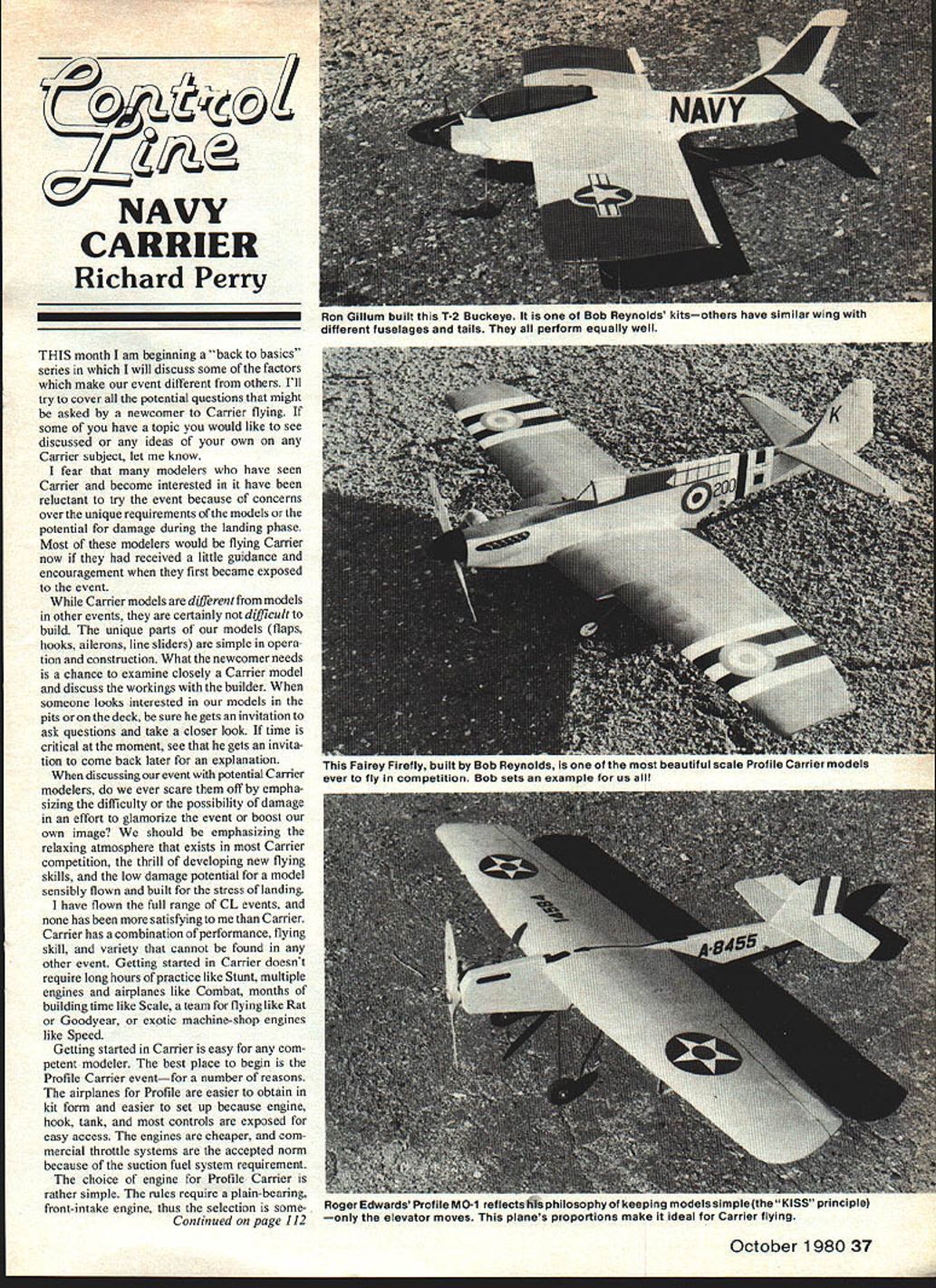
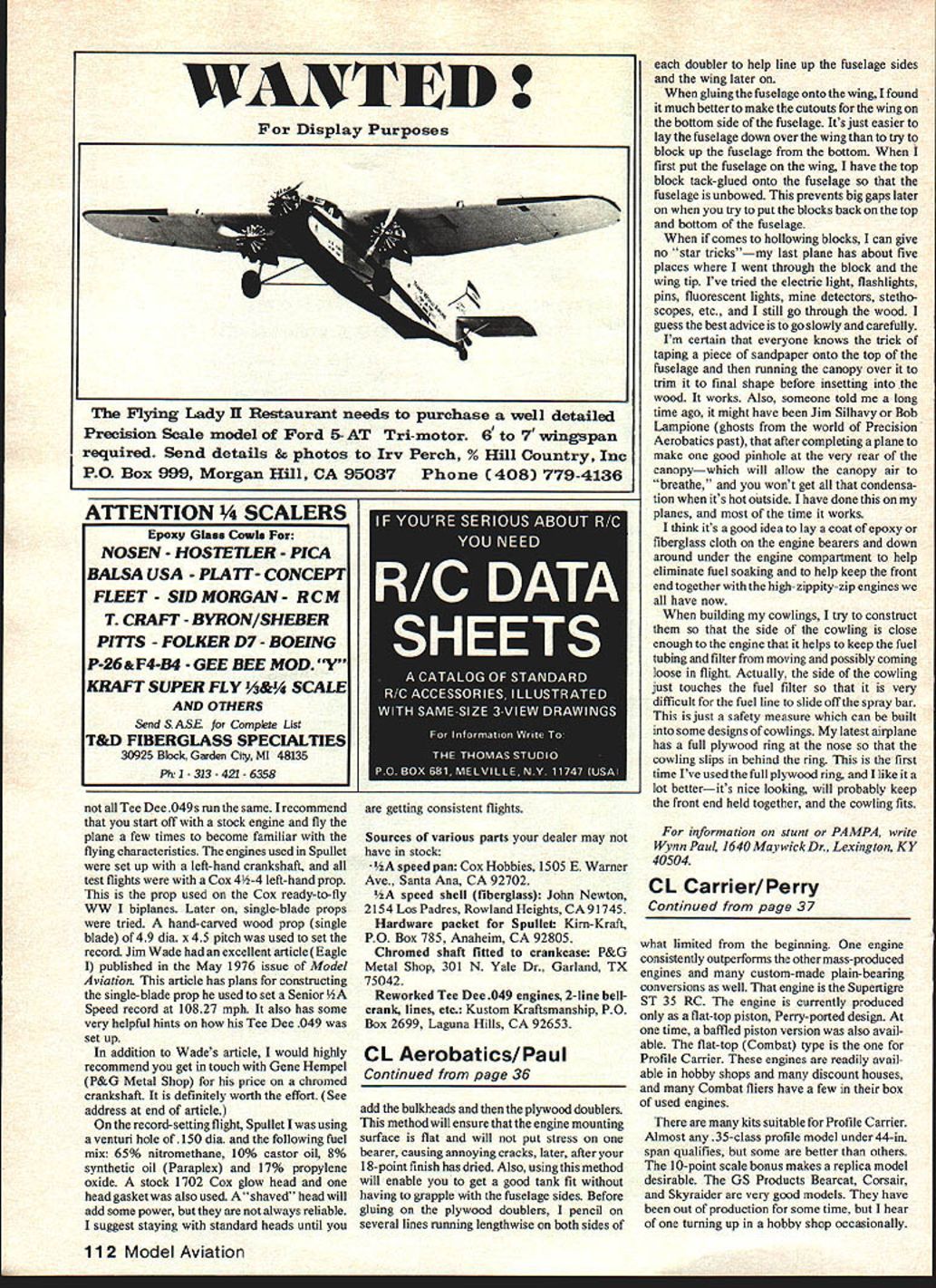
Bob Reynolds (Route 8, Box 51, Tucson, AZ 85710) sells a variety of kits designed for Profile Carrier. They all use basically the same straight wing with different fuselages and tail surfaces. Because of the wing shape, some are better candidates for scale bonus points than others. Contact Bob for a list of available models and prices.
There are a variety of plans available for Profile. Three good ones have appeared in the last couple of years:
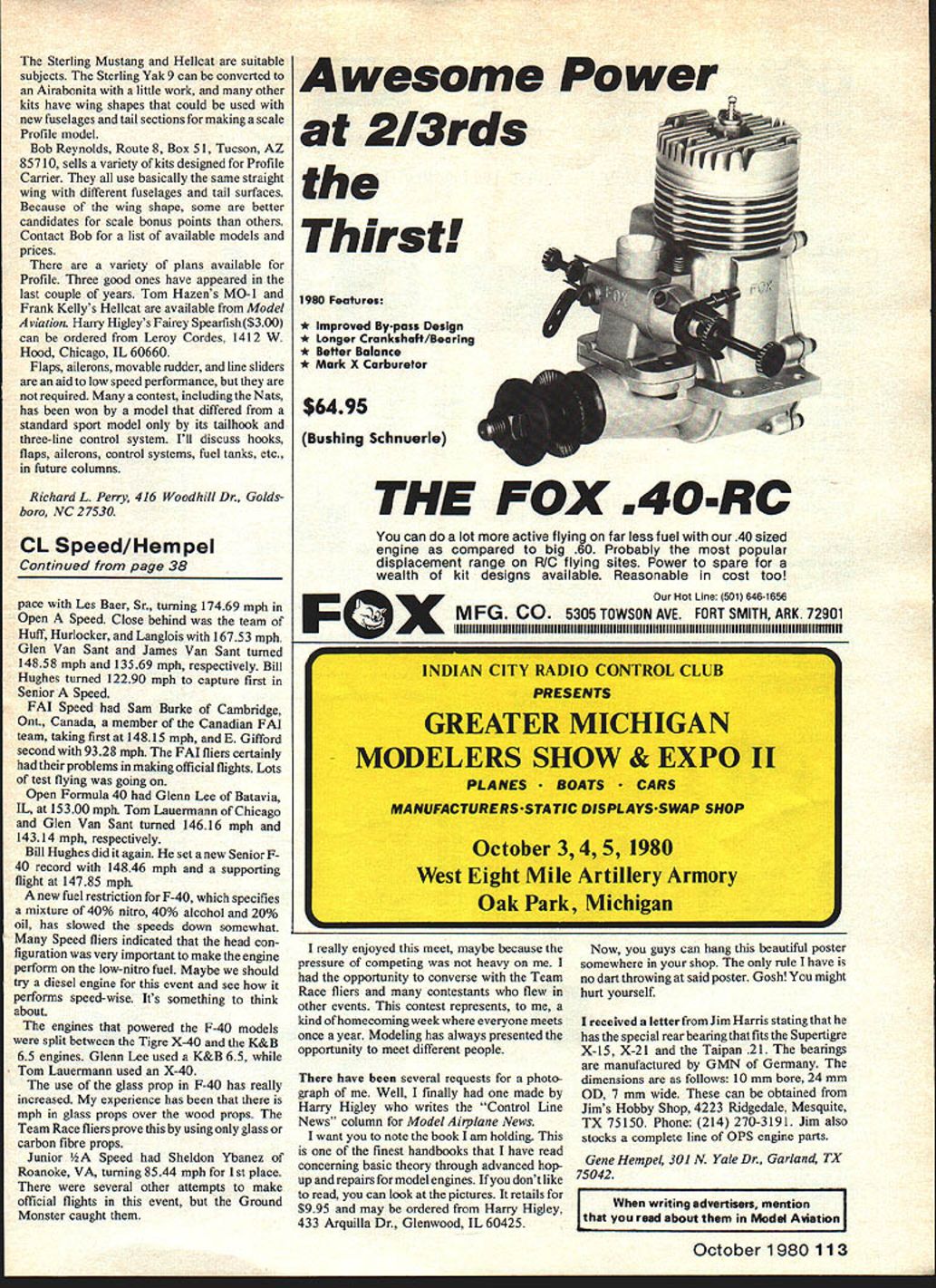
- Tom Hazen's MO-1 (available from Model Aviation)
- Frank Kelly's Hellcat (available from Model Aviation)
- Harry Higley's Fairey Spearfish ($3.00) — order from Leroy Cordes, 1412 W. Hood, Chicago, IL 60660
Optional features
Flaps, ailerons, movable rudder, and line sliders are an aid to low-speed performance, but they are not required. Many a contest, including the Nats, has been won by a model that differed from a standard sport model only by its tailhook and three-line control system. I'll discuss hooks, flaps, ailerons, control systems, fuel tanks, etc., in future columns.
Contact
Richard L. Perry 416 Woodhill Dr. Goldsboro, NC 27530
Transcribed from original scans by AI. Minor OCR errors may remain.

