
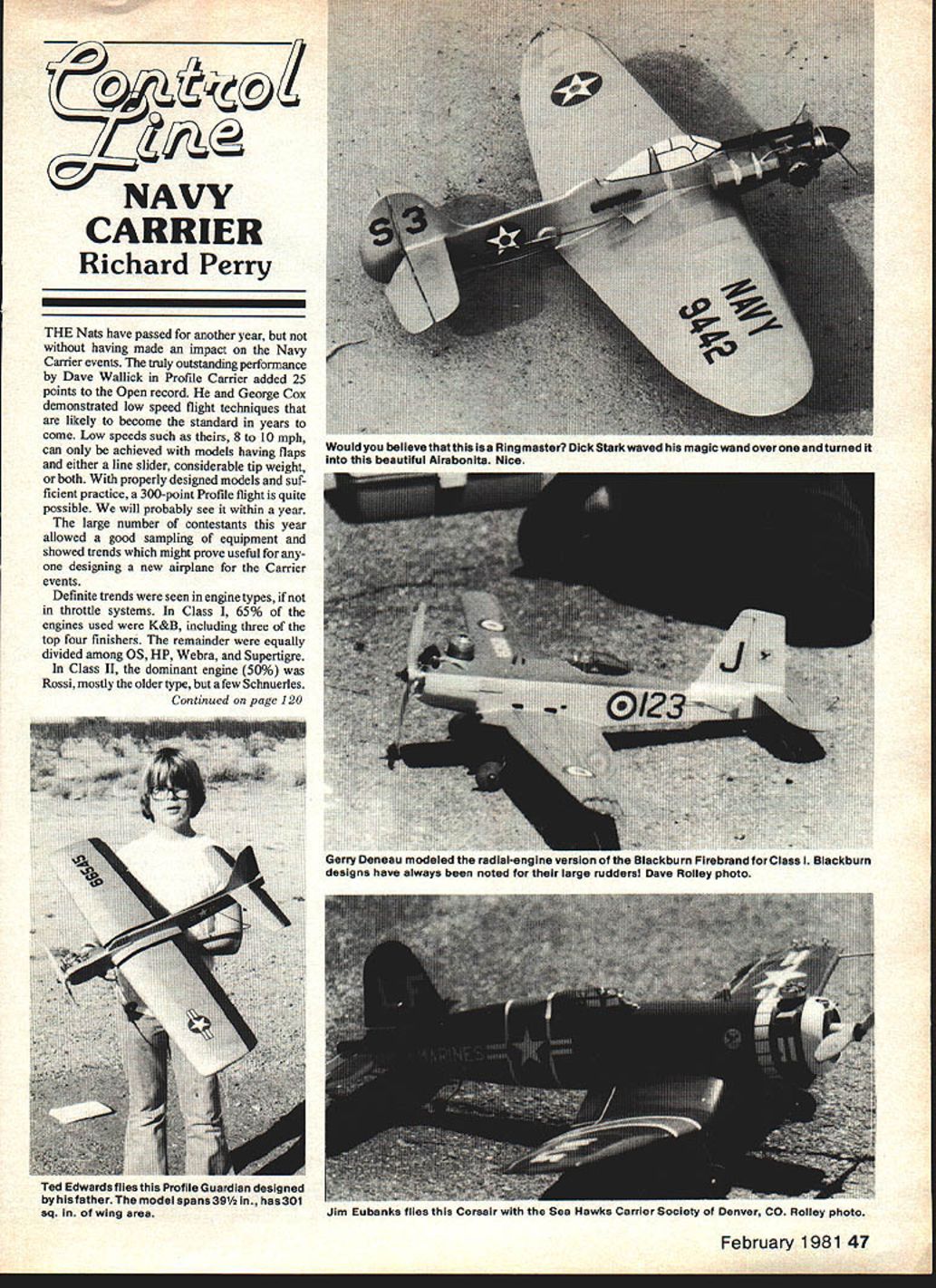
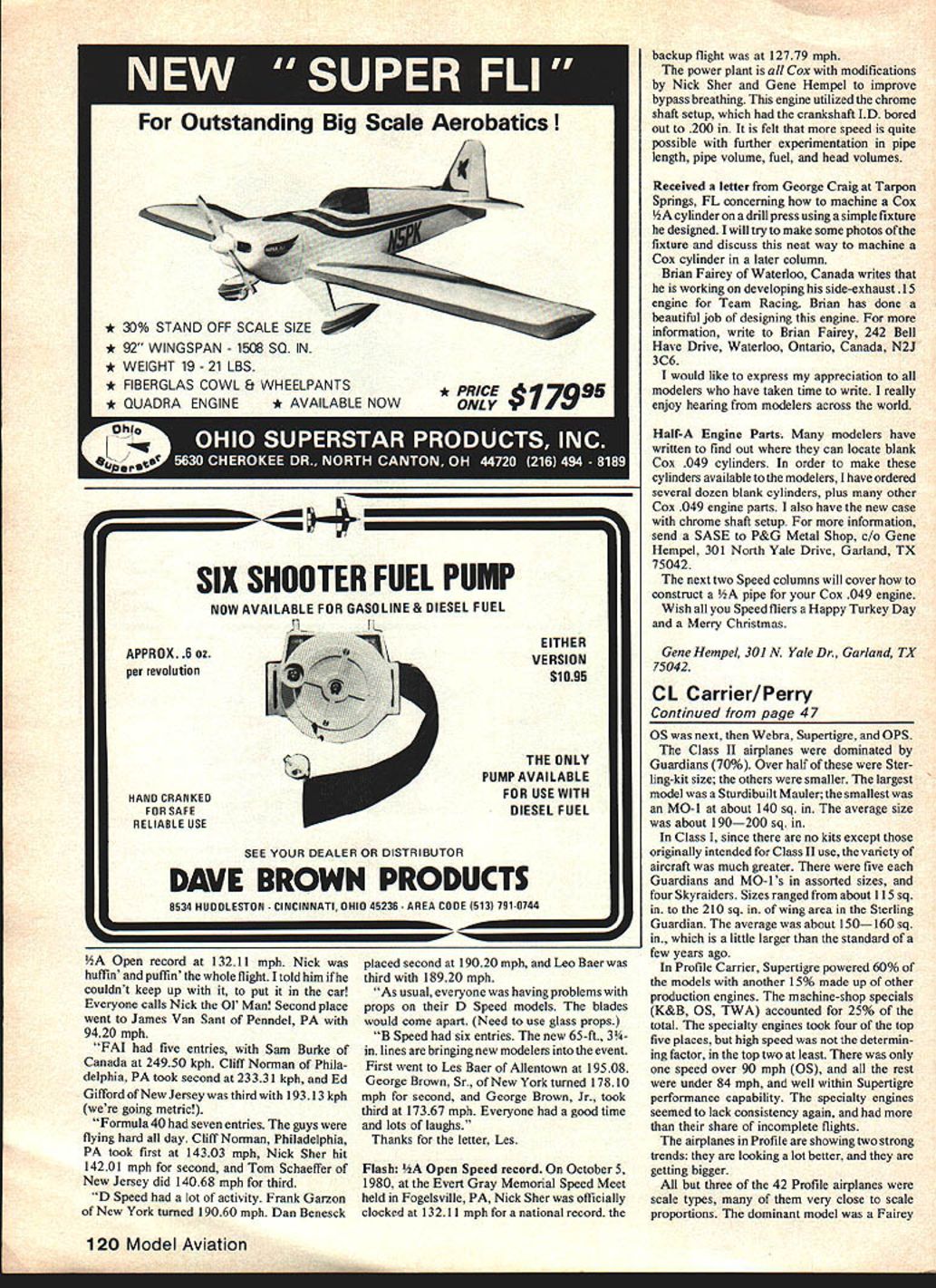
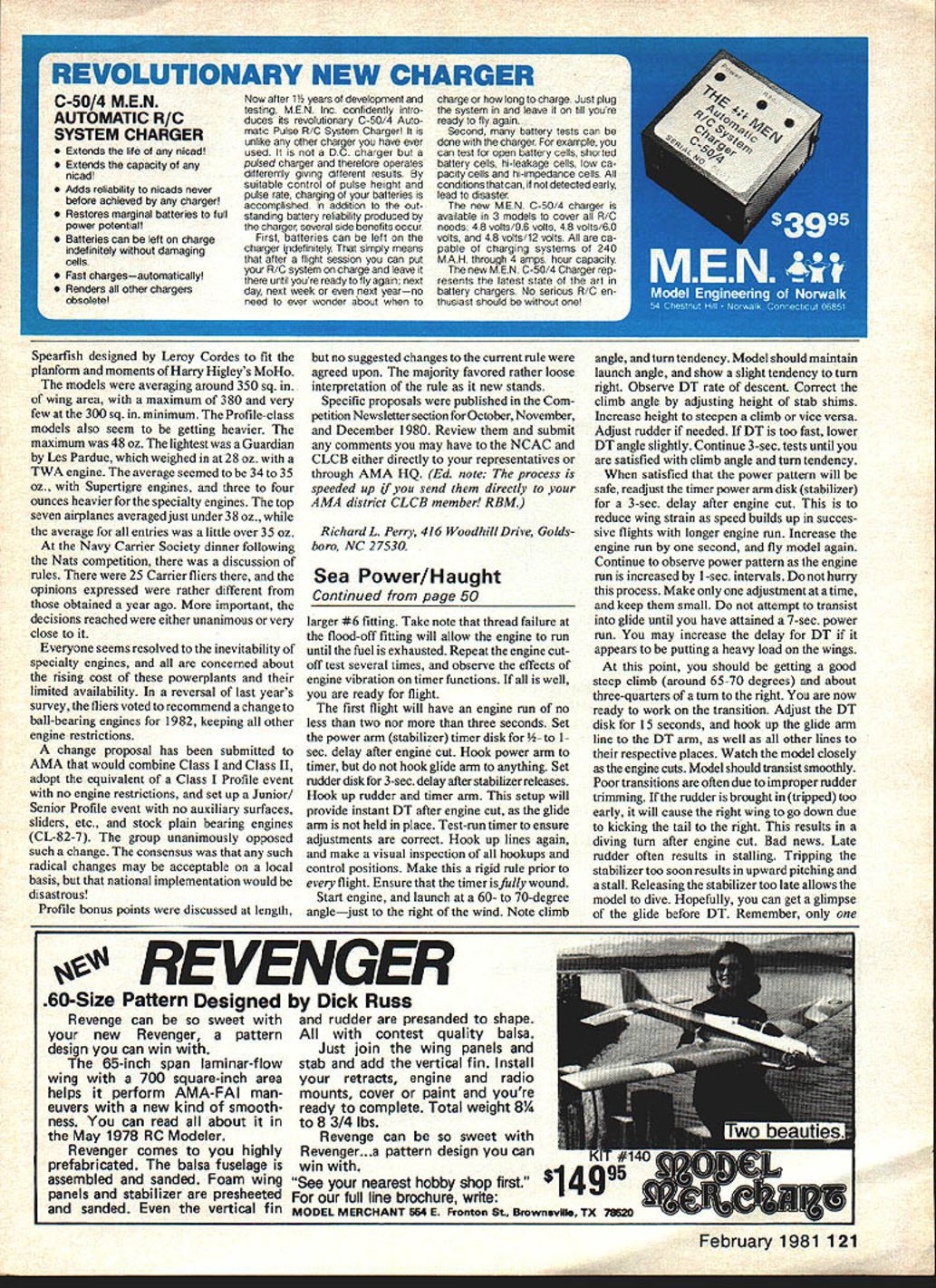
NAVY CARRIER
Richard L. Perry
The Nats have passed for another year, but not without having made an impact on the Navy Carrier events. The truly outstanding performance by Dave Wallick in Profile Carrier added 25 points to the Open record. He and George Cox demonstrated low-speed flight techniques that are likely to become the standard in years to come. Low speeds such as theirs, 8 to 10 mph, can only be achieved with models having flaps and either a line slider, considerable tip weight, or both. With properly designed models and sufficient practice, a 300-point Profile flight is quite possible. We will probably see it within a year.
The large number of contestants this year allowed a good sampling of equipment and showed trends which might prove useful for anyone designing a new airplane for the Carrier events.
Engine and equipment trends
- Class I engines:
- 65% of engines used were K&B, including three of the top four finishers.
- The remainder were equally divided among OS, HP, Webra, and Supertigre.
- Class II engines and airframes:
- Rossi was dominant (50%), mostly the older type, with a few Schnuerle engines.
- OS was next, followed by Webra, Supertigre, and OPS.
- Class II airplanes were dominated by Guardians (70%).
- Over half of these were Sterling-kit size; the others were smaller.
- Largest model: Sturdibuilt Mauler.
- Smallest: an MO-1 at about 140 sq. in.
- Average size: about 190–200 sq. in.
- Class I airframes:
- Greater variety since there are no kits except those originally intended for Class II use.
- Examples: five Guardians and five MO-1s in assorted sizes, two Terrors, and four Skyraiders.
- Sizes ranged from about 115 sq. in. to 210 sq. in. (Sterling Guardian).
- Average size: about 150–160 sq. in., a little larger than the standard of a few years ago.
Profile Carrier
- Engines:
- Supertigre powered 60% of the models.
- Another 15% were other production engines.
- Machine-shop specials (K&B, OS, TWA) accounted for 25% of the total.
- Specialty engines took four of the top five places, but high speed was not the determining factor for the top two.
- There was only one speed over 90 mph (OS); all the rest were under 48 mph and well within Supertigre performance capability.
- Specialty engines again seemed to lack consistency and had more than their share of incomplete flights.
Profile aircraft trends
- Appearance and size:
- All but three of the 42 Profile airplanes were scale types, many very close to scale proportions.
- The dominant model was a Fairey Spearfish designed by Leroy Cordes to fit the planform and moments of Harry Higley's MoHo.
- Models averaged around 350 sq. in. wing area, with a maximum of 380 and very few at the 300 sq. in. minimum.
- Weights:
- The Profile-class models seem to be getting heavier.
- Maximum weight: 48 oz.
- Lightest: a Guardian by Les Pardue, 28 oz. with a TWA engine.
- Average seemed to be 34–35 oz. with Supertigre engines, and 3–4 oz. heavier for the specialty engines.
- The top seven airplanes averaged just under 38 oz.; the average for all entries was a little over 35 oz.
Rules discussion at Navy Carrier Society dinner
At the Navy Carrier Society dinner following the Nats competition, there was a discussion of rules. Twenty-five Carrier fliers attended, and the opinions expressed were rather different from those obtained a year ago. More important, the decisions reached were either unanimous or very close to it.
Everyone seems resolved to the inevitability of specialty engines and is concerned about the rising cost and limited availability of these powerplants. In a reversal of last year's survey, the fliers voted to recommend a change to ball-bearing engines for 1982, keeping all other engine restrictions.
A change proposal has been submitted to the AMA that would:
- Combine Class I and Class II.
- Adopt the equivalent of a Class I Profile event with no engine restrictions.
- Set up a Junior/Senior Profile event with no auxiliary surfaces, sliders, etc., and stock plain-bearing engines (CL-82-7).
The group unanimously opposed such a change. The consensus was that any such radical changes may be acceptable on a local basis, but national implementation would be disastrous.
Profile bonus points were discussed at length, but no suggested changes to the current rule were agreed upon. The majority favored a rather loose interpretation of the rule as it now stands.
Specific proposals were published in the Competition Newsletter section for October, November, and December 1980. Review them and submit any comments you may have to the NCAC and CLCB either directly to your representatives or through AMA HQ. (Ed. note: The process is speeded up if you send them directly to your AMA district CLCB member; RBM.)
Richard L. Perry 416 Woodhill Drive Goldsboro, NC 27530
Transcribed from original scans by AI. Minor OCR errors may remain.

