

Control Line: Navy Carrier
Richard Perry
CLCB ballot and the Navy Carrier Society
As this was being written, the Control Line Contest Board (CLCB) was deciding which of the various proposals and cross-proposals will be placed on the final ballot for rules to be effective in 1982. The results of the CLCB interim ballot will probably appear in the Competition News section of the next issue of Model Aviation. The issues to be decided on this ballot are scoring and landing definition. I will not speculate about what the CLCB decisions might be.
This summer will provide all of us with an opportunity to evaluate all of the proposed changes to our present rules. By trying the proposed changes at flying sessions, and by taking the time for candid discussions of the relative merits of existing rules versus proposed changes, we will be able to make intelligent decisions based on experience rather than emotion. When the CLCB makes their final decision in September, they will have the benefit of well thought out advice from those of us who fly the events and must use the rules.
One of the strongest vehicles we have for expressing our views is the Navy Carrier Society (NCS). The NCS newsletter, Hi-Low Landings, for April (the last issue I received before writing this) was one of the best I've read, with many diverse views on the proposed rules changes. Those of you who are not NCS members are missing an excellent newsletter which can provide current information. A major advantage of NCS membership, however, is a common voice in relationship to the CLCB Navy Carrier Rules Advisory Committee. Membership is $6.00 for 12 months; you can join by contacting LeRoy Cordes, 1412 West Hood Avenue, Chicago, IL 60660. It's well worth the price.
Fuel tanks revisited
A common question raised about the fuel tank drawing in the April MA was: "Doesn't the fuel run out if the entire vent tube is below the level of the fuel tank?" The problem isn't simply two openings — in a tank fuel cannot flow out either line unless air flows into the tank through the other line. As long as the inside end of the vent tube is above the fuel pickup point (below the carburetor), there will be no leakage either through the vent line or through a carb tank mounted behind the engine on a conventional-gear model — so these conditions are met.
Note that any overflow tank will tend to pass fuel through the vent line if the engine is primed by choking, because the intake timing can cause air to be pumped into the tank through the fuel line.
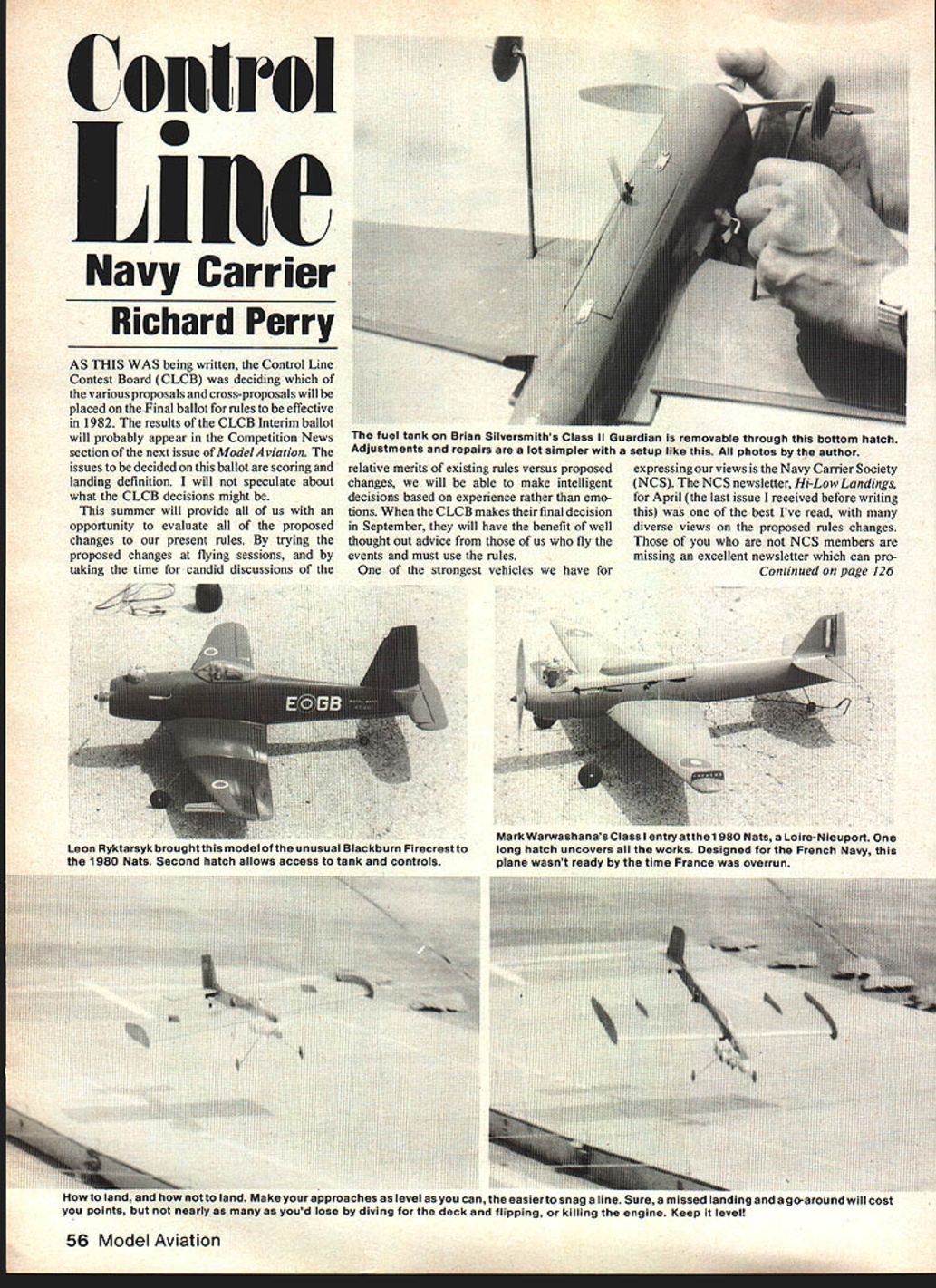
Make it easy on yourself. How often have you had to change a fuel tank because of a leak or because you changed throttle systems? Or perhaps the throttle linkage or control mechanism needed modification. If you built your models like most of us, you either had to live with what you had or cut open the airplane to make the changes. This month's models, as well as being interesting prototypes, show some handy solutions to this problem.
- Brian Silversmith used a hatch on the bottom of his Guardian for fuel tank access.
- Marc Warwashana's Loire-Nieuport 42 uses a single long hatch for access to throttle, tank, and bellcrank. This arrangement is possible because of the aft location of the bellcrank on this particular model.
- The Blackburn Firecrest built by Leon Ryktarsyk uses separate hatches for engine and tank access. The control system is installed in the wing and limited access is possible after tank removal.
The end result in each case is a model which can accept changes or repairs to the fuel system, throttle, and even the control system without damaging the model. An added benefit is the ability to inspect each of these components and correct problems at an early stage before they cause the loss of a score or the loss of an airplane.
The art of landing
With only two official flights, and the landing score amounting to about 40% of the flight score, every landing is an important one. The two factors most important to a successful landing are:
- Getting the airplane on the deck within the arresting area.
- Getting the hook to engage an arresting line to stop the airplane.
Assuming the hook is properly constructed and adjusted (see the June column), the type of approach holds the secret of success.
Getting the plane on the deck, in the arresting area, takes a bit of practice since it is a different type of landing than the normal type most CL modelers are used to. Soft, gentle landings must take second place to precision landings, even if the latter are a little harder. The landing area is only 20 ft. long, and the model needs only half to three-quarters of a second to pass completely over it.
There are two ways to land a Carrier model. The best way, by far, is to approach the deck in level flight at about a 5-ft. altitude. At a point about 20 ft. from the stern of the deck, as the deck comes clearly into view, begin a smooth descent that will cause the model to hit the deck about 8 to 10 ft. past the stern (at the fourth or fifth arresting line). At this rate of descent, the landing loads are equivalent to dropping the model onto its gear from a height of about 12 in. The model will land in a near-level attitude, and a normal arrested landing is almost a certainty.
The alternative landing technique is to fly over the deck and apply down elevator to dive at the landing area — reminiscent of a Kamikaze attack. Such approaches are familiar to all of us and are the natural reaction to an approach made too high. The fear of losing five points for a missed landing approach overrides reason, and the thought of going around for another approach disappears entirely. The usual result is a loss of 50 to 100 points rather than the five that would have resulted from going around.
The problem with the Kamikaze method is that the tail is the last thing to hit the deck, and the hook often doesn't get a chance to do its job. The usual result is that the prop shaft (and what is left of the broken propeller) or the badly deflected landing gear is forced under an arresting line, and the model either stops on its nose (50 points) or, more likely, is flipped on its back (25 points). If the model should end up on its gear, the chance of the hook catching a line is reduced because of the severe bouncing that results. The engine will have stopped, and a go-around is impossible (0 points).
Patience is the key. Success, and trophies, usually go to the flier who abandons a bad approach if necessary and takes a much more certain 95-point landing on the next lap.
The landing photos are of Bill Rutledge's STOL Bearcat at the 1978 Nats. With the good landing, he placed first in Junior Profile.
Richard L. Perry 416 Woodhill Drive Goldsboro, NC 27530
Transcribed from original scans by AI. Minor OCR errors may remain.

