
Control Line: Navy Carrier
Richard Perry
Background: scoring and performance emphasis
The original Carrier scoring system — and the proposed change to be voted on in September — placed primary emphasis on the high-speed portion of the flight. Because of that emphasis, there was little alternative to high speed for a long time; top places went almost exclusively to the best engines.
The current scoring system was devised to place more emphasis on low speed and to require balanced performance for consistently high scores. The multipliers used and the ratio method of low-speed scoring achieve this objective for the low speeds that can be reached without stalling the model (about 15 mph).
It was possible to achieve roughly equivalent scores with either:
- a small, light, clean model capable of about 18 mph slow, or
- a heavier, more complex flapped model capable of about 15 mph.
People tended to adapt their models and flying styles to suit personal philosophies regarding high-performance engines.
High-speed plateau and the rise of flapped models
High-speed performance reached a plateau in the high 80s and low 90s as plain-bearing conversions and really good ST .35 engines became more common. Since engine and line drag were limiting high speed to a greater extent than model weight, wing flaps could be added without incurring a significant high-speed penalty. Flapped models became more prominent in the winner’s circles at major meets.
With high speed limited by engine performance and low speed limited by wing stall at about 15 mph, the logical avenue for improvement was to abandon purely aerodynamic flight at low speed and pursue an exaggerated nose-high stalled configuration with the engine providing a major portion of the lift. This style of flying became a prominent factor in the event at the 1976 Dayton Nats when Dick Davis amazed spectators with near-vertical prop-hanging. A rule was later adopted to limit low-speed flight to a 60° nose-high attitude.
The model used by Dick Davis had an unflapped, symmetrical airfoil. That configuration is well suited to prop-hanging flight because propwash over the wing produces no noticeable forces on the model; the only pitching force from propwash is that produced by the stabilizer and elevator. With the 60° rule, however, an unflapped model can't be slowed below about 13 mph.
Flaps, propwash, and the pitching-moment problem
By adding flaps, propwash over the wing can be made to produce lift that slows the model to the 8–12 mph range. The flaps, in addition to producing lift, also generate a strong nose-down pitching moment that varies with engine thrust. This pitching moment can cause serious problems in maintaining a constant pitch attitude.
A pacesetter in solving these problems has been Dave Wallick. His 1980 Nats win and Profile Carrier record attest to his success.
Dave Wallick’s techniques for low-speed control
Dave's models employ a number of techniques to ensure adequate line tension and controllability during low-speed flight:
- Thrust-line offset:
- At extremely low speeds, centrifugal force is insufficient to overcome the weight of the lines.
- Since the engine provides lift, an offset thrust line positioned to the outside of the circle can supply additional line tension. About 5° offset appears to be the minimum.
- Aileron and flap coordination:
- Dave uses ailerons to help keep the outboard wing down during the transition to low speed.
- The outboard aileron is raised by a bellcrank and pushrods as the flaps are lowered.
- Adjustable devices at the flap and aileron horns allow adjustment of aileron throw and neutral point relative to the flaps.
- Weight and sweep considerations:
- As an additional aid to line tension, the outboard wing should be weighted at least three ounces — more if variable line sweep is not used.
- Flap actuation and trimming:
- Dave's flaps are operated by pushrods from the tail hook.
- Adjustable clevises are used here as well to aid in flight trimming.
- The inboard flap is set slightly more than the outboard.
- By setting the hook so that it is deflected only 30° down in the extended position, Dave has an accurate visual reference (hook vertical) to avoid exceeding the 60° nose-high limit.
Balancing and control sensitivity
To overcome the nose-down pitching moment of the flaps, the model must be balanced farther aft than is usual for control-line models. This tends to make the model less stable in pitch and more sensitive to elevator inputs. The tendency can be partially overcome by:
- increasing tail area,
- extending the tail moment arm, or
- both.
Reducing the elevator travel for a given bellcrank movement by increasing the bellcrank leverage also reduces the effective sensitivity of the elevator. A small amount of handle deflection can aid in maintaining comfortable high-speed stability.
Design notes and examples
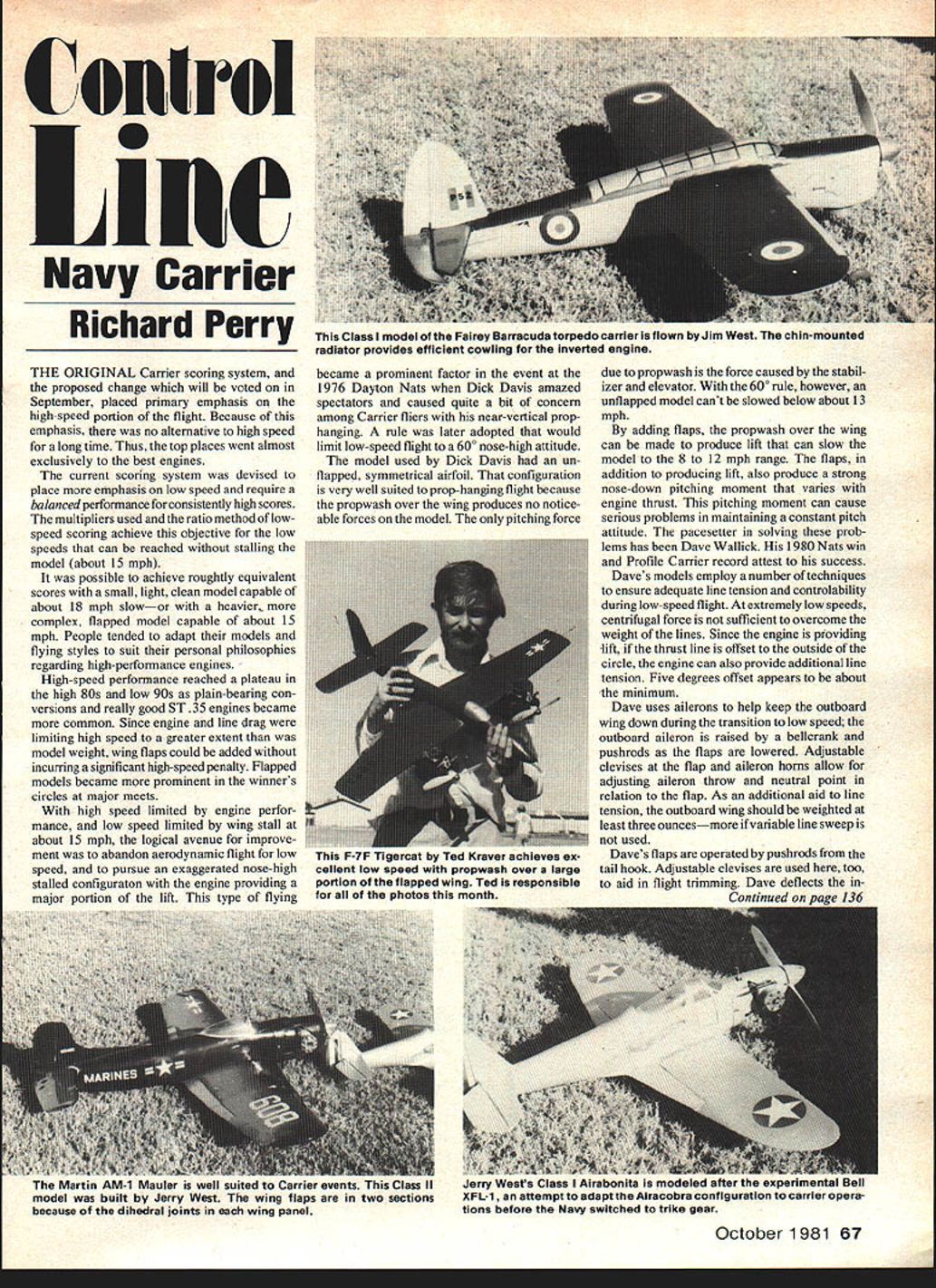
- Jerry West's Class II Airabonita was modeled after the experimental Bell XFL-1 — an attempt to adapt an Airacobra configuration to carrier operations before the Navy switched to tricycle gear.
- A 67-class model of the Fairey Barracuda, flown by Jim West, uses a chin-mounted radiator that provides efficient cowling for the inverted engine and achieves excellent low-speed propwash over a large portion of the flapped wing.
(Photos by Ted.)
Transcribed from original scans by AI. Minor OCR errors may remain.

