
Control Line: Navy Carrier
Richard Perry
The CLCB final vote on the 1982–83 rules changes is in, and was reported in the Competition Newsletter section of MA last month. There are four significant rules changes that affect equipment or the running of the event, plus some clean-up and clarification items. Most of the changes have the effect of making official rules out of the more commonly accepted interpretations of the existing wording.
The major change is in engine specifications for Profile Carrier. Sleeve bearings will no longer be required, greatly reducing the advantage currently held by machine-shop conversions of ball-bearing engines. The vibration-prone ST .35 is no longer the only competitive production engine for the event. We didn't get the change to .40 engines that would have given us a wide variety of suitable commercially available engines — engines that could have been used in Class I as well. We did gain access to the .35-class engines developed for the AMA Combat event.
The Fox Combat and Supertigre S-36 engines would seem to be the front contenders among the front-intake ball-bearing engines. Neither comes equipped with a throttle, but the S-40 carb will fit the S-36. The Fox will require an adapter to fit a carb, but with its suction venturi it should be quite docile with an exhaust-restrictor speed control. Those with K&B 5.8 engines should find them very well suited to Profile Carrier.
The pilot's signal for low speed now must be given over the stern of the deck, with timing starting one lap later. This will provide more consistent judging and greatly ease the judges' workload right after high speed. Now one judge can monitor the model and also watch for the low-speed signal, while the others are recording high-speed times.
The landing definition has been changed to provide a compromise between the "hooked" and "stopped" interpretations that presently make up the predominant methods of judging landings. The new rule follows full-scale practice. The arresting cable must be the primary means of stopping the aircraft, and the attitude is judged at the instant that forward motion stops. Thus, pit-crew "saves" that keep a model with a broken prop or an over-excited pilot from being bounced or pulled off the deck after landing will no longer be a point of controversy. Neither will it be possible for a pilot to shake a model down off its nose to gain full landing points — some judges, incredible as it may seem, have allowed this.
CL Navy Carrier / Perry
The only landings that will lose points are pilot-error landings: crashing on the deck, forcing the landing gear under an arresting line and flipping the model onto its back; landing too near the edge of the deck; failing to hook any lines and rolling off the deck; etc. Pilot skill will be the determining factor. Luck, a factor under some existing interpretations, will no longer play any significant part in landing scores.
The builder-of-the-model rule has been modified for Junior and Senior Carrier competitors, requiring only that they participate in the construction of their models. This rule passed by a narrow margin. I opposed this rule for Senior-age contestants, and it was opposed by some Junior and Senior Carrier fliers as well. It will be a good rule, however, if it results in increased participation among the younger AMA members. Nothing would make me happier than to see a two-, three-, or fourfold increase in the number of younger modelers in the Carrier events.
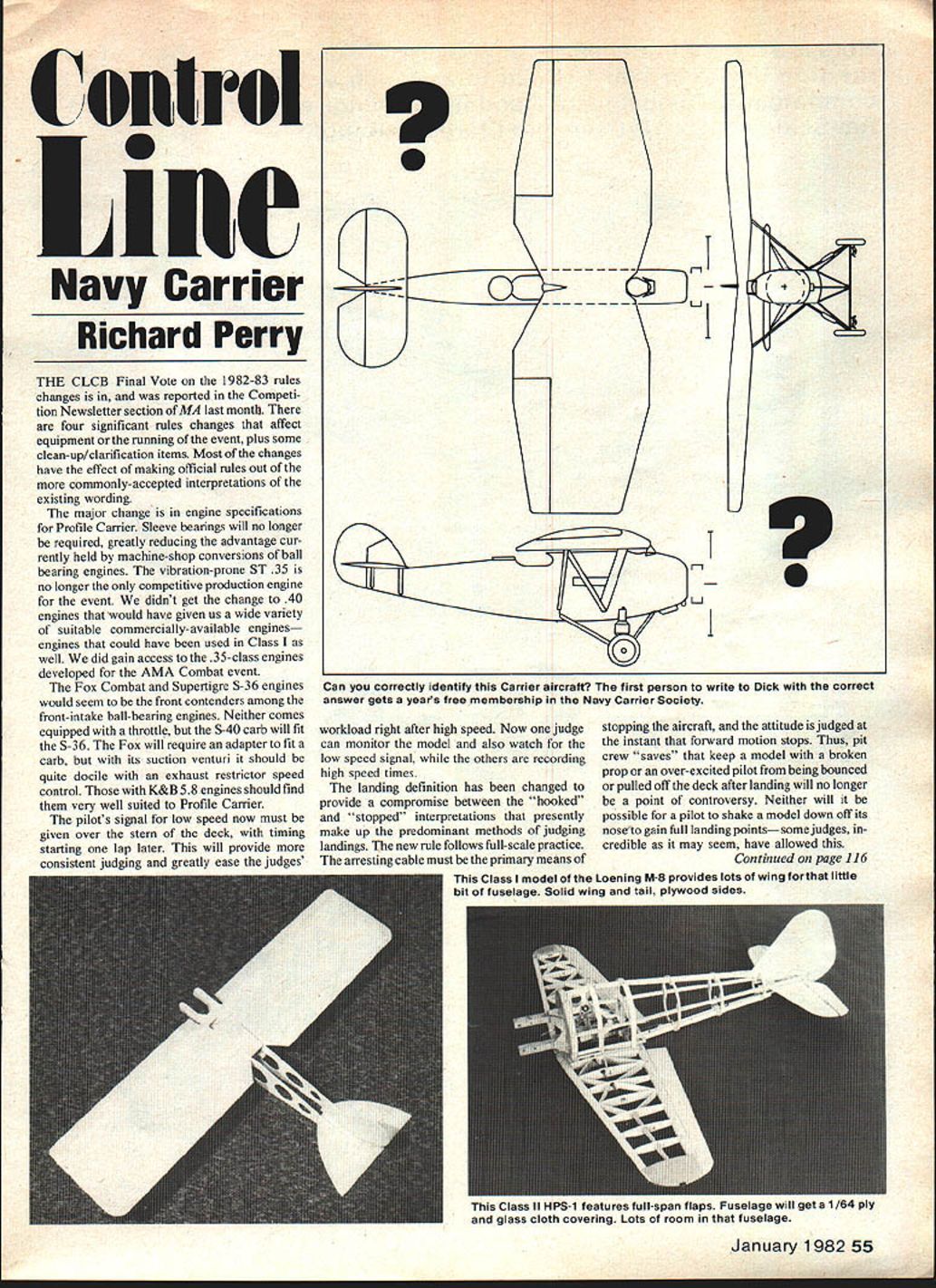
The photos and drawing this month depict a few obscure carrier aircraft and a very prominent figure in Carrier modeling on the West Coast. Ron Duly is one of the true gentlemen of our sport. He has been a pacesetter in Carrier with Nats victories, national records, and the Eugene Ely Award among his list of accomplishments, yet he has always had a word of encouragement or a helping hand for his fellow competitors, no matter what their experience level. Ron is a Contest Director, was one of the first members of AMA's Navy Carrier Advisory Committee, and edited the Hi-Low Landing newsletter for the Navy Carrier Society. People like Ron help make the event more enjoyable for the rest of us.
The model photos are my current projects for the scale Carrier classes. The Loening M-8 is a 1920s observation airplane — a contemporary of the Glenn Martin MO-1. It was one of Loening's few monoplanes among a whole stable full of biplane designs, the better known of which were amphibians. Its configuration makes for a very compact Class I model, even with a 200-square-inch wing.
The HPS-1 was an experimental fighter built by Handley Page in 1923. No more than three were built, interest in the design being rather low. The full-span flaps and leading-edge slats gave it good landing characteristics in spite of a relatively high wing loading. The flaps were what drew me to the design in the first place. Built for Class II at about 210 square inches of wing area, the 4-in.-wide, 6-in.-high fuselage gives ample room for fuel tank and control system.
I'll leave the remaining aircraft for you to identify. The first reader to correctly name the plane will receive one year's free membership in the Navy Carrier Society. I'll publish the name of the winner in my next column if I get a correct response in time to meet my deadline. Send your entries directly to me.
Richard L. Perry 416 Woodhill Dr. Goldsboro, NC 27530
Transcribed from original scans by AI. Minor OCR errors may remain.

