
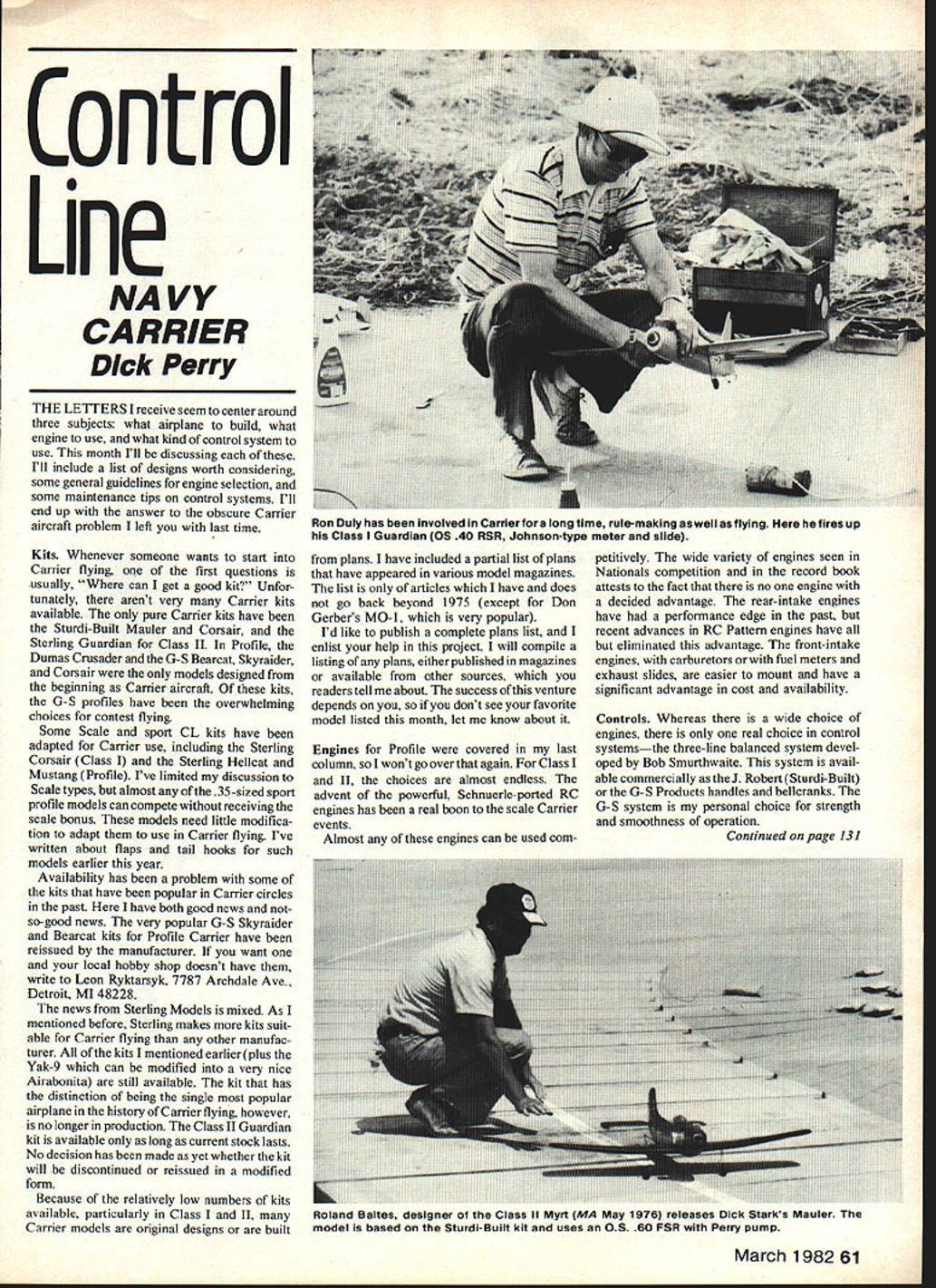
Control Line: Navy Carrier
Dick Perry
The letters I receive seem to center around three subjects: what airplane to build, what engine to use, and what kind of control system to use. This month I'll be discussing each of these. I'll include a list of designs worth considering, some general guidelines for engine selection, and some maintenance tips on control systems. I'll end up with the answer to the obscure Carrier aircraft problem I left you with last time.
Kits
Kits. Whenever someone wants to start into Carrier flying, one of the first questions is usually, "Where can I get a good kit?" Unfortunately, there aren't very many Carrier kits available. The only pure Carrier kits have been the Sturdi-Built Mauler and Corsair, and the Sterling Guardian for Class II. In Profile, the Dumas Crusader and the G-S Bearcat, Skyraider, and Corsair were the only models designed from the beginning as Carrier aircraft. Of these kits, the G-S profiles have been the overwhelming choices for contest flying.
Some Scale and sport CL kits have been adapted for Carrier use, including the Sterling Corsair (Class I) and the Sterling Hellcat and Mustang (Profile). I've limited my discussion to Scale types, but almost any of the .35-sized sport profile models can compete without receiving the scale bonus. These models need little modification to adapt them to use in Carrier flying. I've written about flaps and tail hooks for such models earlier this year.
Availability has been a problem with some of the kits that have been popular in Carrier circles in the past. Here I have both good news and not-so-good news. The very popular G-S Skyraider and Bearcat kits for Profile Carrier have been reissued by the manufacturer. If you want one and your local hobby shop doesn't have them, write to Leon Ryktarsyk, 7787 Archdale Ave., Detroit, MI 48228.
The news from Sterling Models is mixed. As I mentioned before, Sterling makes more kits suitable for Carrier flying than any other manufacturer. All of the kits I mentioned earlier (plus the Yak-9 which can be modified into a very nice Airabonita) are still available. The kit that has the distinction of being the single most popular airplane in the history of Carrier flying, however, is no longer in production. The Class II Guardian kit is available only as long as current stock lasts. No decision has been made as yet whether the kit will be discontinued or reissued in a modified form.
Because of the relatively low numbers of kits available, particularly in Class I and II, many Carrier models are original designs or are built from plans. I have included a partial list of plans that have appeared in various model magazines. The list is only of articles which I have and does not go back beyond 1975 (except for Don Gerber's MO-1, which is very popular). I'd like to publish a complete plans list, and I enlist your help in this project. I will compile a listing of any plans, either published in magazines or available from other sources, which you readers tell me about. The success of this venture depends on you, so if you don't see your favorite model listed this month, let me know about it.
Engines
Engines for Profile were covered in my last column, so I won't go over that again. For Class I and II, the choices are almost endless. The advent of the powerful, Schnuerle-ported RC engines has been a real boon to the scale Carrier events.
Almost any of these engines can be used competitively. The wide variety of engines seen in Nationals competition and in the record book attests to the fact that there is no one engine with a decided advantage. The rear-intake engines have had a performance edge in the past, but recent advances in RC Pattern engines have all but eliminated this advantage. The front-intake engines, with carburetors or with fuel meters and exhaust slides, are easier to mount and have a significant advantage in cost and availability.
Controls
Controls. Whereas there is a wide choice of engines, there is only one real choice in control systems—the three-line balanced system developed by Bob Smurthwaite. This system is available commercially as the J. Robert (Sturdi-Built) or the G-S Products handles and bellcranks. The G-S system is my personal choice for strength and smoothness of operation.
While I am on the subject of control systems, I want to relate a problem that a few of you have encountered with the commercial handles, caused by the loosening of one or more of the screws that hold the internal mechanism together. These problems have been very isolated, but are still worthy of your attention. With these internal screws loose, binding of the throttle mechanism is possible. The handles can be easily disassembled to check the screws, and the unit can be checked at the same time for wear where lines are attached to the bellcrank.
Check the unit for wear where lines are attached and for corrosion of the mechanism itself. (Remember that contest last fall when it poured?) A little maintenance now can prevent a lot of frustration later.
Identification: Blackburn Airedale
Aha! The unidentified aircraft in my previous column is a Blackburn Airedale. Perhaps it is more appropriate to say the Blackburn Airedale, since I can find no reference to any aircraft of this design past the prototype stage. The Fleet Air Arm of the British Royal Navy, which like many other military organizations was buying biplanes well into the 1940s, had little love for monoplanes when the prototype appeared about 1923. It was a large airplane, intended to fill the FAA spotter/reconnaissance role with an observer/radio operator in the enclosed cabin.
The hooks on the axle are part of the arresting system in use at the time. Fore-and-aft wires were strung flush with the deck, and the elevator was lowered about nine inches. As the aircraft dropped onto the elevator after landing, the hooks engaged the wires. The plane rolled up a ramp at the far end of the deck, and the tension on the wires brought the plane to rest. In 1924, the Royal Navy abandoned this system in favor of sandbags and tail hooks very similar to the method we use with our models.
The first reader to correctly identify the Airedale was Jerry Bockius of Colchester, CT. He'll be receiving the Navy Carrier Society's Hi-Low Landings for a year for his identification skills.
Published plans for CL Navy Carrier
- Short Seamew — Class I — 101 / Jul 75
- Japanese "Myrt" — Class I — 145 / May 76
- Martin MO-1 — Pro — 258 / May 79
Richard Perry, 416 Woodhill Dr., Goldsboro, NC 27530.
Transcribed from original scans by AI. Minor OCR errors may remain.

