
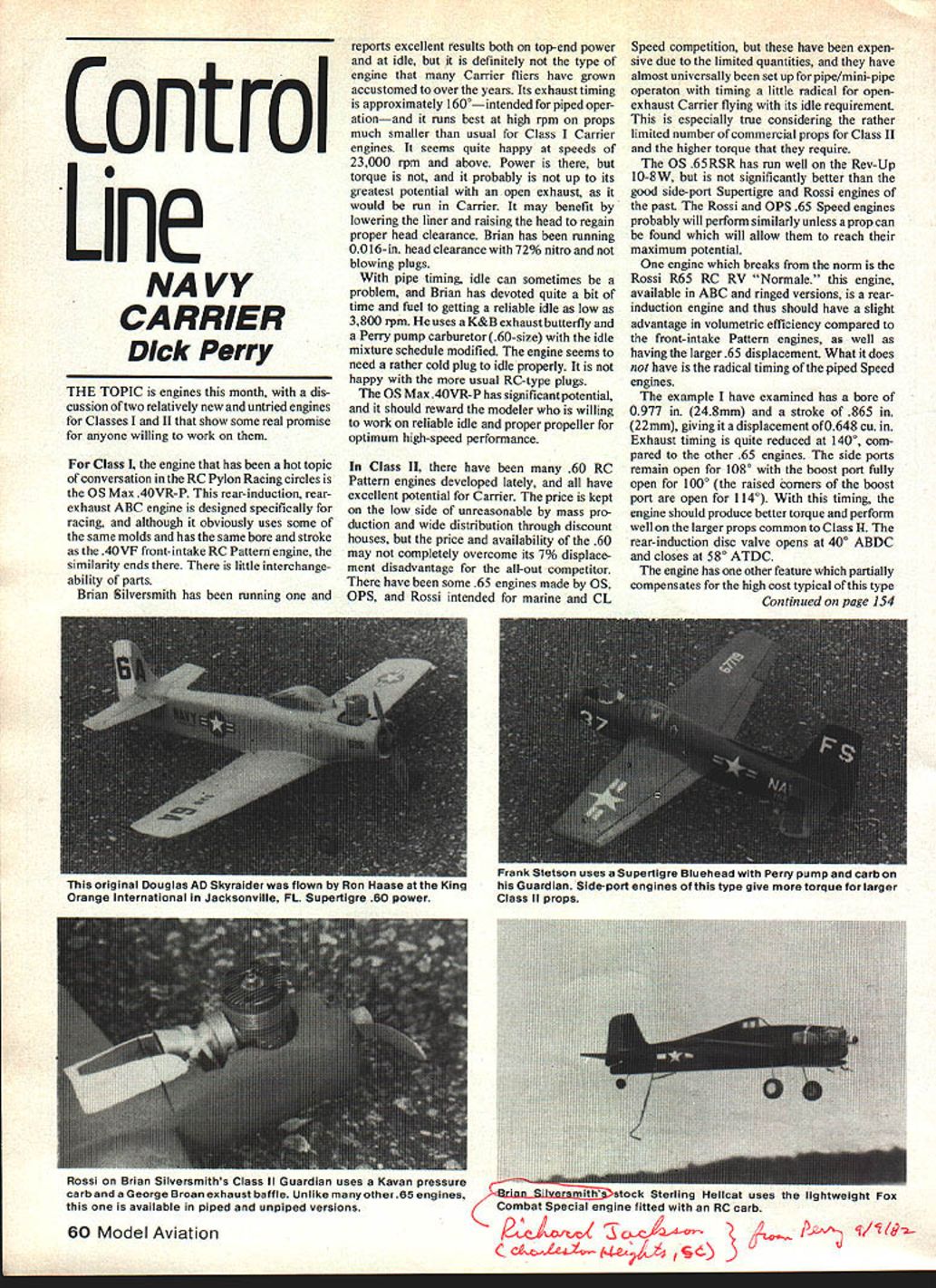

Control Line: NAVY CARRIER
By Dick Perry
THE TOPIC is engines this month, with a discussion of two relatively new and untried engines for Classes I and II that show real promise for anyone willing to work on them.
Class I — OS Max .40VR-P
For Class I, the engine that has been a hot topic in RC pylon racing circles is the OS Max .40VR-P. This rear‑induction, rear‑exhaust ABC engine is designed specifically for racing. Although it uses some of the same molds and has the same bore and stroke as the .40VF front‑intake RC Pattern engine, the similarity ends there — there is little interchangeability of parts.
Brian Silversmith has been running one and reports excellent results both on top‑end power and at idle, but it is definitely not the type of engine many Carrier fliers have grown accustomed to. Its exhaust timing is approximately 160° — intended for piped operation — and it runs best at high rpm on props much smaller than usual for Class I Carrier engines. It seems quite happy at speeds of 23,000 rpm and above. Power is there, but torque is not, and it is probably not at its greatest potential with an open exhaust. As used in Carrier, it may benefit from lowering the liner and raising the head to regain proper head clearance.
- Recommended head clearance run by Brian: 0.016 in with 72% nitro; he reports not blowing plugs.
- Idle: With pipe timing, idle can be problematic. Brian has spent considerable time and fuel to obtain a reliable idle as low as 3,800 rpm.
- Carburetion and accessories: He uses a K&B exhaust butterfly and a Perry pump carburetor (0.60‑size) with a modified idle mixture schedule.
- Ignition/plug: The engine seems to need a rather cold plug to idle properly and is not happy with the more usual RC‑type plugs.
The OS Max .40VR-P has significant potential and should reward the modeler willing to work on reliable idle and select the proper propeller for optimum high‑speed performance.
Class II — .60 and .65 Engines
Lately there have been many .60 RC Pattern engines developed; these generally have excellent potential for Carrier. Their low price is driven by mass production and wide distribution through discount houses, but the price and availability of the .60 may not completely overcome its roughly 7% displacement disadvantage for the all‑out competitor.
Several .65 engines have been produced by OS, OPS, and Rossi for marine and CL Speed competition. These have been expensive due to limited quantities and have almost universally been set up for pipe/mini‑pipe operation with timing a bit radical for open‑exhaust Carrier flying, which requires a strong idle. This is especially true given the limited number of commercial props for Class II and the higher torque those props require.
- OS .65RSR: Has run well on the Rev‑Up 10‑8W, but is not significantly better than the good side‑port Supertigre and Rossi engines of the past.
- Rossi and OPS .65 Speed engines: Likely to perform similarly unless a prop is found that allows them to reach their full potential.
One engine that breaks from the norm is the Rossi R65 RC RV "Normale." Available in ABC and ringed versions, this is a rear‑induction engine and thus should have a slight volumetric efficiency advantage over front‑intake Pattern engines, plus the larger .65 displacement. It does not have the radical timing typical of piped Speed engines.
Key specifications and features of the Rossi R65 RC RV "Normale":
- Bore: 0.977 in (24.8 mm)
- Stroke: 0.865 in (22 mm)
- Displacement: 0.648 cu in
- Exhaust timing: 140°
- Side ports open: 108°
- Boost port fully open: 100° (raised corners of boost port open 114°)
- Rear‑induction disc valve: opens at 40° ABDC, closes at 58° ATDC
- Carburetor: large bore — 10.5 mm with a narrow 2.2 mm spraybar; effective choke area ≈ 64 sq. mm
- The in‑flight adjustable needle‑valve feature can be readily bypassed for conventional three‑line operation.
- Crankcase width: 1.70 in (43 mm)
- Bolt spacing: 2.05 in (52 mm) by 0.985 in (25 mm)
With the relatively mild timing and rear‑induction design, this Rossi should produce better torque and perform well on the larger props common to Class II. Its large‑bore carburetor should be readily adaptable to Carrier operation using a pump or exhaust pressure.
Richard L. Perry 416 Woodhill Dr. Goldsboro, NC 27530
Transcribed from original scans by AI. Minor OCR errors may remain.

