
Control Line: Navy Carrier
By Dick Perry
I've been indulging in a nostalgia trip for the past few days—cleaning out old magazines and getting ready to move. I did a lot more reading than sorting and cleaning, I'm afraid. The "good old days" really were pretty good. Engines have been developed, of course, and the coming of epoxy, cyanoacrylate glue, plastics, foam, and iron-on coverings have simplified and speeded building a little, though the flying has remained relatively unchanged.
Nostalgia and early developments
Back in the 1950s, the RC people were flying tube sets, escapements, and reeds—control line was king in modeling. Frisco Racing Fuel left a peculiar odor around the speed circles where Dooling and McCoy engines did their thing. Ads for Forster and Johnson engines and Berkeley kits tempted us. Silk was 59¢ a yard, .35-sized kits were $4, Rev-Up props were 35¢, and balsa was almost free compared to today's prices.
You could join the AMA for $2.50 when we added liability coverage in 1958—quite a bargain, though Model Aviation was a far cry from its present status.
1950s: Navy Carrier beginnings
"Navy Carrier Landing," as it was called, was flown much as it is today after the introduction of the J. Roberts three-line flight control system, but the event has seen some significant changes over the years. Back in the 1950s there was only one class, and the only real engine limit was a practical one—the McCoy .60 was the most powerful engine available, and it was easy to find, though expensive at $40. The Randalls were showing up regularly in the winner's circle, and Tony Naccarato and Dave Wallick were gaining experience in the junior and senior ranks.
Scores were running under 500, using the original system which scored speed as three times the difference between high and low speed. Highs in the 90s and lows in the 30s were prevalent.
1960s: Rules and equipment changes
The 1960s saw the addition of the protective ramp at the stern of the deck—short landings had been a little hard on models previously. Super Tigre brought out the ST .35 Combat engine that would later develop into the standard profile carrier engine. The success of the Randall Tigercat with its two Johnson .35 engines (the outboard engine quit after the high-speed run) was hard to overcome with single-engine models, and the rule to limit low-speed points with engines out was introduced. Engines were limited to .65 cu. in. displacement, establishing the upper limit we have today.
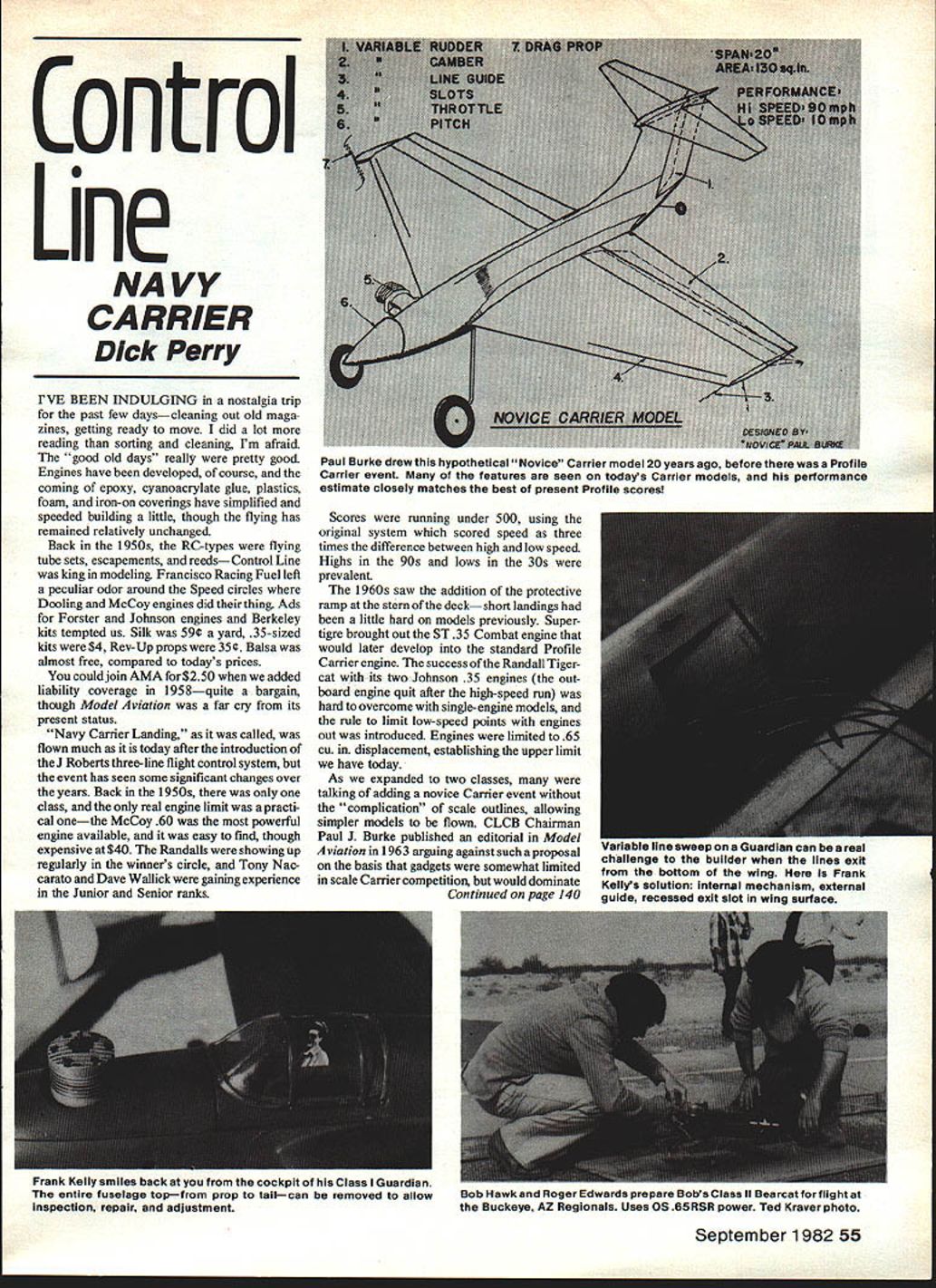
As we expanded to two classes, many were talking of adding a novice carrier event without the "complication" of scale outlines, allowing simpler models to be flown. CLCB Chairman Paul J. Burke published an editorial in Model Aviation in 1963 arguing against such a proposal on the basis that gadgets were somewhat limited in scale carrier competition but would dominate the novice event. His hypothetical design had all the features of today's airplanes, plus a few more. The speeds he projected (90 mph and 100 mph) are very close to our present top profile scores.
We did get a profile event in the late 1960s, however, and its popularity boomed.
1970s: Profile growth and organizational changes
By the early 1970s, scores had risen about 100 points as high and low speeds both improved. New names—Sawicki, Willman, Bedard, Herron, Finley, Ryktarsky, Simpson, Wielms—appeared on the trophy lists in Class I and II, and a new set of names appeared in Profile as well, as carrier modelers had to decide whether to fly Scale (Class I and/or Class II) or Profile Carrier at the Nats (one couldn't fly both).
Harry Higley's flying and designs pointed the way for many in the Profile event, but the Aloise family with their Condor design and ST .35 engines were unbeatable. In three Nats (1974 through 1976) they won every Profile category they entered. The only thing that prevented a clean sweep was that they didn't have anyone in the senior-age category in 1976!
The 1970s also saw the formation of the Navy Carrier Advisory Committee and the Navy Carrier Society (NCS). Scores dropped in 1976 as the present scoring system was adopted. Nats performance has been relatively constant in Class I and II since then, but there has been consistent improvement in the Profile event as engines and flying techniques improved.
Awards and recognition
The NCS originated the Eugene Ely Award in 1977 to recognize the best carrier flier in all three classes at the Nats. Ron Duly was the first recipient. Winners since then include:
- Senior Louis Matusitz
- NCS president Pete Mazur
- Perennial record-holder Dave Wallick
- Southwest's prominent carrier flier Bill Helton
Looking forward
That brings us up to the present, ready for new developments and new faces, enjoying the companionship of current competitors and the memories of earlier times. There are those whom I have overlooked due to failing memory, incomplete records, and lack of space. Rest assured, your contributions are appreciated by those of us who still enjoy the carrier events.
Richard L. Perry 416 Woodhill Dr. Goldsboro, NC 27530
Transcribed from original scans by AI. Minor OCR errors may remain.

