
Control Line: NAVY CARRIER
Dick Perry
The initial proposal portion of the 1984–85 AMA competition rules proposal cycle has ended with the September 1, 1982 cutoff date for proposal submissions. A few of the proposals were printed in the October 1982 edition of the Competition Newsletter; most of the remainder are in this month's Competition Newsletter.
I won't go into the particulars of the new proposals here, but I do urge you to send comments on any that affect Carrier to the Navy Carrier Advisory Committee (NCAC)—and do it soon. All too often there is very little time between publication of the proposals and the deadline for the NCAC to submit comments to the CL Contest Board prior to its vote. If modeler comments do not get to the NCAC in a timely manner, the committee members end up talking only to modelers in their local areas—and you might not be one of them. If you want your views considered in the rule-making process, you must take the initiative and contact your NCAC representative.
Editor’s note: At minimum, write down your comments and send them to your AMA district CL Contest Board representative—you’ll find his name and address in the Competition Director section of the Competition Newsletter. (RMcM)
In the July issue I misidentified the photograph of the profile Hellcat that appeared on page 60. My apologies to Richard Johnson (Charleston Heights, SC), who built and flew the model in the photo.
Engine notes and reports:
- Brian Silversmith’s work on the OS .40 VR-P engine: he has been flying it in an MO-1, but speeds have been somewhat lower than expected at 106–109 mph.
- Fred Knopf is also using the new OS engine and getting slightly better results—around 112 mph. Fred seems to have the best results with OS 4B and 4E carbs. He uses a crankcase-pressure fuel system and encounters some flooding at mid-range throttle settings—more so with the 4E than the 4B. This is to be expected when using an intake throttle with crankcase pressure and could probably be overcome by using exhaust pressure only and by carefully tuning the tank as you would for a suction fuel system. Both Fred and Brian are using stock heads and timing.
- Fred uses a Rev-Up 9-6½ prop cut down to an 8½‑in. diameter. While thin-blade pylon-racing props allow the engine to reach higher RPM, the lack of blade area seems to hurt acceleration enough that overall speeds are lower.
- Brian has also been experimenting with a Supertigre S-36 fitted with the carb from an S-40. Since the crankcase casting and intake boss diameter are identical on both engines, the carb fits easily with no modifications. First tests were not as good as expected, but after the exhaust timing was raised by 10°, performance improved considerably; top speeds are now in the 90–95 mph range. This engine seems an excellent alternative to the machine-shop .40 modifications and avoids the inconvenience of adapting a carb to the square intake of the other readily available lightweight, the Fox .36 Combat.
Tom Schafer is using a K&B 5.8 with excellent results, if the Navy Carrier Society Top Ten listing is any indication. His times run almost two seconds better than other K&B engines in the Northeast. Tom has replaced the stock double-bubble head with a trumpet-shaped head of his own design. (Tom, write and tell me how to spell your name—everyone has a different opinion! We’d also like some details on your engine, if you wouldn’t mind sharing them.)
CL Navy Carrier
Continued from page 60
Higher compression increases power output by improving engine efficiency. It also shortens glow-plug life, which presents obvious disadvantages for our event, which demands that the plug survive the high-speed portion of the flight more or less intact. The Fox RC plug has an excellent reputation for element life and seal life. The OPS RC 300 plug also seems to have a very good reputation for element durability; however, its price is about three times that of the Fox. User reports indicate the OPS RC 300 can last through multiple runs without damage in engines that regularly require a new plug after each run.
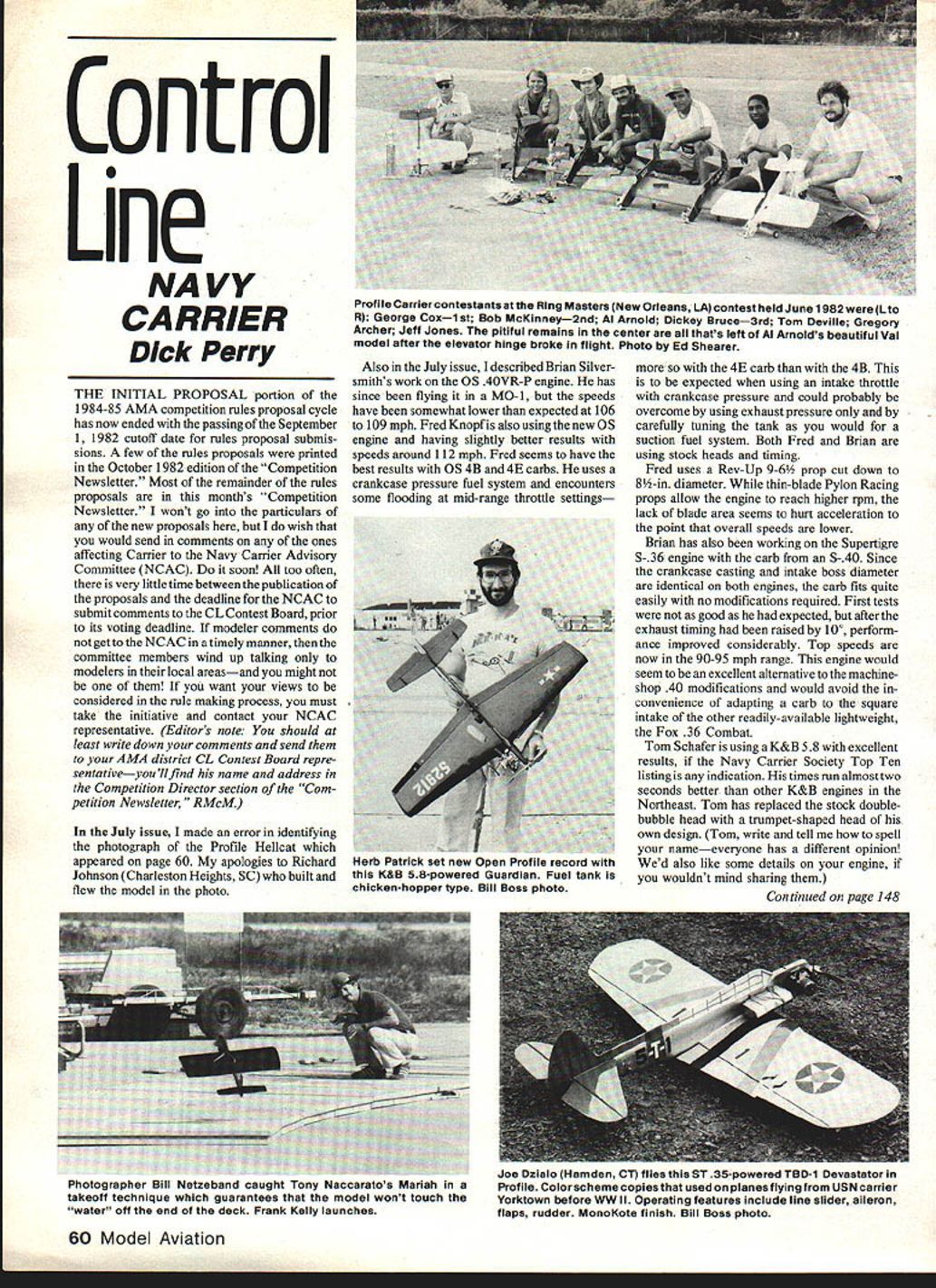
This month’s photos are a cross section from throughout the country. Bill Boss’s photos from the Northeast are the first from that region in quite some time. There has always been a lot of activity there, but these are the first photos I’ve received from the Northeast that were good enough to print. The photos you send are great for seeing what equipment is being used in various areas; I’ll print any that are suitable. Preferred format: 5 x 7, B&W, glossy—slightly larger photos reproduce even better.
The smile on Herb Patrick’s face is the result of his August 22 record performance in Profile. All I have at this time is the photo; I’ll gather more information for a later column. Well done, Herb!
Richard L. Perry 416 Woodhill Dr. Goldsboro, NC 27530
Transcribed from original scans by AI. Minor OCR errors may remain.

