
Control Line: Navy Carrier
Dick Perry
It's building time again around most of the country now that winter has set in. With that in mind, this month's column includes a listing of carrier plans available from the model magazines as well as from some individuals. I'll also give rules for some carrier events that are run in various parts of the country as a supplement to the AMA Carrier events. And I have another mystery aircraft to give you something to think about while you sit in front of the fire wishing it were warm enough to go flying. You lucky folks down south can join in, too — between flying sessions.
Before I get started, I'd like to call your attention to my new address. I've moved to Northern Virginia and will be working in Washington, D.C., for the next few years. My new address is listed at the end of the column.
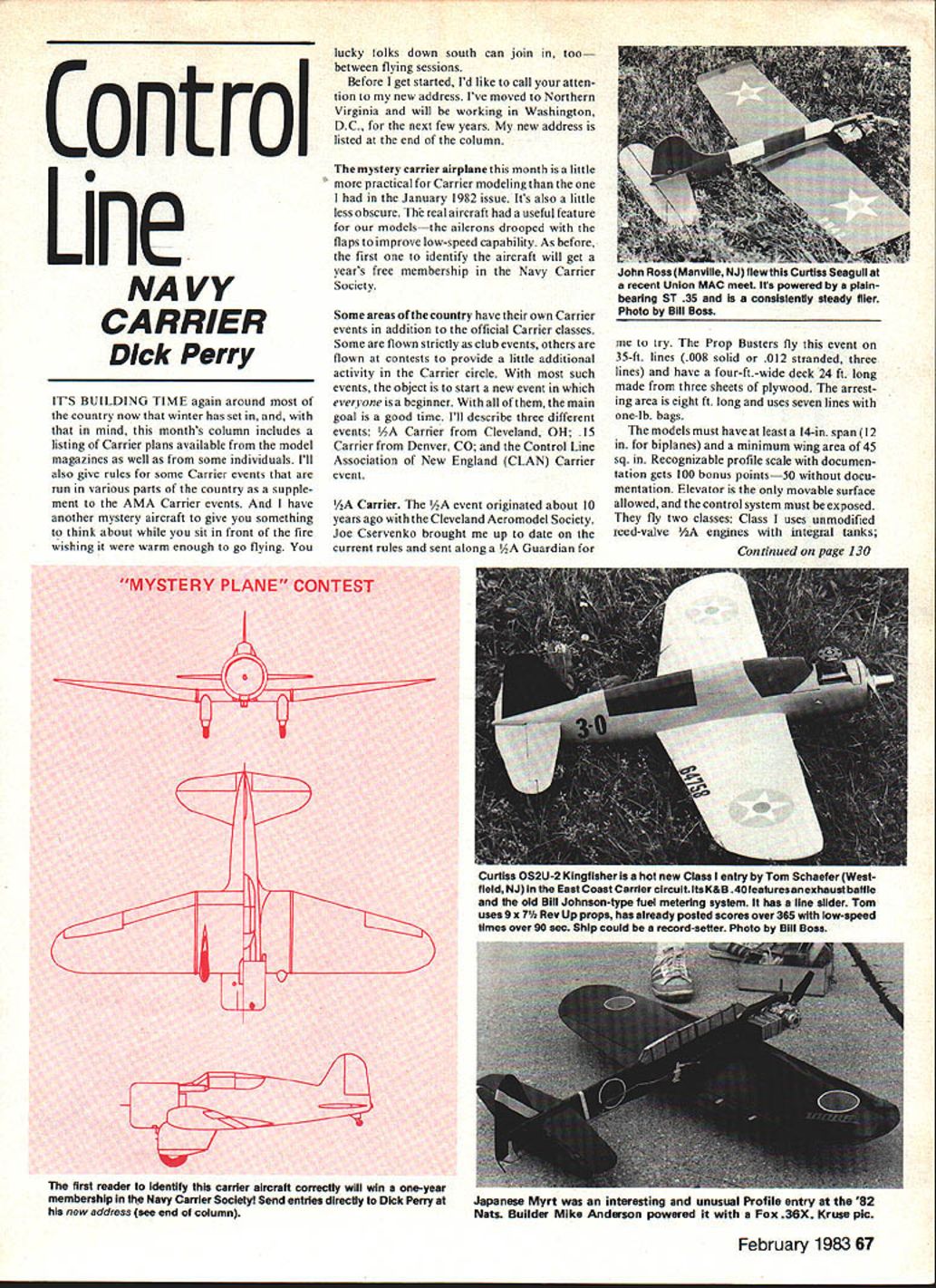
The mystery carrier airplane this month is a little more practical for carrier modeling than the one I had in the January 1982 issue. It's also a little less obscure. The real aircraft had a useful feature for our models — the ailerons drooped with the flaps to improve low-speed capability. As before, the first one to identify the aircraft will get a year's free membership in the Navy Carrier Society.
Some areas of the country have their own carrier events in addition to the official AMA Carrier classes. Some are flown strictly as club events, others are run at contests to provide a little additional activity in the Carrier circle. With most such events, the object is to start a new event in which everyone is a beginner. With all of them, the main goal is a good time.
Regional Carrier Events
The three events described below are examples of local Carrier competitions:
- 1/2A Carrier — Cleveland, OH (Prop Busters / Cleveland Aeromodel Society)
- .15 Carrier — Denver, CO (Seahawk Squadron / Rocky Mountain Aeromodelers)
- CLAN Carrier — New England (Control Line Association of New England)
1/2A Carrier (Cleveland)
The 1/2A event originated about 10 years ago with the Cleveland Aeromodel Society. Joe Cservenko provided the current rules and sent along a 1/2A Guardian for trial flying.
- Lines: 35 ft., three lines (.008" solid or .012" stranded).
- Deck: 4 ft. wide, 24 ft. long, made from three sheets of plywood.
- Arresting area: 8 ft. long, uses seven lines with one-lb. bags.
Model requirements and rules:
- Minimum span: 14 in. (12 in. for biplanes).
- Minimum wing area: 45 sq. in.
- Recognizable profile scale: 100 bonus points with documentation, 50 without.
- Elevator is the only movable surface allowed; the control system must be exposed.
- Classes:
- Class I: Unmodified reed-valve 1/2A engines with integral tanks.
- Class II: 1/4A engines. Twin- or multi-engine aircraft allowed.
- The event is flown using AMA procedures.
.15 Carrier (Seahawk Squadron / Rocky Mountain Aeromodelers — Denver)
This class originated with the Seahawk Squadron in the Denver area. The event was devised by Dave Rolley, Jim Brown and Jerry Deveau.
- Lines: 52 ft. 6 in., three lines required (.010" solid or .012" stranded).
- Control functions allowed: throttle, elevator and hook.
- Speed limit: 70 mph maximum for high-speed portion.
- No bonus points are awarded for scale outline.
- Models: Profile models were emphasized originally; no restrictions on type, engine or model size beyond the speed limit.
- Timing: Shorter lines require timing eight laps rather than the standard seven. For the 1/4-mile distance a six-lap timing is used in some variations.
- A normal AMA deck is used. Even with the shorter lines, models will stay within about one-half foot of the center line if the center of the circle is properly located.
Jim Brown has drawn up a set of rules intended for a fully developed Scale event, though the profile class may remain the favorite.
CLAN Carrier (Control Line Association of New England)
The CLAN has a unique form of Class I Carrier for profile models. Model specifications mirror those of the AMA Profile Carrier event, but the engines follow AMA Class I Carrier rules.
- Engine: .049s (no restrictions on type of engine or fuel system).
- Scoring:
- 1 point per mph of high speed.
- 1 point per second of low speed.
- 10–30 points awarded for quality of the takeoff.
- 10 points for keeping the arresting hook retracted through the high-speed portion of the flight.
- Landing and scale bonuses are the same as AMA Profile Carrier.
- The event has a good following in the Northeast.
Plans Listing and Sources
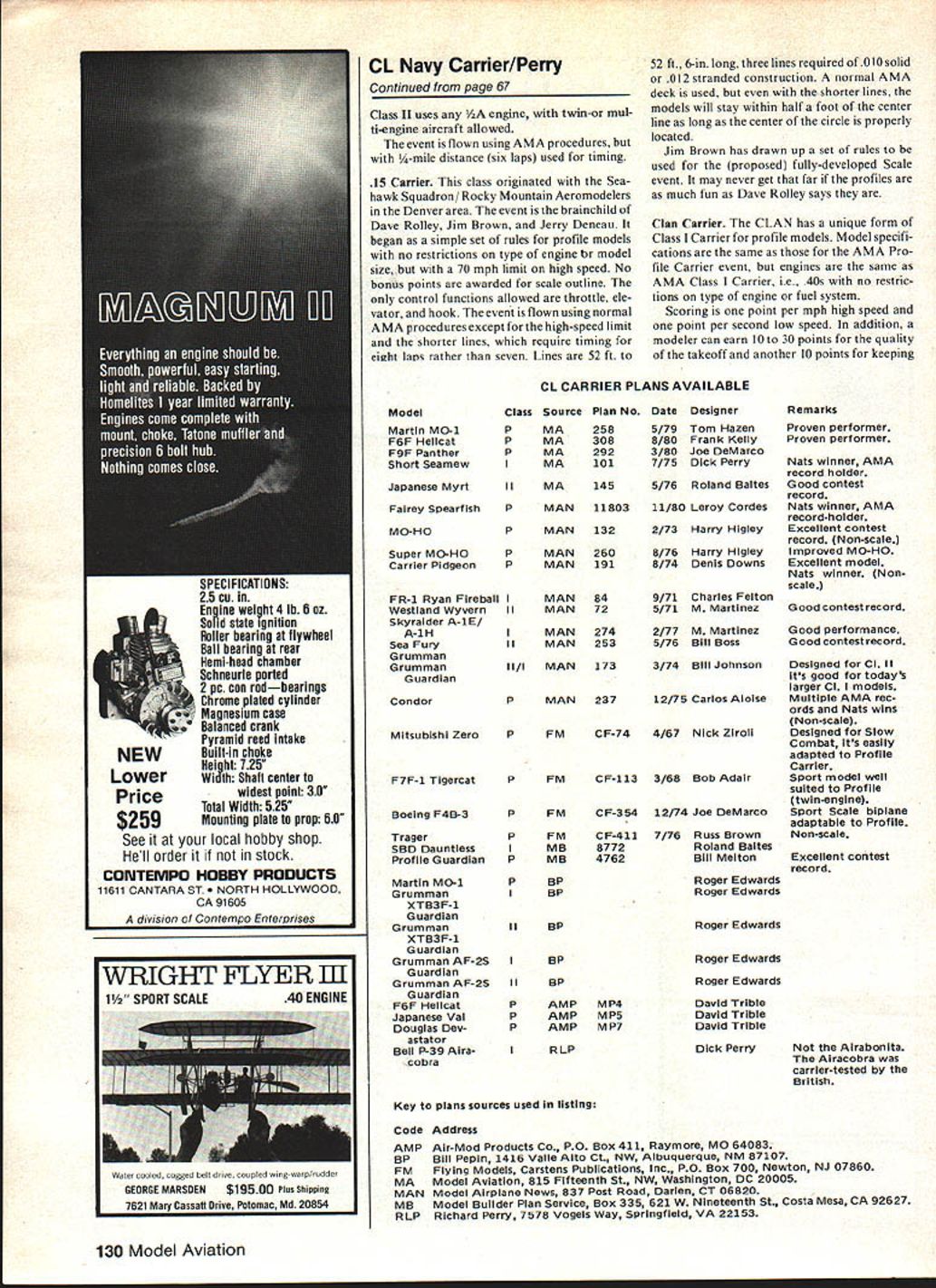
The plans listing this month covers models available from U.S. sources. Although Aeromodeller plans are available through a U.S. distributor, I have yet to determine which of their plans are suitable for Carrier. I'll report on that effort in a later column. The listing includes models designed specifically for Carrier as well as a few intended for other events that could be readily adapted for Carrier flying.
Mystery Aircraft
The mystery aircraft this month features ailerons that droop with the flaps to improve low-speed capability. The first reader to identify this carrier aircraft correctly will win a one-year membership in the Navy Carrier Society. Send entries directly to Dick Perry at the address below.
Contact / Address
Richard L. Perry 7578 Vogels Way Springfield, VA 22153
Transcribed from original scans by AI. Minor OCR errors may remain.

