
Control Line: Navy Carrier
Dick Perry
Mystery Plane
Because of the time required for editing, compiling, and printing Model Aviation each month, my columns must be in the mail before the issue with the preceding column is distributed. Thus, although I can't announce a winner for the February Mystery Airplane Contest, I will identify the airplane as the Northrop XFT-2. This airplane is a modification of the original XFT-1 experimental fighter monoplane which first flew in 1933.
Based on the Northrop Gamma transport and the Lockheed Vega which John Northrop designed, the XFT-1 was fast—but not as maneuverable as its biplane predecessors. In addition, the large fairings on its fixed landing gear caused maintenance problems and a bad tendency to spin. So, the XFT-1 went back to the factory to get a new engine and cowl, new wheel fairings, a larger rudder, and a new designation—XFT-2.
The modifications did little to improve the handling, and the Navy grounded the airplane. The only prototype crashed when a Northrop pilot attempted an unauthorized ferry flight back to the Northrop factory.
The large horizontal stabilizer and ailerons which droop with the flaps would make the XFT-1 or XFT-2 a good candidate for Carrier competition, though the short nose would make it necessary to build the tail and aft fuselage very light.
Derek Bird — British Nationals / Carrier Flying in England
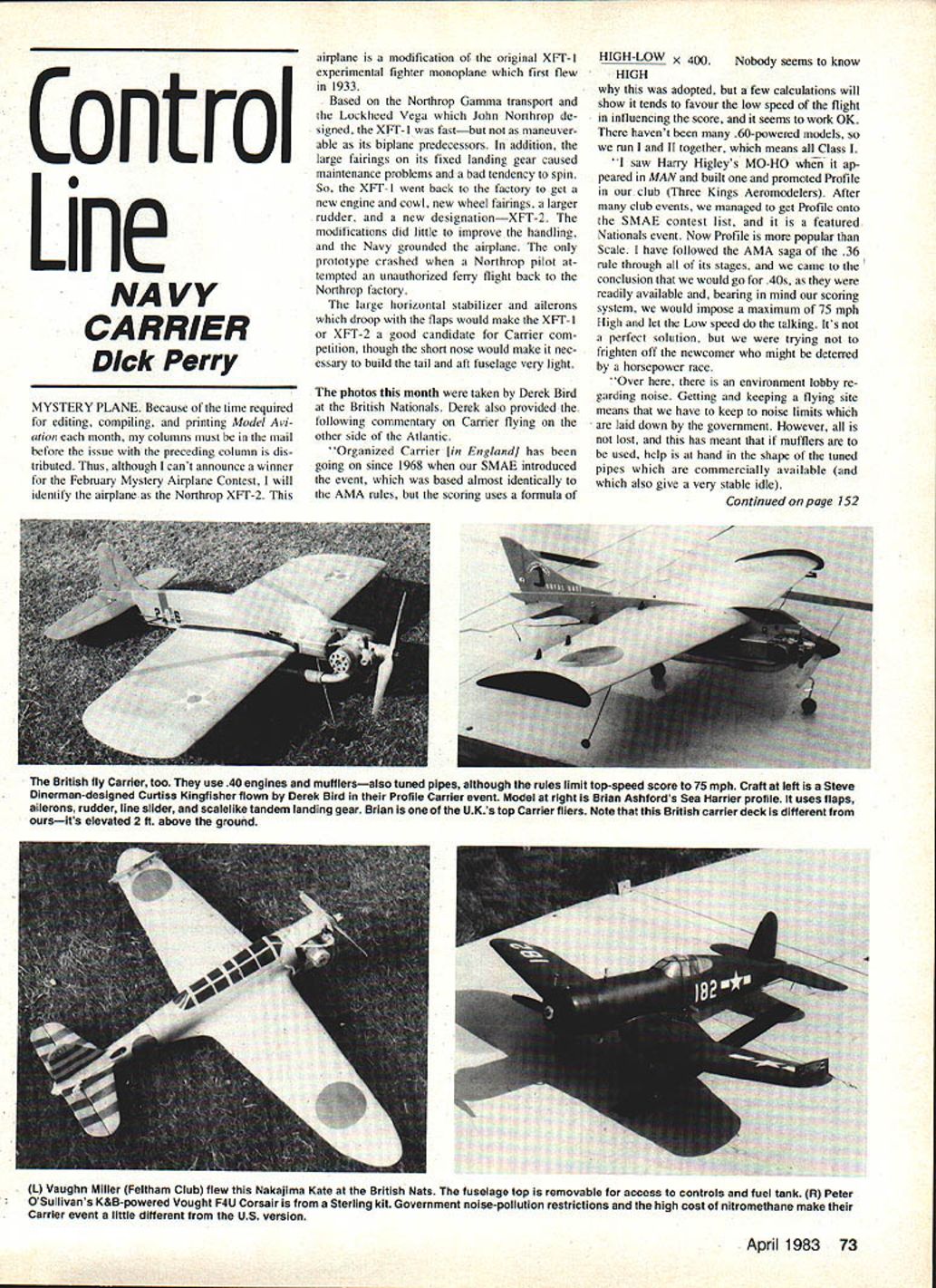
The photos this month were taken by Derek Bird at the British Nationals. Derek also provided the following commentary on Carrier flying on the other side of the Atlantic:
"Organized Carrier [in England] has been going on since 1968 when our SMAE introduced the event, which was based almost identically to the AMA rules, but the scoring uses a formula of HIGH-LOW x 400.
"Nobody seems to know why this was adopted, but a few calculations will show it tends to favour the low speed of the flight in influencing the score, and it seems to work OK. There haven't been many .60-powered models, so we run I and II together, which means all Class I.
"I saw Harry Higley's MO-HO when it appeared in MAN and built one and promoted Profile in our club (Three Kings Aeromodellers). After many club events, we managed to get Profile onto the SMAE contest list, and it is a featured Nationals event. Now Profile is more popular than Scale. I have followed the AMA saga of the .36 rule through all of its stages, and we came to the conclusion that we would go for .40s, as they were readily available and, bearing in mind our scoring system, we would impose a maximum of 75 mph High and let the Low speed do the talking. It's not a perfect solution, but we were trying not to frighten off the newcomer who might be deterred by a horsepower race.
"Over here, there is an environment lobby regarding noise. Getting and keeping a flying site means that we have to keep to noise limits which are laid down by the government. However, all is not lost, and this has meant that if mufflers are to be used, help is at hand in the shape of the tuned pipes which are commercially available (and which also give a very stable idle).
"Most people use pipe pressure to the tank, and as nitro is fairly expensive, we don't usually need more than about 20% to get to the high speed previously mentioned. The CG has to be adjusted as most pipes and headers weigh about 4–5 oz, but this is no real problem. Pipe-length data is available, and motors can be set up quite easily. Obviously this is very different from your methods, but it's better to bear this minor inconvenience than not to be able to fly.
"I've been flying a Steve Dinerman Kingfisher this season, powered by an HKG .40 with AAC piston/liner plus OPS pipe and 9 x 6 Taipan prop. Typical high of 80 plus, and this year lows of around 16 mph. We don't have a 60-degree right attitude rule (yet), and so we are just experiencing the delights of prop hanging.
"In Scale, I've got a MO-1 (Yes, they're here too!) with K&B .40S and ED pipe plus 9 x 7 Top Flite pylon prop. I placed second at the Nats on one flight 85/24/100 (487 points), beaten by a Guardian 75/19/100 (498 points). [AMA scoring would have produced scores of 320 and 314, respectively. RLP]
"The Dumas Crusader is well-regarded here as a first-time model, and we favour most of the published American plans [in Profile], while in Scale a wide variety [of models] have been tried with no one type outstanding. I used to favor the Seamew, and think it has a lot to offer, but I am thinking of a Fulmer for 1983."
Decks and Other Differences
A further difference between British Carrier and the U.S. version is the deck used. One of the two decks used in England was built by the Royal Navy and is patterned after the real angle-deck carriers. It has four arresting lines, a landing area which is only about five feet wide, and it is elevated almost two feet above the ground.
Miscellaneous Notes
As I was preparing the column this month, I happened to see a photo article in Aviation Week and Space Technology which adds another eligible prototype to the list of aircraft for our events. The article described secret Navy tests about 13 years ago in which the Lockheed U-2 was evaluated as a carrier-based maritime reconnaissance aircraft! Although the prototype does not lend itself readily to our event, I have to admit that the photo of the U-2 rebounding off the deck with its hook engaged in the wire was rather impressive!
Richard L. Perry 7578 Vogels Way Springfield, VA 22153
Transcribed from original scans by AI. Minor OCR errors may remain.

