
Control Line: Navy Carrier
Dick Perry
Mystery Aircraft
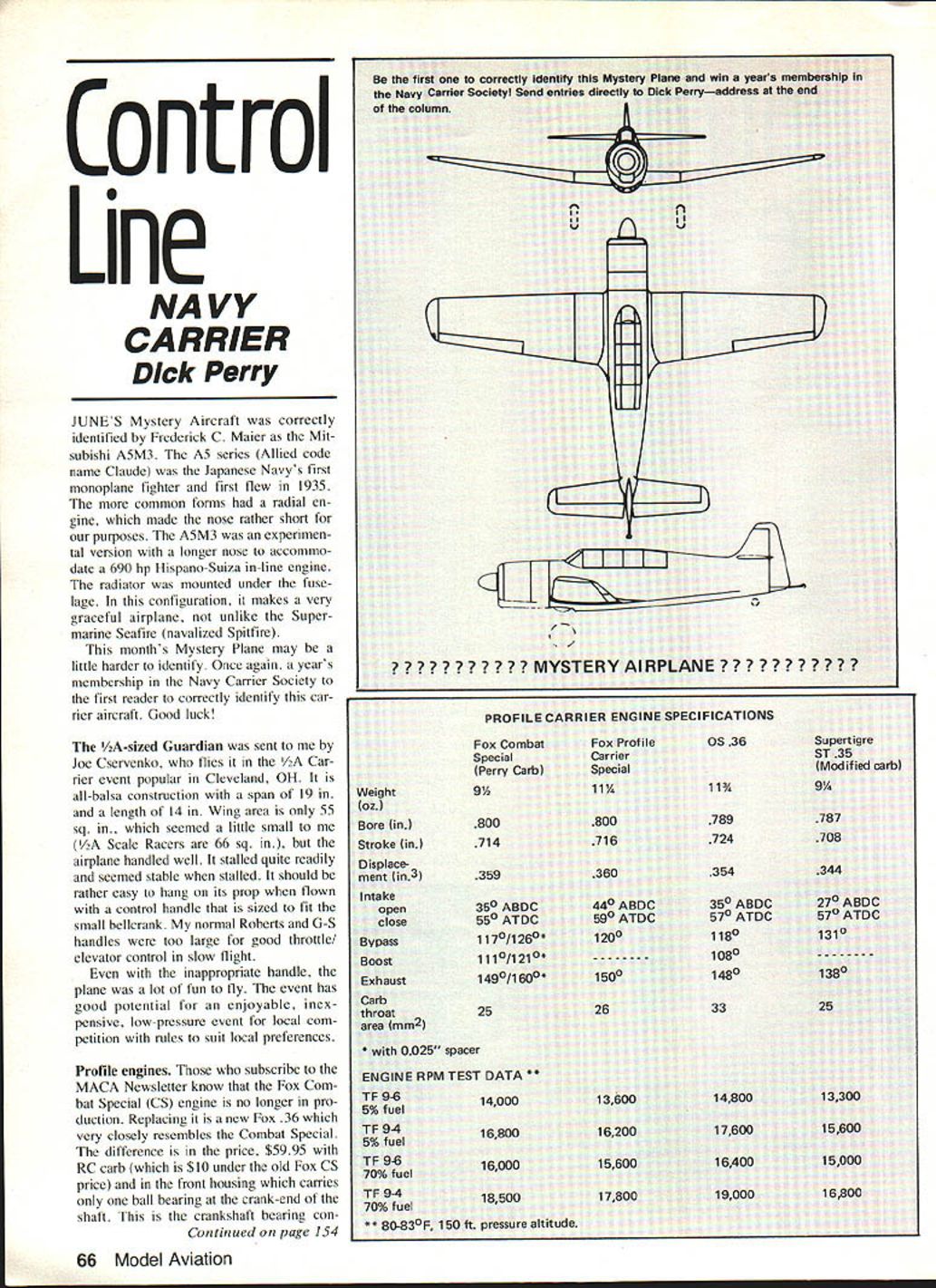
June's Mystery Aircraft was correctly identified by Frederick C. Maier as the Mitsubishi A5M3. The A5 series (Allied code name Claude) was the Japanese Navy's first monoplane fighter and first flew in 1935. The more common forms had a radial engine, which made the nose rather short for our purposes. The A5M3 was an experimental version with a longer nose to accommodate a 690 hp Hispano‑Suiza in‑line engine. The radiator was mounted under the fuselage. In this configuration, it makes a very graceful airplane, not unlike the Supermarine Seafire (the navalized Spitfire).
This month's Mystery Plane may be a little harder to identify. Once again, a year's membership in the Navy Carrier Society is offered to the first reader to correctly identify this carrier aircraft. Good luck!
1/2A Guardian (model)
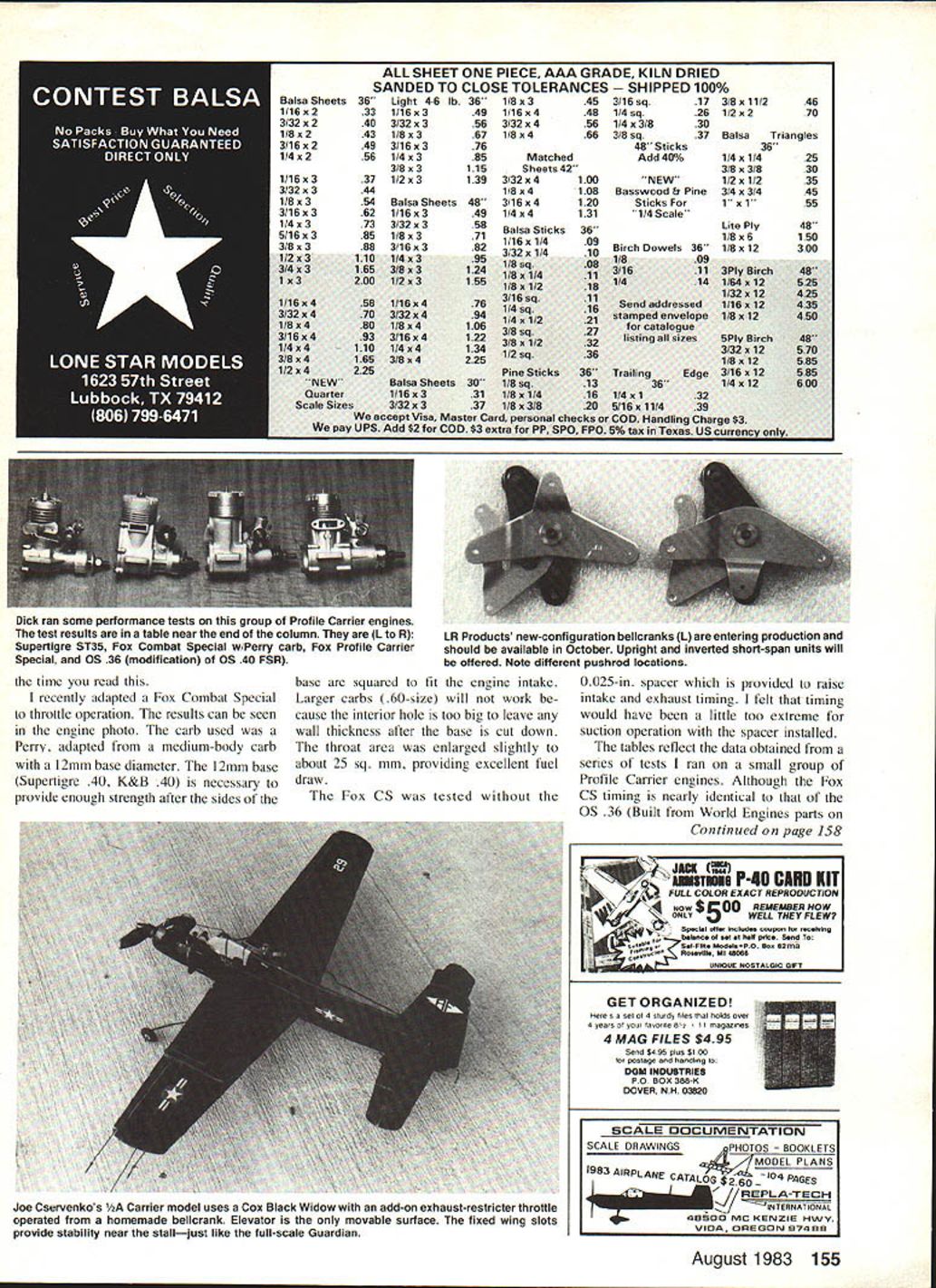
The 1/2A‑sized Guardian was sent to me by Joe Cservenko, who flies it in the 1/2A Carrier event popular in Cleveland, OH. It is all‑balsa construction with a span of 19 in. and a length of 14 in. Wing area is only 55 sq. in., which seemed a little small to me (1/2A Scale Racers are 66 sq. in.), but the airplane handled well. It stalled quite readily and seemed stable when stalled. It should be rather easy to hang on its prop when flown with a control handle that is sized to fit the small bellcrank. My normal Roberts and G‑S handles were too large for good throttle/elevator control in slow flight.
Even with the inappropriate handle, the plane was a lot of fun to fly. The event has good potential for an enjoyable, inexpensive, low‑pressure local competition with rules to suit local preferences.
Profile engines and the new Fox .36
Those who subscribe to the MACA Newsletter know that the Fox Combat Special (CS) engine is no longer in production. Replacing it is a new Fox .36 which very closely resembles the Combat Special. The difference is in the price ($59.95 with RC carb, which is $10 under the old Fox CS price) and in the front housing, which carries only one ball bearing at the crank end of the shaft. This is the crankshaft bearing configuration that was produced as an option on the original Profile Carrier Special engine. The longer crankshaft will produce a better shaft seal and provide more room for the carburetor; a problem with the CS conversions was that the short shaft left little room for the carburetor.
According to the literature, porting and head configuration have been optimized for running on straight alcohol fuel, so the new Fox may be overcompressed on high‑nitro fuels.
One major advantage of the new Fox is its weight. At nine oz., it is the lightest throttled .36 available. It even beats the Super Tigre ST‑35 by a fraction of an ounce. The engine uses the Mark X carb, which fits the square intake boss. (The new carb may fit the old Fox CS as well.) The engine was due out in May, so you should be able to get them by then.
Continued notes on the Fox CS and Profile Carrier engines
I recently adapted a Fox Combat Special to throttle operation. The results can be seen in the engine photo (not included here). The carb used was a Perry, adapted from a medium‑body carb with a 12 mm base diameter. The 12 mm base (Supertigre .40, K&B .40) is necessary to provide enough strength after the sides of the base are squared to fit the engine intake. Larger carbs (.60‑size) will not work because the interior hole is too big to leave any wall thickness after the base is cut down. The throat area was enlarged slightly to about 25 sq. mm, providing excellent fuel draw.
The Fox CS was tested without the 0.025‑in. spacer which is provided to raise intake and exhaust timing. I felt that timing would have been a little too extreme for suction operation with the spacer installed. The tables reflect data obtained from a series of tests I ran on a small group of Profile Carrier engines. Although the Fox CS timing is nearly identical to that of the OS .36 (built from World Engines parts on the original Tune‑Hill modification specifications), the Fox performance was below that of the OS. Carb throat area had little effect, since OS power advantage is greater at lower engine speeds. The difference may be attributed to internal fit and configuration. The Fox is a lapped engine, while the OS has a Dykes ring. I am not familiar with Fox metallurgy, so it is quite likely that someone with more Fox experience could get better results.
Tests were run on 5% nitro and 70% nitro/10% propylene oxide fuels using Top Flite 9‑6 and Power Prop 9‑4 Super M propellers.
Plans and engine work from Tom Dixon
It appears there was a little confusion on the availability of plans and engine work from Tom Dixon. You can contact him at:
- Controline Sales, Tom Dixon, P.O. Box 27540, Contract Station #7, Atlanta, GA 30327.
He has added the following plans to his list:
- El Diablo (by Red Reinhardt)
- Baby Barnstormer (Half‑A Guillou kit)
- Tom‑Tom and Warrior (Veco kits)
- Gobbleswatz (Charlie Mackley)
- Argus (Steve Wooley, from his own plans)
- Oriental 40 (similar to the .35 size, but scaled up for .40–.46 engines)
Tom recently said that he has filled several orders for his custom‑ported Fox .35 stunt engines (see the May 1983 column), so if you want a .35 for the summer, contact him about the various stages of work on his veteran engine.
Stunt and PAMPA information
For information on stunt or PAMPA, contact:
- Wynn Paul, 1640 Maywick Dr., Lexington, KY 40504.
Canadian Nationals
The Canadian Nationals will be held at Centralia, Ontario, July 9 through 17. Carrier (all three classes) will be flown on Sunday, July 17. It should be a good warmup for the AMA Nats 10 days later.
Richard L. Perry 7578 Vogels Way, Springfield, VA 22135.
Transcribed from original scans by AI. Minor OCR errors may remain.

