
Control Line: Navy Carrier
Dick Perry
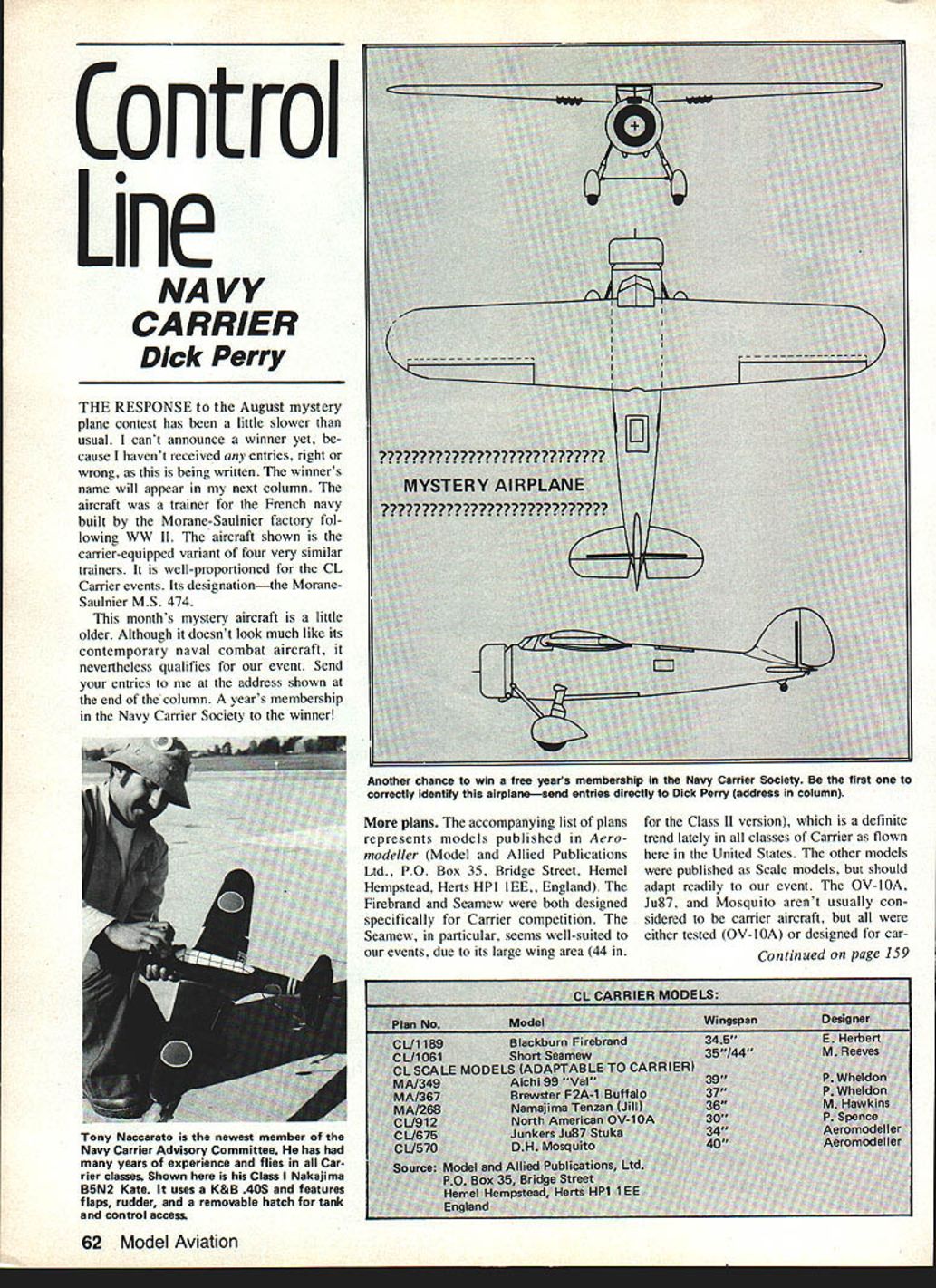
The response to the August mystery plane contest has been slower than usual. I can't announce a winner yet, because I haven't received any entries, right or wrong, as this is being written. The aircraft was a trainer for the French navy built by the Morane-Saulnier factory following World War II. The aircraft shown is the carrier-equipped variant of four very similar trainers. It is well-proportioned for the CL Carrier events. Its designation—the Morane-Saulnier M.S. 474.
This month's mystery aircraft is a little older. Although it doesn't look much like its contemporary naval combat aircraft, it nevertheless qualifies for our event. Send your entries to me at the address shown at the end of the column. A year's membership in the Navy Carrier Society goes to the winner!
More plans. The accompanying list of plans represents models published in Aeromodeller (Model and Allied Publications Ltd., P.O. Box 35, Bridge Street, Hemel Hempstead, Herts HP1 1EE, England). The Firebrand and Seamew were both designed specifically for Carrier competition. The Seamew, in particular, seems well-suited to our events due to its large wing area (44 in. for the Class II version), which is a definite trend lately in all classes of Carrier as flown here in the United States. The other models were published as scale models but should adapt readily to our event. The OV-10A, Ju 87, and Mosquito aren't usually considered carrier aircraft, but all were either tested (OV-10A) or designed for carrier operations in at least one variant.
- Firebrand (designed for carrier competition)
- Seamew (designed for carrier competition; Class II wing area 44 in.)
- OV-10A (tested for carrier operations)
- Ju 87 (tested/designed for carrier operations in at least one variant)
- Mosquito (tested/designed for carrier operations in at least one variant)
Kingfisher
The search for information about the use or testing of the Vought OS2U Kingfisher turned up no previously published data other than the American Aircraft Modeler article of 10 years ago, which was a very tenuous reference upon which to base the legality of a Kingfisher Carrier entry. A recent letter from Bill Skelton, however, has provided information which fully justifies the use of the Kingfisher for our events.
Bill was serving aboard the carrier USS Saratoga (CV-3), which was sailing out of Pearl Harbor at the time of the Japanese attack in 1941. For a short period following the attack, the Saratoga was on patrol near Hawaii and regularly took aboard a few OS2U aircraft (although these were probably the identical OS2Ns manufactured by the Naval Aircraft Factory). The Kingfishers were part of a utility squadron at a remote airfield which escaped destruction in the attack. The Kingfishers landed and took off from the Saratoga as part of their observation duties during the early weeks of the war. Thanks for the information, Bill.
Seahawk Squadron
A few years ago, the Seahawk Squadron (Navy Carrier contingent of the Rocky Mountain Aeromodelers) instituted an annual competition to designate the Top Carrier Pilot in their club for Profile and Class I/II. The competition was spread over three weekends, and scoring was based on the average of the best six flights for each contestant. The number of attempts was not limited, but a fee was charged for each attempt to help defray the cost of the awards that were presented to the winner in each category. Class I/II was run on a percent-of-record basis. It sounds like something well worth trying for a club with a large number of Carrier fliers.
Slow flight
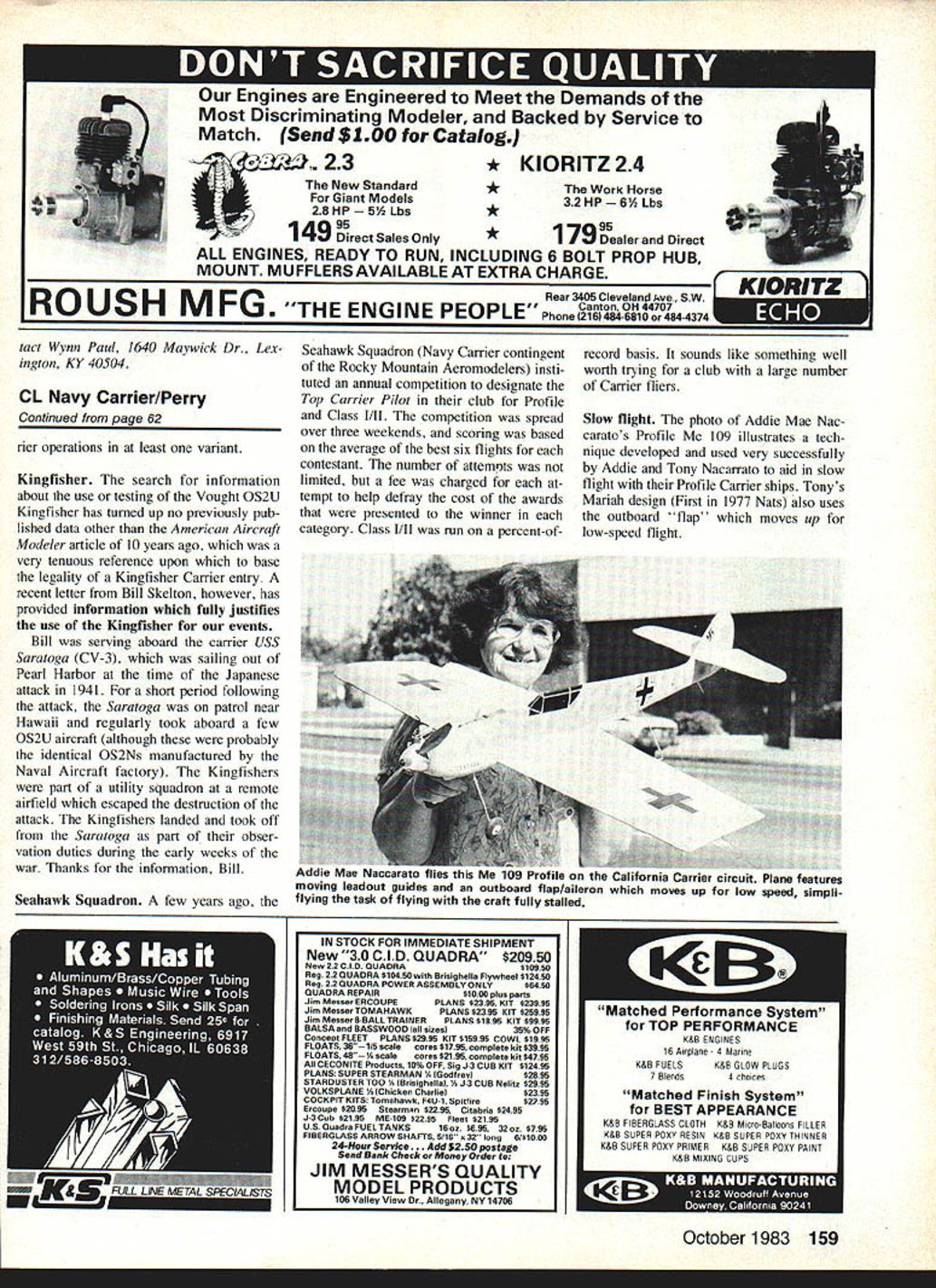
The photo of Addie Mae Naccarato's Profile Me 109 illustrates a technique developed and used very successfully by Addie and Tony Naccarato to aid in slow flight with their Profile Carrier ships. Tony's Mariah design (first in the 1977 Nats) also uses the outboard "flap" which moves up for low-speed flight.
A problem with conventional flaps is that they tend to push the nose down. This is not usually a problem in a level (normal) attitude, but as the airplane assumes a nose-high attitude this effect can become pronounced, particularly with a strong prop wash over the wing. Disturbances in airflow at the tail can cause the tail to lose effectiveness, resulting in a very rapid (and often uncontrollable) nose-down rotation. The common solution is to move the center of gravity well aft. Unfortunately, this makes the model extremely sensitive during high-speed flight.
The up-moving flap tries to rotate the nose up, thus countering some of the natural tendency of a stable model to drop its nose when it stalls. While the up-moving flap (flip) doesn't aid in slow flight when the model is in a level attitude, it does bank the model out, thereby improving line tension. The advantage lies in the ease with which the model can be held in a nose-high stalled attitude without having to resort to balancing the model farther aft than normal and sacrificing high-speed stability. I haven't seen anyone besides Tony and Addie using this technique, but it may be worth a try if you are having difficulty with combined high- and low-speed characteristics on your Profile model. Try it first with a cardboard or aluminum flap taped on the outboard wing.
Richard L. Perry 7578 Vogels Way Springfield, VA 22153
Transcribed from original scans by AI. Minor OCR errors may remain.

