
Control Line: NAVY CARRIER
Dick Perry
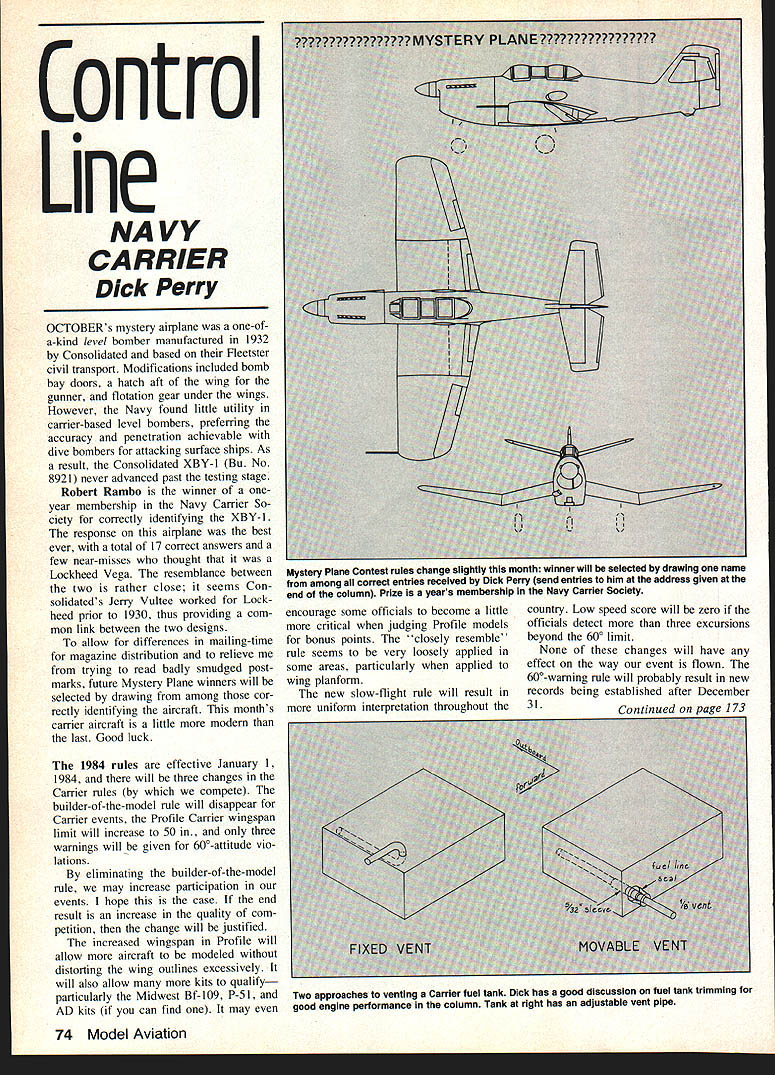
Mystery Plane: Navy Carrier
October's mystery airplane was a one-of-a-kind level bomber manufactured in 1932 by Consolidated and based on their Fleetster civil transport. Modifications included bomb-bay doors, a hatch aft of the wing for the gunner, and flotation gear under the wings. However, the Navy found little utility in carrier-based level bombers, preferring the accuracy and penetration achievable with dive bombers for attacking surface ships. As a result, the Consolidated XBY-1 (Bu. No. 8921) never advanced past the testing stage.
Robert Rambo is the winner of a one-year membership in the Navy Carrier Society for correctly identifying the XBY-1. The response on this airplane was the best ever, with a total of 17 correct answers and a few near-misses. The resemblance between the two is rather close; it seems Consolidated's Jerry Vultee worked for Lockheed prior to 1930, thus providing a common link between the two designs.
To allow for differences in mailing-time magazine distribution and to relieve me from trying to read badly smudged postmarks, future Mystery Plane winners will be selected by drawing from among those correctly identifying the aircraft. This month's carrier aircraft is a little more modern than the last. Good luck.
Rule Changes for 1984
The 1984 rules, effective January 1, 1984, include three changes to the Carrier rules (by which we compete):
- The builder-of-the-model rule will disappear for Carrier events.
- The Profile Carrier wingspan limit will increase to 50 in.
- Only three warnings will be given for 60°-attitude violations.
By eliminating the builder-of-the-model rule, we may increase participation in our events. If the end result is an increase in the quality of competition, the change will be justified.
The increased wingspan in Profile will allow more aircraft to be modeled without distorting the wing outlines excessively. It will also allow many more kits to qualify—particularly the Midwest Bf-109, P-51, and AD kits (if you can find one). It may even encourage some officials to become a little more critical when judging Profile models for bonus points. The "closely resemble" rule seems to be very loosely applied in some areas, particularly when applied to the wing planform.
The new slow-flight rule will result in more uniform interpretation throughout the country. Low-speed score will be zero if the officials detect more than three excursions beyond the 60° limit.
None of these changes will have any effect on the way our event is flown. The 60°-warning rule will probably result in new records being established after December 31.
Fuel Tanks and Performance Problems
Fuel tanks are a common problem among Profile Carrier models. The tendency for the engine to go lean on acceleration and rich once airborne is a problem in achieving good engine performance both during takeoff and in flight, and is more pronounced with larger venturi intake areas. Some modelers have resorted to partially closing the throttle at takeoff and opening it once the airplane is airborne. Consistent performance under these conditions can be hard to achieve.
The ideal situation is to set the needle valve consistently on the ground—say 1-1/2 turns open, optimum first break on a hard two-cycle—and have the engine not lean out immediately upon release but hold the optimum setting through acceleration and high-speed flight. It's impossible to achieve this type of performance unless you use a variation of the uniflow tank-venting scheme. The vent line should end near the front of the tank to reduce fuel pressure variations during acceleration. You should also have an outboard needle valve to achieve good mixture both in acceleration and high-speed flight.
The vent should end at a point below the carburetor to prevent fuel siphoning through the carb before the engine is started. The two drawings (not shown here) illustrate tanks used by Carl T. (Tom) Schaefer (Nats Profile Carrier Champion) and one on our airplanes. Tom's tank is a little harder to adjust, but it doesn't require a hole through the fuselage to move the vent tube lower in the tank.
Adjusting In-Flight Mixture
The next step is to set in-flight mixture by adjusting the vent. If the engine is too lean in flight, you can:
- Start with a richer mixture on the ground.
- Tilt the external vent so that the end is pointed more directly into the airstream.
- Move the tank (internal) end of the vent line—or the entire fuel tank—inboard.
If the engine is too rich in flight, you can:
- Start with a leaner ground setting (be sure the engine won't sag on takeoff).
- Bend or cut the external vent so that it is pointed less squarely into the airstream (start with 45°, then go to 60° or even 90°, as required).
- Move the tank (internal) end of the vent line—or the entire fuel tank—outboard.
In each case, moving the position of the vent line relative to the needle valve will have the greatest effect, whether it is accomplished by moving the vent within the tank or by moving the tank itself.
Practical Tip
Be sure to start each takeoff with a full tank to duplicate competition conditions. By following this procedure, any engine which can be set a little rich on the ground can be made to perform well throughout takeoff and high-speed flight.
Richard L. Perry 7578 Vogels Way Springfield, VA 22153
Transcribed from original scans by AI. Minor OCR errors may remain.

